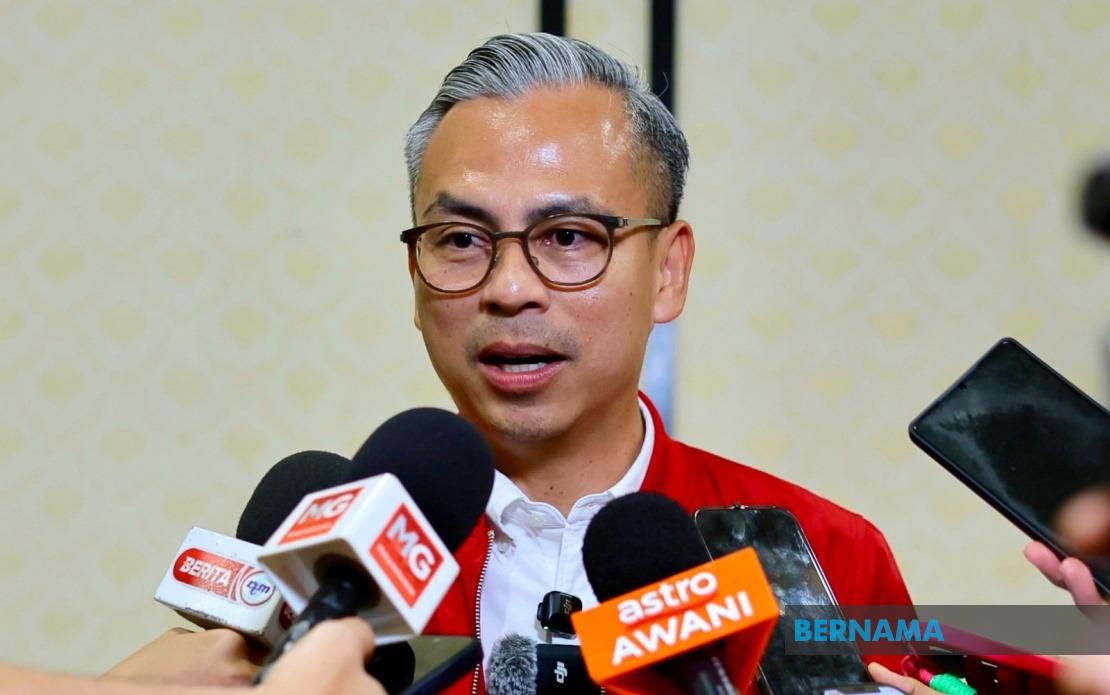
Communications Minister Datuk Fahmi Fadzil has signalled the national broadcaster's willingness to facilitate a live televised exchange between incumbent Johor Menteri Besar Datuk Onn Hafiz Ghazi and Pakatan Harapan's Dr Maszlee Malik, who is contesting the Puteri Wangsa state seat in the upcoming election. The offer represents an attempt to elevate campaign discourse beyond partisan rhetoric, positioning the dialogue as an opportunity for voters to assess competing visions for Johor's trajectory over the next five years.
Spoke during a visit to Muar, Fahmi indicated that RTM's TV1 channel stands ready to host the discussion at a time and location agreeable to both camps, with Johor Bahru among the suggested venues. His proposal underscores a strategic push by the coalition to demonstrate openness to public engagement on substantive policy matters, particularly on economic development and social progress. The flexibility regarding logistics suggests an effort to remove barriers that might otherwise prevent direct confrontation between the two figures.
The minister framed the proposed platform as fundamentally distinct from traditional adversarial debates, instead characterising it as a structured forum for exchanging perspectives on state governance challenges. This distinction carries significance in Malaysian political culture, where public perception of civility and mutual respect during electoral campaigns can influence voter sentiment. By emphasising the developmental focus rather than partisan combat, Fahmi attempted to position Pakatan Harapan as the more intellectually serious option, willing to engage opponents on matters of substance rather than mere political theatre.
Fahmi's intervention responds to earlier suggestions within opposition circles that Pakatan Harapan should first publicly identify its Menteri Besar candidate before committing to any formal debate structure. His rebuttal essentially argued that the ability to confront different viewpoints and handle criticism gracefully represents a prerequisite quality for effective state leadership. This reasoning implies that a leader's willingness to face scrutiny directly translates into better governance outcomes, an assertion with particular resonance in Johor's political context where administrative performance and economic competitiveness remain central electoral concerns.
Dr Maszlee has already demonstrated engagement with grassroots constituents, recently convening discussions with 41 young people to canvass their aspirations for Johor's future. Fahmi highlighted this initiative as evidence of the PH candidate's commitment to listening beyond traditional party structures. The emphasis on youth engagement carries strategic weight given demographic shifts in electoral participation and the younger generation's increasing influence on state political outcomes. Such grassroots consultations can generate authentic policy insights that formal party platforms sometimes overlook.
The Puteri Wangsa contest presents a fragmented field that extends beyond the Menteri Besar incumbent's direct race. Dr Maszlee confronts not only Barisan Nasional's Teow Chia Ling but also Nicholas Paul Vincent representing Parti Bersama Malaysia, Rashifa Aljunied from the Malaysian United Democratic Alliance, and independent candidate Wang Wee Seong. This crowded field potentially complicates election outcomes and may allow relatively narrow vote pluralities to determine representation, a pattern increasingly common in Malaysian state elections as voter fragmentation increases.
Meanwhile, the concurrent Machap constituency battle presents starker binary choices. Incumbent Onn Hafiz, standing as the Barisan Nasional representative, faces a direct challenge from Pakatan Harapan's Nor Hafiz Roslan. The absence of third candidates in this race suggests either stronger party consolidation or limited space for alternative political voices in this particular constituency. This straight contest offers clearer referendum-style outcomes compared to the multi-cornered Puteri Wangsa configuration.
The campaign timeline compresses considerably around the mid-month polling arrangement. Voters will cast ballots on July 11, with early voting scheduled for July 7, allowing working individuals and those with travel constraints an alternative voting window. Fahmi's appeal to young voters emphasised the importance of overcoming logistical obstacles to participate, acknowledging that youth engagement patterns often reflect convenience factors alongside political conviction. His explicit urging suggests concerns within Pakatan Harapan about potentially lower youth turnout rates.
The RTM platform offer carries broader implications for Malaysian media relations and political communication standards. State broadcaster involvement in facilitating dialogue between competing political forces raises questions about editorial independence and balanced coverage, even when structured as development-focused rather than partisan discussion. The distinction Fahmi drew between substantive policy dialogue and electoral combat, while conceptually appealing, may prove difficult to maintain practically when candidates inevitably highlight policy disagreements that reflect ideological differences.
Johor's political significance extends beyond its 16th state election importance to the federation's broader political calculations. As Malaysia's most populous state and a key economic engine, Johor's governance trajectory influences national competitiveness and investor confidence. The electoral outcome here will therefore reverberate through regional and federal political alignments, making the quality of candidate engagement and public discourse particularly consequential. Fahmi's initiative to elevate campaign conversation reflects awareness that merely winning elections without demonstrating administrative capability creates long-term legitimacy challenges.
The Communications Minister's intervention also reflects evolving thinking about how political competition functions in multiparty democracies. Rather than viewing debate participation as advantage to be strategically withheld, Fahmi positioned openness to dialogue as itself a positive governance signal. This approach assumes voters reward candidates who demonstrate confidence in their positions through direct engagement rather than evasion. Whether Malaysian electoral behaviour actually rewards such transparency remains an empirical question that the Johor contest may help illuminate.
Looking forward, the reception of RTM's offer by both candidates will indicate their strategic calculations regarding public perception and campaign confidence. Acceptance by Onn Hafiz would signal security in his incumbent position and policy record, while acceptance by Maszlee would reinforce the coalition's messaging about serious engagement with developmental issues. Conversely, either candidate's refusal would invite questions about electoral confidence and substantive policy positions, potentially damaging their public standing during this critical final campaign phase.

