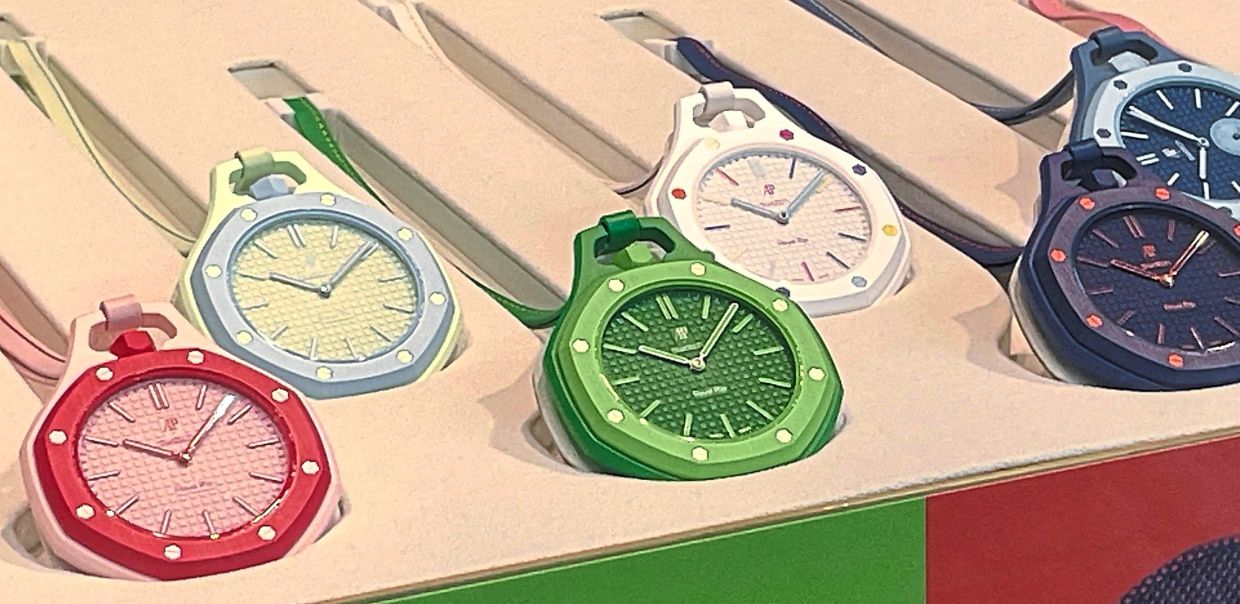
On May 16, the watch world witnessed a carefully orchestrated convergence of two worlds when Swatch unveiled Royal Pop with independent watchmaker Audemars Piguet. The collaboration transformed one of haute horlogerie's most celebrated designs into a collection of bioceramic pocket watches retailing for less than S$600 (RM1,800), yet it sparked the kind of frenzy typically reserved for limited-edition pieces costing tens of thousands of ringgit. The launch revealed something far more significant than a simple celebrity endorsement or brand partnership: it exposed how contemporary luxury marketing wields engineered scarcity, strategic secrecy and clever product repositioning to maintain brand prestige while capturing attention across consumer demographics.
The road to May 16 was paved with deliberate mystification. In the weeks preceding the official May 12 announcement, cryptic newspaper advertisements and social media teasers dangled words like "iconic" and "unexpected" before enthusiast communities. Watch forums filled with speculation, while artificial intelligence-generated mock-ups circulated rapidly across Reddit, Instagram and dedicated horological communities. Yet despite the fevered guessing, credible information remained locked down. Strict non-disclosure agreements, compartmentalised teams and tightly restricted pre-release materials ensured that no genuine images or concrete details emerged before the reveal. This strategic ambiguity intensified anticipation to a fever pitch, transforming the announcement from a routine product launch into a cultural moment.
When Royal Pop finally appeared, the execution proved brilliantly unexpected. Rather than wristwatches that might directly compete with or cheapen Audemars Piguet's core offerings, the collection took the form of eight distinctly colourful bioceramic pocket watches. The designs borrowed liberally from Gerald Genta's legendary Royal Oak: the immediately recognisable octagonal bezel, the intricate "Petite Tapisserie" dial pattern, and the eight exposed hexagonal screws that have defined the Royal Oak's aesthetic for decades. The collection itself split into two functional configurations—Lepine models with a crown positioned at 12 o'clock, and Savonnette pieces featuring a crown at 3 o'clock alongside a small seconds subdial. Inside beat hand-wound SISTEM51 movements, mechanically fascinating for their minimalist engineering philosophy but fundamentally distant from traditional haute horlogerie craftsmanship.
The choice of bioceramic as the case material proved essential to the collaboration's strategic positioning. These materials reinforced a playful, almost toy-like character that fundamentally differentiated Royal Pop from conventional luxury timepieces. This distinction was never incidental—it was core to protecting Audemars Piguet's brand architecture. A straightforward affordable wristwatch interpretation of the Royal Oak could have posed genuine risks to exclusivity, particularly given that entry-level Audemars Piguet Royal Oak wristwatches command prices near S$30,000 (RM94,881). By repositioning the project as a pocket-watch collection—a nostalgic, niche category far removed from contemporary wristwatch culture and Audemars Piguet's principal business—the brand could confidently play with its most recognisable design language without directly cannibalising its prestige product line or confusing consumers about what the brand truly represents.
For Swatch, Royal Pop represents the next chapter in a strategy proven phenomenally successful in 2022 with the MoonSwatch collaboration alongside Omega. That earlier partnership demonstrated conclusively the commercial and cultural potential of pairing an accessible mass-market brand with established luxury credentials. The result shocked industry observers: queues wrapped around boutiques globally, police forces deployed crowd management in multiple cities, and secondary market resellers commanded dramatic premiums for secured pieces. Controlled scarcity, even at entry-level pricing under S$400 (RM1,265), demonstrated remarkable power to generate cultural currency, media visibility and financial returns. The MoonSwatch blueprint proved that luxury in the contemporary moment transcends traditional price hierarchies—consumers will invest time, patience and genuine enthusiasm for the intangible value of heritage and storytelling, even when the physical product costs the same as a quality leather handbag.
Royal Pop amplifies the MoonSwatch playbook significantly, though with elevated complexity. Unlike Omega, which remains a subsidiary within the Swatch Group's corporate structure, Audemars Piguet operates as an independent family-owned manufacture. This distinction carries profound implications. Royal Pop transcends the dynamics of internal corporate collaboration and instead signals Swatch's strategic positioning as an increasingly influential platform through which independent luxury houses can meaningfully broaden their appeal without requiring direct dilution of their core product architecture. The partnership suggests that Swatch has evolved from being merely a watch manufacturer into a cultural intermediary capable of transferring prestige, heritage and desirability from established luxury names to its own commercial ecosystem.
Pat Law, founder of Goodstuph, a social marketing agency operating across Asia-Pacific regions, articulates the mechanism at work: "Luxury today is not just about ownership anymore. It's about proximity." His analysis illuminates how the transaction benefits both parties asymmetrically. Swatch acquires what he describes as cultural elevation—a plastic watch that, overnight, inherits decades of Audemars Piguet's accumulated craftsmanship, historical prestige and horological sophistication. The brand leverages this inheritance for immediate market positioning. Conversely, Audemars Piguet achieves something equally valuable: "AP gets relevance at scale without having to dilute its product line," Law observes. The independent manufacture reaches demographics—particularly younger consumers—who would never voluntarily enter an Audemars Piguet boutique. By placing its design language directly into the consciousness of price-sensitive markets, the brand cultivates long-term brand affinity years before these consumers possess the financial capacity to purchase authentic Royal Oak pieces.
Yet this strategy contains embedded tensions that merit serious consideration. Marketing scholarship examining luxury brand extensions suggests that while democratisation tactics generate substantial short-term commercial momentum and media attention, they simultaneously risk eroding the exclusivity foundations upon which luxury brands historically established value. The phenomenon remains particularly acute when many consumers gain access to a brand's visual identity and design language. There exists a delicate equilibrium: sufficiently limited availability maintains aspirational scarcity, yet excessive restriction undermines the whole purpose of a mass-market collaboration. If Royal Pop achieves too much distribution, the psychological premium attached to Audemars Piguet's design codes potentially diminishes. If scarcity proves excessive, Swatch fails to capitalise on its position as a cultural intermediary. This tension has never been entirely resolved in the luxury market—each brand must calibrate its own response.
For Southeast Asian consumers and collectors, Royal Pop carries particular resonance. The region's rapidly expanding middle class increasingly demonstrates appetite for luxury signalling and cultural participation in global consumer phenomena. The sub-S$600 price point (approximately RM1,800) positions the collection within the psychological purchase range of aspirational professionals, particularly younger demographics in developed Southeast Asian markets like Singapore and Malaysia. Unlike traditional luxury watches requiring multi-year financial commitments, Royal Pop permits cultural participation at modest expense. Moreover, the pocket watch format itself carries nostalgic appeal in a region where many contemporary consumers never regularly encountered such mechanisms before smartphones rendered them obsolete. The product thus functions simultaneously as contemporary art object, cultural artefact and wearable heritage—a layering of value that extends far beyond mechanical timekeeping.
The success or failure of Royal Pop will likely establish templates for how independent luxury manufacturers approach mass-market collaborations in coming years. If the pocket watch collection achieves strong sales while maintaining Audemars Piguet's brand prestige, expect similar partnerships to proliferate. If excessive distribution undermines the brand's exclusivity positioning, manufacturers may retreat to more restrictive models. Either way, Royal Pop represents a significant evolution in how heritage luxury brands navigate contemporary consumer markets, where traditional gatekeeping through price alone no longer guarantees cultural relevance. The collaboration demonstrates that scarcity, when paired with strategic product repositioning, can deliver the intoxicating combination of accessibility and aspiration—allowing brands to simultaneously reach mass audiences and maintain the mystique upon which true luxury ultimately depends. For Malaysian watch enthusiasts and Southeast Asian consumers tracking global luxury trends, Royal Pop signals that the definition of luxury itself continues rapid transformation, becoming less about absolute exclusivity and increasingly about meaningful cultural proximity.

%22%2F%3E%3C%2Fpattern%3E%3C%2Fdefs%3E%3Crect%20width%3D%22100%25%22%20height%3D%22100%25%22%20fill%3D%22url(%23ph1354vg)%22%2F%3E%3Crect%20width%3D%22100%25%22%20height%3D%22100%25%22%20fill%3D%22url(%23ph1354vp)%22%2F%3E%3Ctext%20x%3D%2250%25%22%20y%3D%2250%25%22%20text-anchor%3D%22middle%22%20dominant-baseline%3D%22central%22%20fill%3D%22rgba(255%2C255%2C255%2C0.95)%22%20font-family%3D%22Georgia%2C%20'Times%20New%20Roman'%2C%20serif%22%20font-weight%3D%22700%22%20font-size%3D%22320%22%20letter-spacing%3D%22-0.02em%22%3EGRS%3C%2Ftext%3E%3C%2Fsvg%3E)