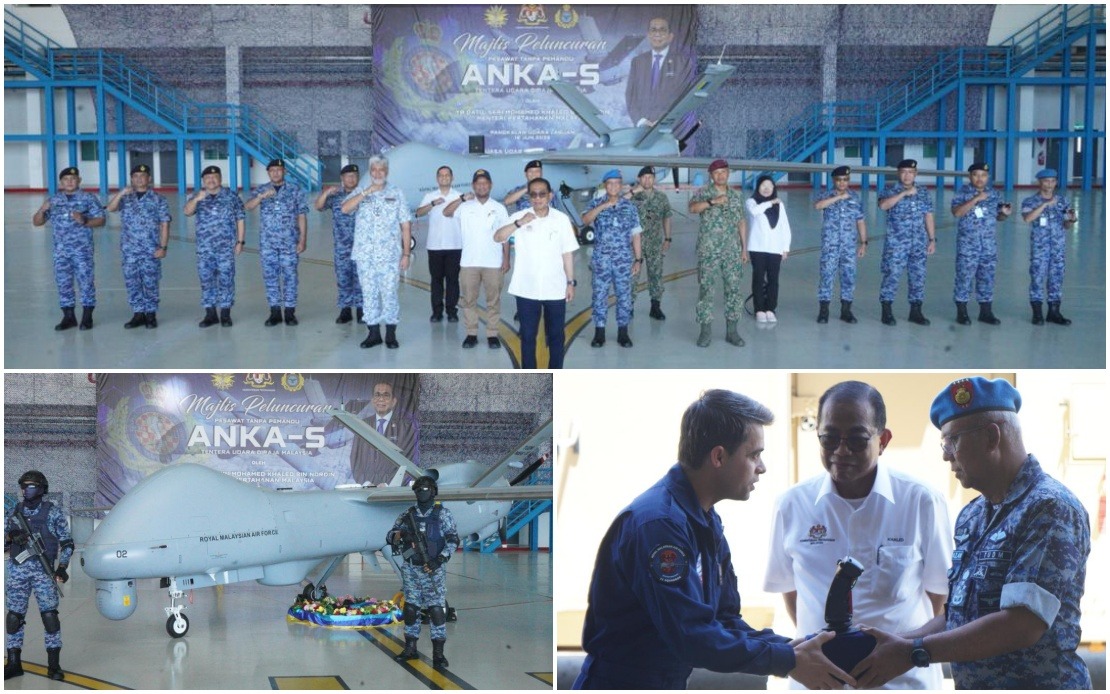
Malaysia has taken a significant step forward in its maritime defence capabilities with the operational deployment of the ANKA-S Unmanned Aircraft System by the Royal Malaysian Air Force at Labuan Air Base. Defence Minister Datuk Seri Mohamed Khaled Nordin described the move as a watershed moment for the nation's ability to monitor and protect its interests in one of the world's most strategically important and contentious waters. The launch of the system, which formally entered service with No 11 Squadron, underscores Kuala Lumpur's determination to bolster its surveillance and intelligence-gathering operations across the South China Sea amidst growing maritime pressures and competing territorial claims in the region.
The acquisition of three ANKA-S aircraft represents a substantial investment in military modernisation, with the total procurement standing at RM423.8 million. This figure encompasses not merely the aircraft themselves but also the accompanying ground control infrastructure and a comprehensive two-year training programme for personnel. The decision to base these systems at Labuan reflects Malaysia's strategic assessment of where enhanced monitoring capabilities are most critically needed. Labuan's geographic position in the northern part of Malaysian waters provides optimal coverage of sea lanes and disputed maritime zones that fall within Malaysia's purview under international maritime law.
The technical specifications of the ANKA-S platform address longstanding gaps in Malaysia's surveillance architecture. Classified as a Medium Altitude Long Endurance system, the aircraft can sustain flight operations for more than 24 consecutive hours whilst maintaining operational altitudes reaching 30,000 feet. This extended endurance represents a transformative capability compared with conventional patrol aircraft, which require frequent refuelling stops and crew rotations. The ability to loiter over designated areas for extended periods fundamentally changes the nature of maritime surveillance, enabling persistent observation patterns that can detect and track maritime activities with a consistency previously unattainable through crewed patrols alone.
Beyond raw endurance, the ANKA-S brings sophisticated sensor capabilities that sharpen Malaysia's maritime awareness. The system's capacity to identify and track vessel profiles with precision enables the RMAF to move beyond reactive patrolling towards a more intelligent, targeted approach to resource deployment. Rather than conducting broad sweeps of Malaysian waters in hopes of encountering incursions or irregular activities, commanders can now direct naval and air assets with confidence towards specific locations where intelligence indicates potential threats. This represents a paradigm shift from labour-intensive, unfocused patrol operations to intelligence-driven, efficient asset utilisation that maximises the impact of Malaysia's defence resources.
The operational cost implications of the ANKA-S system extend beyond the initial procurement. According to Defence Minister Mohamed Khaled, deploying unmanned systems for surveillance generates substantial savings compared with the traditional alternative of committing expensive fighter aircraft or large maritime patrol vessels to surveillance-only missions. Fighter jets and maritime patrol aircraft command significant hourly operating costs and tie up assets that might otherwise be needed for other defence roles. The ANKA-S allows surveillance operations to proceed whilst preserving these more versatile platforms for higher-priority tasks, thereby improving overall force efficiency and reducing the drain on defence budgets stretched across multiple operational requirements.
The South China Sea context colours all assessments of this acquisition. The waterway through which trillions of dollars in global trade annually transits remains an arena of strategic competition where multiple claimants assert overlapping rights. China's expansive claims under its "nine-dash line" framework directly contradict Malaysia's own maritime boundaries as defined by the United Nations Convention on the Law of the Sea. The region has witnessed increasing military modernisation among regional powers and occasional incidents involving civilian and military vessels. Enhanced Malaysian surveillance capabilities serve to reinforce the nation's practical assertion of authority over its claimed maritime zones and provide early warning of activities that might threaten Malaysian interests or sovereignty.
A distinctive aspect of Malaysia's approach involves the deliberate decision not to weaponise the ANKA-S platform despite its technical capacity to carry ordnance. This choice carries symbolic weight in the regional security environment. By maintaining the ANKA-S as a surveillance-only system, Malaysia signals that its expanded defence posture remains fundamentally defensive rather than offensive in character. Defence Minister Mohamed Khaled explicitly framed this restraint as a message to the international community that Malaysia harbours no intentions of aggression or threatening neighbouring nations. In the context of regional sensitivities and frequent diplomatic discourse about regional powers' military buildups, this signal takes on diplomatic significance beyond the aircraft's operational role.
The government's vision for expansion indicates the strategic importance attached to this capability. Plans are already advancing for a second phase acquisition of three additional ANKA-S aircraft, with proposals being prepared for submission under the current national development planning framework. This suggests that operational experience with the initial batch has validated the system's utility and that defence planners assess additional capacity as justified and feasible. Should the second phase proceed as anticipated, Malaysia would eventually field a fleet of six ANKA-S aircraft, providing substantially greater coverage of critical maritime zones and enabling more continuous operations through overlapping patrol patterns.
The technical demonstration of the ANKA-S during the launch event showcased its Intelligence, Surveillance and Reconnaissance capabilities in action. Defence Minister Mohamed Khaled witnessed the live ISR mission conducted from the Data Exploitation Centre, observing how information flows from airborne sensors through ground systems to decision-makers. This infrastructure integration—linking aircraft, control stations, and analytical centres—represents the genuine operational advantage offered by the system. The ability to process surveillance data in real time and translate observations into actionable intelligence multiplies the practical impact of the airborne platform itself. Modern unmanned systems derive much of their strategic value from these integrated networks rather than from the aircraft alone.
For Malaysia's broader defence modernisation trajectory, the ANKA-S deployment signals a recognition that contemporary maritime security demands capabilities that traditional aircraft and surface vessels cannot efficiently provide. The decision to invest heavily in unmanned systems reflects global defence trends and the increasing integration of autonomous or remotely-operated platforms into operational doctrines. As maritime disputes persist and shipping routes demand protection, persistent surveillance emerges as a non-negotiable requirement for any coastal nation asserting control over its waters. The ANKA-S gives Malaysia a credible technological answer to this imperative, moving the nation's defence capabilities closer to the sophisticated integration of sensors, communications, and analytical capacity that characterises advanced maritime forces.
The launch ceremony at Labuan brought together senior defence officials including Chief of Navy Admiral Tan Sri Dr Zulhelmy Ithnain, Chief of Air Force Gen Tan Sri Muhamad Norazlan Aris, and Joint Forces Commander Lt Gen Datuk Tengku Muhammad Fauzi Tengku Ibrahim, reflecting the significance assigned to the capability across Malaysia's military establishment. This cross-service presence underscores that the ANKA-S serves not merely the Air Force's interests but contributes to integrated maritime domain awareness that benefits naval and joint operations planning. The convergence of military leadership around the system's launch symbolises institutional buy-in and suggests coordinated approaches to leveraging this new asset within broader defence strategies.