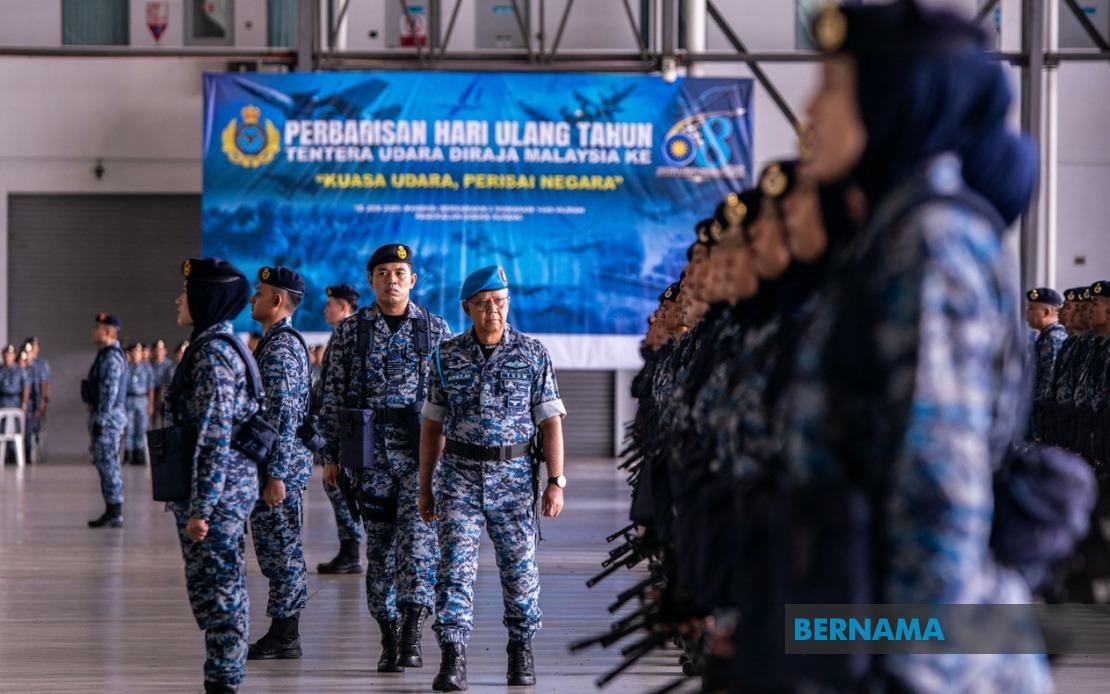
The Royal Malaysian Air Force is moving decisively to strengthen its air defence posture by installing a network of radar systems at carefully selected locations spanning from Sarawak to the South China Sea. Air Force Chief General Tan Sri Muhamad Norazlan Aris announced the deployment programme during the service's 68th Anniversary Parade in Subang, marking a significant step in the force's ability to detect and respond to aerial threats. The installation of these detection systems represents a substantial commitment to modernising Malaysia's defensive infrastructure at a time when regional security dynamics remain in flux.
The radar deployment strategy encompasses multiple regions, each chosen for its strategic importance to national security. Bintulu in Sarawak will receive an air defence radar, as will Bukit Puteri in Terengganu and Bukit Lunchu in Johor, positioning the country with layered coverage across the peninsula. Complementing this continental network, an air surveillance radar will be established on Pulau Layang-Layang, extending Malaysia's monitoring capability into the South China Sea, a waterway of immense significance to regional stability and economic activity. This geographical distribution reflects an understanding that modern air threats do not respect state boundaries and require comprehensive detection networks across multiple zones.
The installations form the cornerstone of phase one within the RMAF Capability Development Plan 2055, a forward-looking framework designed to ensure the air force remains technologically relevant and operationally effective throughout the coming decades. Rather than pursuing piecemeal upgrades, the CAP55 approach acknowledges that sustained preparedness demands systematic modernisation aligned with evolving security challenges. By anchoring current procurement decisions within a long-term strategic vision, the RMAF is attempting to avoid the capability gaps that have historically plagued developing air forces and ensure coherent force development.
General Muhamad Norazlan framed the modernisation programme within the context of contemporary global security challenges, particularly the ongoing conflict in West Asia. He pointed out that disruptions to critical sea lanes, notably the Strait of Hormuz, demonstrate how regional instability can ripple across global energy markets, supply chains, and economic systems. Malaysia, despite its distance from the Middle East, remains vulnerable to such cascading effects through its dependence on stable energy supplies and uninterrupted maritime trade. This reality has direct implications for the cost of living and industrial competitiveness for ordinary Malaysians and businesses.
The strategic importance of the Strait of Malacca and the South China Sea to Malaysia's economic wellbeing cannot be overstated. These waterways account for a substantial proportion of global maritime commerce and represent vital arteries for Southeast Asia's trade-dependent economies. The Strait of Malacca, in particular, funnels enormous volumes of energy resources and manufactured goods through a narrow chokepoint, making it essential to regional prosperity. Malaysia's geographical position astride these critical passages creates both opportunity and responsibility—the nation must be capable of protecting its interests and contributing to the security of these commons.
The air defence radar programme addresses a documented vulnerability in Malaysia's current surveillance architecture. Previous assessments have identified gaps in airspace coverage, particularly in remote regions and over maritime areas. These gaps create potential security risks by limiting the advance warning available to respond to unauthorised intrusions or unidentified aircraft. Enhanced early warning capability fundamentally changes the operational calculus by providing decision-makers with additional time to assess threats and direct appropriate responses. In modern air operations, such temporal advantages can prove decisive.
Beyond the technical dimensions, the radar deployments carry implications for Malaysia's position within regional power dynamics. The South China Sea remains disputed territory, with multiple claimants asserting overlapping sovereignty and resource rights. By enhancing its surveillance and detection capabilities, Malaysia strengthens its practical control over claimed maritime zones and demonstrates commitment to defending national interests. This assertion of capability, while measured and defensive in character, sends a signal to other regional actors regarding Malaysia's seriousness about protecting its sovereignty and maritime claims. The installations thus serve both practical defensive purposes and broader geopolitical messaging functions.
The ceremony itself emphasised the RMAF's professionalism and institutional continuity. General Muhamad Norazlan received formal military honours before reviewing a parade that included 16 officers and 272 personnel organised into four distinct flights representing different specialisations within the service. The presence of the Women's Composite Flight and the Multi-Trade Composite Flight reflected the RMAF's evolving approach to recruitment and utilisation of available human resources. Such institutional inclusivity, while primarily concerning personnel management, carries secondary benefits for military effectiveness by broadening the talent pool from which the service draws its personnel.
Recognition ceremonies formed another component of the anniversary commemoration, with seventeen officers and personnel receiving service medals and commendation certificates. The Pingat Perkhidmatan Am and Pingat Perkhidmatan Setia represent formal acknowledgment of dedicated service, mechanisms through which military institutions reinforce institutional culture and reward loyalty. The attendance of former air force chiefs underscored the service's concern with institutional memory and continuity of leadership principles across generational transitions. Such symbolic gatherings serve to embed current operations within a historical narrative of professional military service.
For Malaysian readers and policymakers, the radar installations represent a tangible manifestation of defence spending translated into improved operational capability. Unlike weapons procurement, which often generates domestic political controversy, infrastructure investment in detection systems appeals to a broader consensus around the need for defensive capacity. However, the success of these installations ultimately depends upon their integration into broader air defence systems, the availability of trained personnel to operate and maintain them, and the political will to respond appropriately to threats they identify. Technical capability alone provides insufficient security without supporting infrastructure and operational commitment.
The announcement also reflects Malaysia's awareness that modern security challenges extend beyond conventional military threats. Cyber intrusions, drone incursions by non-state actors, and unconventional surveillance all pose threats that conventional radar systems cannot address. The radar programme therefore represents necessary but partial progress toward comprehensive air security. Future modernisation must encompass cyber defence, counter-drone systems, and intelligence integration to create coherent air security architecture. The RMAF's long-term planning suggests awareness of this requirement, but implementation will determine whether the force can translate strategic vision into operational reality.

