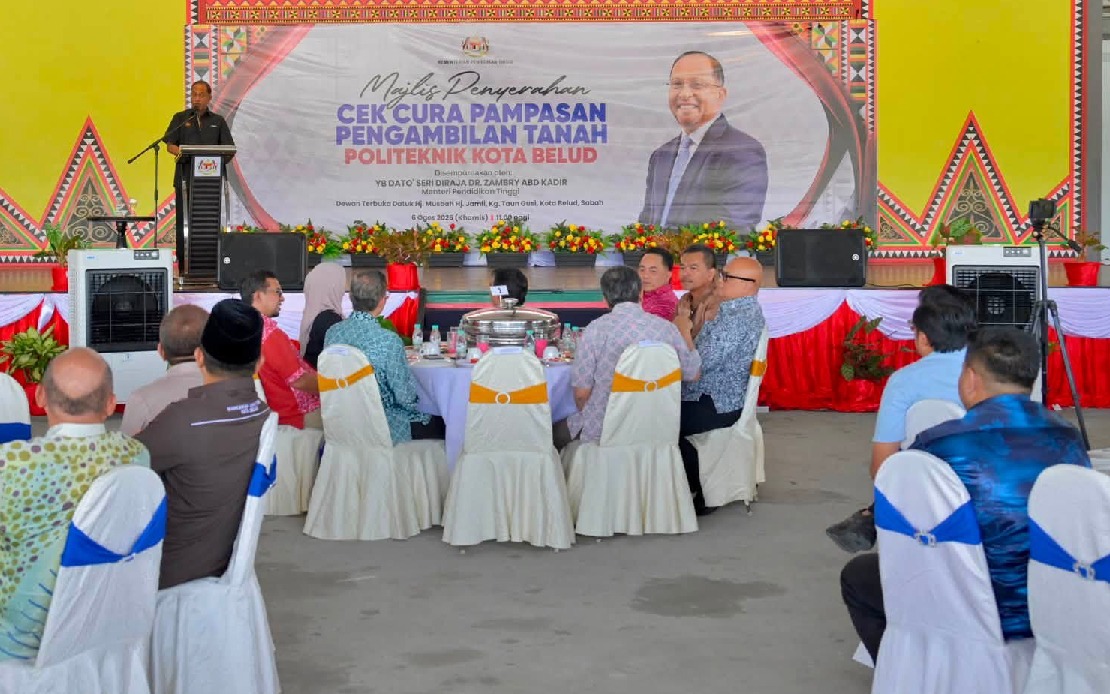
Malaysia's ambitious RM250 million Politeknik Kota Belud project has transitioned into its implementation phase after the completion of land acquisition processes, signalling the formal commencement of one of Sabah's most significant educational infrastructure ventures. Higher Education Minister Datuk Seri Zambry Abd Kadir presided over a ceremony marking the distribution of compensation payments to affected landowners, a milestone that officially unlocks the polytechnic's construction timeline. The institution is anticipated to welcome its first cohort of students and begin full operations by 2030, positioning itself as a critical educational hub in East Malaysia.
The initiative represents over a decade of planning effort within Malaysia's federal education policy machinery. Originally conceived in 2017 following a proposal advanced by then Kota Belud Member of Parliament Datuk Seri Abdul Rahman Dahlan, the project reflects sustained commitment to expanding tertiary-level technical education beyond peninsular Malaysia. The transition from conceptual stage through design phases into active ground preparation underscores how long-term infrastructure projects navigate Malaysia's bureaucratic and financial approval processes before reaching execution. Zambry articulated expectations that development efforts would accelerate beginning with the Third Rolling Plan allocation under the 13th Malaysia Plan commencing next year, providing the budgetary framework necessary for sustained construction momentum.
The polytechnic's curriculum architecture specifically targets alignment with Sabah's emerging and established economic sectors, reflecting a sophisticated understanding of regional workforce requirements. Institutional focus areas encompassing green energy, artificial intelligence, computer science, and smart technology-based agriculture demonstrate recognition that Sabah's future prosperity depends on cultivating human capital equipped for digital transformation and sustainable development imperatives. Rather than generic technical training, the institution will position itself as a specialised talent pipeline addressing genuine employer demand in sectors driving Malaysia's economic evolution. This strategic specificity contrasts with conventional polytechnic offerings, potentially establishing Kota Belud as a demonstration model for vocationally-aligned institutions throughout Southeast Asia.
Enrolment projections reveal institutional scalability embedded within the facility's design framework. An inaugural intake targeting approximately 500 students will enable operational establishment and programme refinement during initial years, with subsequent expansion targeting between 1,000 and 1,500 annual enrolments once the institution matures. This phased capacity approach reflects pedagogical prudence, permitting quality assurance mechanisms and staff development before rapid scaling. For Malaysian higher education policymakers, the model illustrates how polytechnics can operate efficiently across different scale ranges while maintaining educational standards. The expansion trajectory also suggests long-term employment generation for academic and administrative staff, contributing measurable economic activity to Kota Belud's regional economy.
From a Malaysian educational equity perspective, the Kota Belud polytechnic addresses persistent disparities in technical higher education availability across regions. Sabahan students previously required migration to peninsular institutions or private alternatives, creating financial barriers and cultural displacement for rural families. Establishing a regionally-embedded institution reduces such obstacles while retaining talent within the state, potentially creating reverse migration patterns as successful graduates attract complementary investment and opportunity. The project thus embodies broader national objectives around inclusive development and regional autonomy in educational provisioning.
The RM250 million investment magnitude situates this project within Malaysia's major capital expenditure initiatives, reflecting conviction regarding technical education's strategic importance. For comparison with other regional infrastructure spending, such allocations demonstrate prioritisation of human capital formation over purely physical infrastructure, aligning with development economics literature emphasising education's multiplier effects. The construction timeline extending to 2030 accommodates realistic project delivery given Malaysia's complexity in managing large institutional builds, whilst remaining ambitious enough to deliver genuine impact within current decade.
Industrial partnership prospects warrant consideration in evaluating potential institutional impact. Sabah's energy transition, technological upgrading, and agricultural modernisation present genuine engagement opportunities for a dedicated polytechnic. Malaysian and multinational corporations operating across these sectors could potentially collaborate on curriculum design, apprenticeships, and placement pathways, creating symbiotic relationships benefiting student outcomes and employer hiring capabilities. Such partnerships remain implicit rather than formally announced, suggesting potential future development opportunities.
The compensation payment ceremony itself carries procedural significance within Malaysian governance frameworks. Land acquisition necessitated transparent compensation processes respecting landowner rights whilst enabling public infrastructure development. This balance between community interest and state objectives often generates political sensitivity in Malaysian contexts, particularly in Sabah where indigenous land rights carry particular weight. Successful resolution through formal compensation mechanisms demonstrates institutional capacity to navigate such complexities, potentially establishing precedent for future major projects requiring land assembly.
Regional competitive positioning merits consideration within Southeast Asian polytechnic ecosystems. Thailand, Vietnam, and Indonesia operate comparable technical institutions with varying quality standards and international recognition. A well-executed Kota Belud facility could enhance Malaysia's technical education brand regionally, potentially attracting cross-border students and establishing international accreditation credentials. Conversely, execution challenges could undermine confidence in Malaysian tertiary education quality, making project delivery reliability consequential beyond local impacts.
Longer-term implications for Sabah's development trajectory deserve recognition. Educational institutions generate sustained regional benefits through employer attraction, knowledge spillovers, and cultural vitality. A functioning polytechnic attracts complementary service businesses, professional services, and technology companies, creating agglomeration effects extending beyond education sector. Historical experience with Malaysian polytechnics and technical colleges demonstrates such institutions become community anchors generating disproportionate economic value relative to direct institutional spending.
Successful implementation requires sustained political commitment across multiple election cycles, given the 2030 timeline spanning potential changes in government composition. Malaysian infrastructure projects occasionally experience disruption following electoral transitions when incoming administrations reprioritise spending. Institutional insulation of the Kota Belud project through legislative embedding and multi-year budget allocations could enhance implementation security. Public communication of the polytechnic's strategic importance may similarly strengthen political protection against competing budget priorities.
The polytechnic's relationship to Malaysia's broader skills development strategy remains important contextually. National competitiveness increasingly depends on workforce capabilities in emerging sectors. An institution specifically designed for green energy, artificial intelligence, and technology-based agriculture directly addresses skills gaps constraining Malaysia's transition toward higher-value economic activities. Success in Kota Belud could justify similar investments elsewhere in Malaysia, potentially catalysing polytechnic system modernisation aligned with contemporary industrial requirements.

