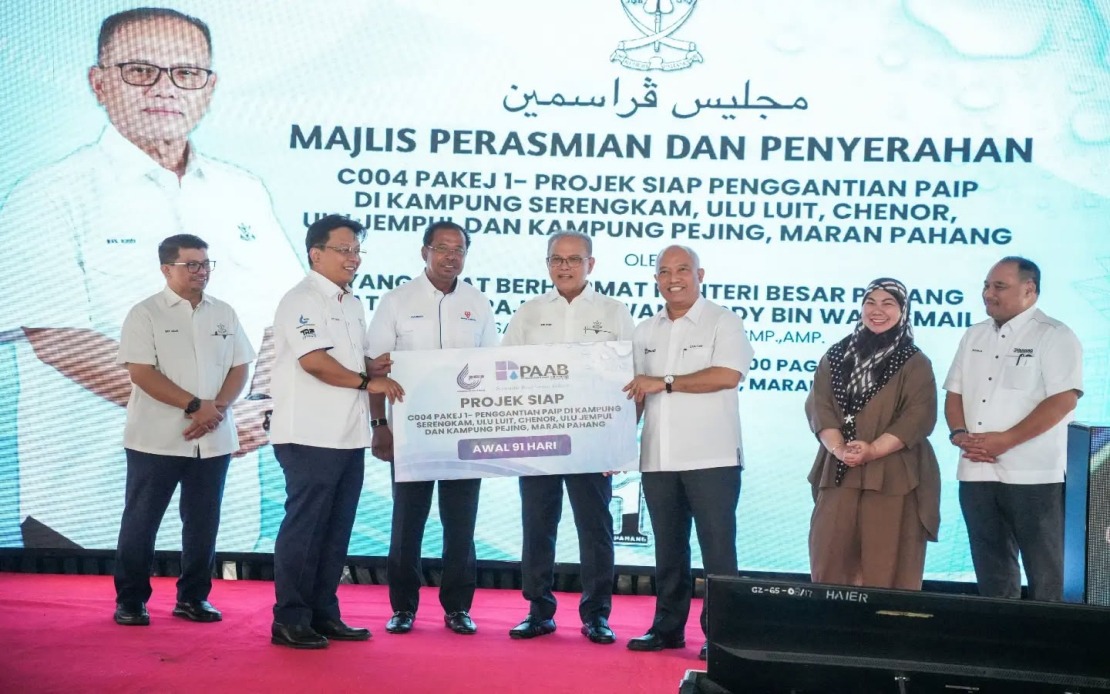
Pengurusan Aset Air Berhad (PAAB) has successfully concluded a major infrastructure overhaul addressing persistent water supply challenges that have plagued Maran residents, particularly in the Chenor sub-district, since the early 2000s. The fully-funded RM11.19 million initiative involved replacing 29.6 kilometres of ageing piping across multiple communities, including Kampung Serengkam, Ulu Luit, Pejing, Ulu Jempul and Chenor, and was handed over to local authorities three months ahead of its original completion schedule.
The project handover ceremony at the Chenor Water Treatment Plant on Wednesday drew senior government officials, including Pahang Menteri Besar Datuk Seri Wan Rosdy Wan Ismail, Deputy Energy Transition and Water Transformation Minister Datuk Seri Abdul Rahman Mohamad, and Deputy Economy Minister Datuk Mohd Shahar Abdullah. The attendance of such high-level representatives underscores the strategic importance of water infrastructure rehabilitation in addressing service delivery gaps across Malaysia's states, particularly in areas where infrastructure degradation has created systemic reliability problems.
For nearly two decades, residents in Maran have contended with frequent pipe bursts and inconsistent water pressure, creating acute supply challenges during peak demand periods such as the dry season and major festivals. The replacement programme directly benefits approximately 10,000 residents across the affected districts, representing a significant portion of Maran's population and addressing one of the region's most pressing utility concerns. By replacing deteriorating infrastructure with modern piping systems, PAAB has effectively eliminated the cascading failures that previously disrupted daily life and economic activity throughout the area.
Beyond immediate relief from supply disruptions, the project delivers operational advantages that ripple across the water distribution network. The initiative substantially reduces non-revenue water losses—the volume of treated water lost through leakage before reaching consumers—a persistent challenge across Malaysia's water utilities. Stabilising water pressure during high-demand periods represents another critical improvement, as previous pressure fluctuations necessitated costly emergency interventions and placed additional strain on treatment and distribution infrastructure.
The successful Maran project serves as a foundation for PAAB's broader three-year regional transformation strategy developed collaboratively with Pengurusan Air Pahang Berhad (PAIP). This expanded programme encompasses multiple districts across Pahang, reflecting a systematic approach to modernising water infrastructure in areas where ageing systems have compromised service reliability and operational efficiency. The strategy acknowledges that isolated projects, while beneficial, require integration into comprehensive state-wide planning to achieve lasting improvements in water security.
One concurrent initiative involves upgrading electrical systems at the Jengka Utama Water Treatment Plant to address supply disruptions affecting communities around the Felda Jengka settlement. Separately, PAAB is advancing a RM35.7 million undertaking to replace 76.2 kilometres of deteriorated pipes across Jerantut and Lipis, covering areas surrounding Pulau Tawar and Kuala Tahan. These geographically dispersed projects indicate that water infrastructure degradation remains a widespread challenge requiring coordinated intervention across multiple constituencies and communities.
A third component involves a RM13 million pipeline replacement in Felda Keratong—11 kilometres of new infrastructure designed to enhance supply system efficiency across Rompin. Collectively, these projects demonstrate PAAB's commitment to systematic network modernisation rather than ad-hoc repairs that merely defer underlying problems. The geographic distribution across Pahang's interior districts also reflects policy prioritisation of rural and semi-rural areas, where infrastructure deficiencies have historically received less attention than urban centres.
As of July this year, PAAB had committed RM1.17 billion toward water infrastructure development throughout Pahang, with differentiated allocation across project lifecycle stages. Completed initiatives account for RM69.79 million, ongoing construction consumes RM66.94 million, while planning and design phases encompass RM981.04 million—indicating substantial future investment in infrastructure modernisation. This allocation structure reveals that the Maran project represents only an initial phase in a prolonged commitment to transforming Pahang's water services infrastructure.
The institutional framework underpinning these initiatives involves PAAB, established in 2006 under the Water Services Industry Act 2006, operating as the federal government's implementation vehicle for the National Water Services Industry Restructuring Plan. As an entity wholly owned by Minister of Finance Incorporated and regulated by the Ministry of Energy Transition and Water Transformation, PAAB operates within a governance structure designed to separate asset management from operational service delivery. PAIP's 2020 signing of the Pahang State Water Supply Services Restructuring Agreement formalised this division of responsibilities, enabling specialised focus on infrastructure investment and modernisation.
For Malaysian readers, particularly those in Pahang and surrounding regions experiencing similar water supply challenges, the Maran completion demonstrates that government-backed infrastructure programmes can successfully address long-standing utility deficiencies. The three-month early delivery suggests competent project management and realistic scheduling—qualities essential for confidence in subsequent initiatives. More broadly, the RM1.17 billion Pahang investment pipeline indicates serious commitment to water security beyond rhetorical endorsement, with substantial capital deployment across planning through execution phases.
The project's success also reflects Southeast Asia's broader water infrastructure imperative, as urbanisation, climate variability, and ageing systems create pressures across the region. Malaysia's restructured water sector governance—separating asset management, operations, and regulation—provides a potential model for peer nations grappling with similar institutional challenges. The Maran initiative demonstrates that systematic replacement of deteriorated infrastructure, while requiring substantial upfront investment, delivers measurable improvements in reliability and operational efficiency that compound across extended service areas.

