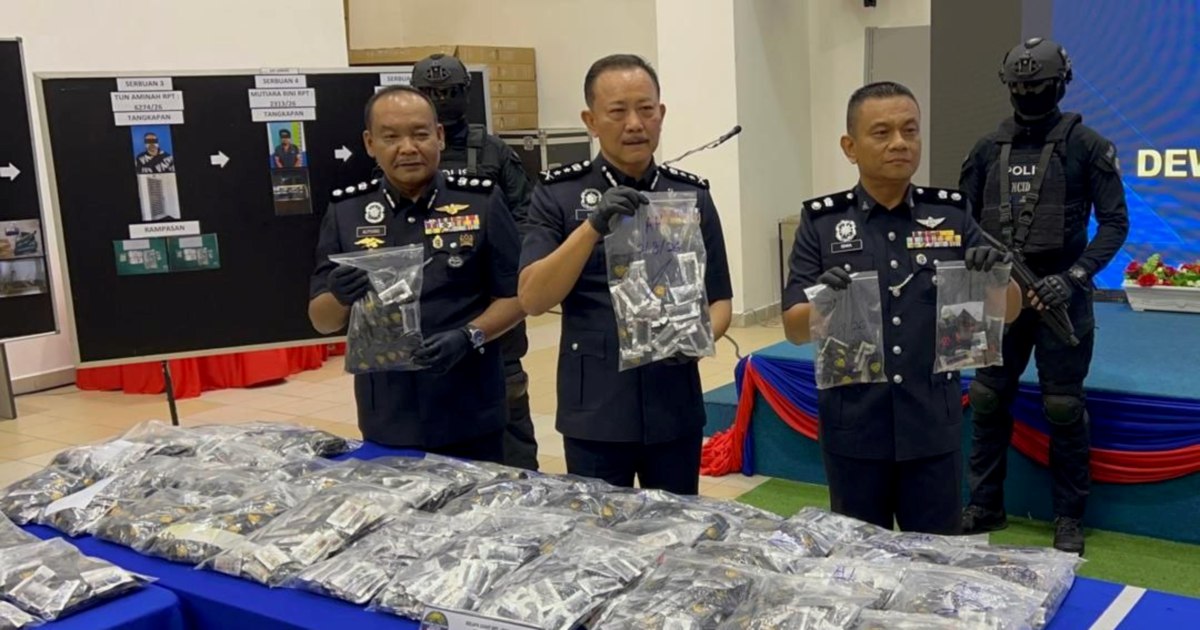
Police have dealt a significant blow to organised drug trafficking in the southern region after dismantling a complex vape distribution network in Johor. The operation, which came together through five coordinated raids on Sunday, resulted in the arrest of seven individuals suspected of processing and distributing vape cartridges laced with narcotics. The confiscated stock, valued at RM10.68 million, represents one of the more substantial drug seizures involving this particular contraband category in recent months.
The scale and sophistication of the detected operation suggests a well-organised enterprise rather than ad-hoc street-level dealing. The fact that the syndicate maintained dedicated processing facilities indicates that members were engaged in converting raw materials into finished products for onward distribution, a labour-intensive operation that requires technical knowledge and logistical coordination. The simultaneous nature of the five raids across the state demonstrates that law enforcement agencies had developed sufficient intelligence to identify and move against multiple nodes of the network concurrently, maximising disruption potential.
The use of vape devices as a vector for drug delivery represents an evolving trafficking trend across Southeast Asia. Unlike traditional consumption methods, vape cartridges offer traffickers several operational advantages: they are inconspicuous, easily transported, and their proliferation in legitimate commerce provides excellent cover for illicit variants. For end-users, vaping technology masks the consumption of controlled substances in environments where traditional methods would attract immediate attention, such as public spaces or educational institutions. This convergence of technological accessibility and criminal opportunism has created a significant enforcement challenge for regional authorities.
Johor, as Malaysia's southernmost state and a major entry point for international smuggling operations, frequently experiences trafficking activities targeting the lucrative domestic market. The state's proximity to Singapore, a wealthy neighbouring jurisdiction with strict drug enforcement, makes it an attractive transhipment location for substances destined for local consumption or onward export. Port facilities in Johor Baru and other coastal areas provide multiple channels through which contraband can enter the supply chain, presenting persistent challenges to enforcement agencies operating with finite resources.
The targeting of recreational vaping products specifically reflects a tactical adaptation by traffickers responding to market opportunities. Legitimate vape commerce has grown substantially across Southeast Asia as smokers explore alternatives to traditional cigarettes. This normalization of vaping culture has generated consumer familiarity with the devices and reduced social stigma around their use, creating an environment where drug-laced variants can circulate with reduced suspicion. The existence of an established retail infrastructure for legitimate products simultaneously provides distribution channels for criminal variants.
The financial valuation assigned to the seized stock—RM10.68 million—warrants examination. This figure typically represents the estimated street value of the narcotics content rather than the wholesale cost to traffickers. The substantial markup between production costs and street value illustrates why organised criminal groups continue to invest in vape-based distribution despite enforcement risks. The profit margins sustaining such operations ensure that successful prosecutions of mid-level operatives rarely eliminate trafficking entirely; instead, they create temporary supply disruptions that trigger reorganisation within the criminal networks.
The arrests of seven individuals spanning five separate locations raises questions about the hierarchical structure of the dismantled organisation. Enforcement agencies typically prioritise identifying and pursuing higher-level coordinators and financiers, recognising that arresting street-level distributors produces temporary disruption without addressing underlying supply chains. The distribution of suspects across multiple locations suggests that investigators may have captured participants operating at varying levels within the network, though the actual leadership and funding sources may remain unidentified or at large.
This operation occurs within the broader context of Malaysia's sustained commitment to combating narcotics trafficking, a persistent public health and security challenge affecting the region. The Royal Malaysia Police and Customs Department continuously adapt enforcement strategies to address evolving trafficking methodologies, including the integration of new technologies and consumption vectors. Coordinated operations such as this one demonstrate institutional capacity for intelligence-gathering and multi-agency coordination, though the continuing emergence of novel smuggling vectors suggests that criminal adaptation often outpaces enforcement response.
The implications extend beyond immediate drug suppression. Cannabis and other controlled substances infused into vape cartridges represent a growing concern for educators and health authorities monitoring substance abuse among young people. The inconspicuous nature of vape-based delivery mechanisms complicates detection efforts in schools and youth facilities. Parents, educators, and community leaders across Malaysia should expect that drug-infused vaping products will remain readily available despite law enforcement successes, underscoring the importance of prevention and awareness campaigns alongside enforcement.
Looking ahead, the disruption of this particular syndicate creates temporary market disruption but unlikely signals a fundamental shift in trafficking patterns. Unless accompanied by sustained investigations into procurement channels, financial flows, and upstream supply sources, the operation risks becoming a tactical victory within an ongoing strategic contest. Southeast Asian nations, including Malaysia, continue developing enhanced intelligence capabilities and cross-border cooperation mechanisms to address transnational drug trafficking at scale. The Johor operation represents incremental progress within this longer struggle against organised narcotics distribution.

