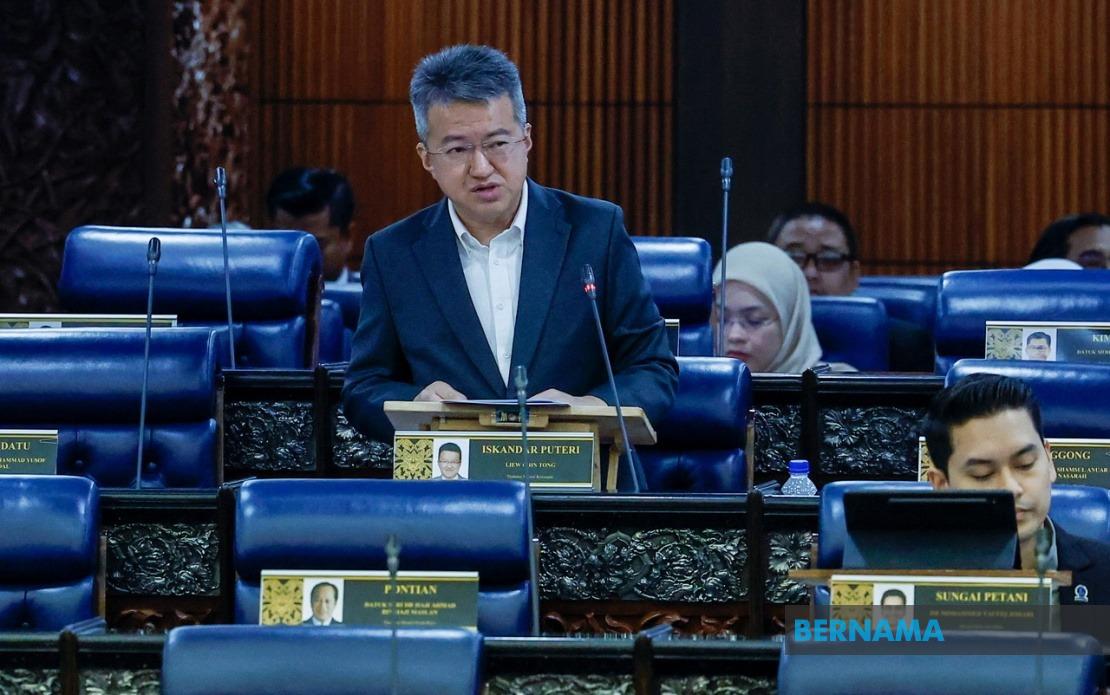
The federal government has moved to reassure Sabah that a substantial boost to the state's interim special grant will not come at the expense of its core development budget. Deputy Finance Minister Liew Chin Tong made the clarification during parliamentary proceedings today, responding to concerns raised by WARISAN politician Isnaraissah Munirah Majilis about the implications of the RM1.5 billion interim grant increase announced by Prime Minister Datuk Seri Anwar Ibrahim in May.
Liew emphasised that the additional special grant would operate as a separate funding stream, leaving intact Sabah's allocation for operating and development expenditure under the current federal budget framework. This distinction matters considerably for East Malaysian policy, as Sabah has long advocated for enhanced federal support while maintaining protection of its existing budgetary entitlements. The assurance addresses a legitimate fiscal concern in a state where infrastructure gaps remain significant compared to Peninsular Malaysia, and where federal funding flows remain scrutinised for adequacy.
To substantiate this commitment, Liew highlighted concrete evidence of expanded development investment. Sabah's development allocation has grown from RM6.7 billion to RM6.9 billion in the current fiscal year, reflecting an additional RM200 million injection. This expanded pool is channelled toward flagship initiatives including the Pan Borneo Highway—a transformative infrastructure project that has reshaped connectivity across Sabah and Sarawak—alongside investments in rural road networks, electrification of remote communities, water supply expansion, and health facility upgrades spanning hospitals, clinics, and rural health posts. Educational infrastructure renewal and police station improvements round out the portfolio, indicating a relatively balanced approach to physical development across key public services.
Beyond traditional capital projects, the federal government continues underwriting operational expenses that would otherwise strain state finances. A particularly significant commitment involves electricity subsidies, which the government will maintain despite transferring regulatory authority to Sabah in 2024. Liew projected that electricity subsidies would reach RM880 million by 2026, a substantial ongoing transfer that effectively cushions Sabah against cost pressures in this essential utility sector. For Malaysian policymakers monitoring fiscal federalism dynamics, such subsidies represent a meaningful form of support that does not appear in conventional development allocation tallies but carries real economic weight.
Water infrastructure, another critical development domain, has similarly benefited from enhanced federal commitment. Rural water supply allocations have been ramped up from RM103.5 million in 2025 to RM143 million in the current year—a roughly 38 percent increase reflecting priorities in peninsular Malaysia's understanding of Sabah's infrastructure deficits. This expansion targets populations in remote areas where private sector provision remains uneconomical and where development gaps generate both social and political consequences if left unaddressed.
Social safety-net programmes complement the development and infrastructure portfolio. Liew noted that cost-of-living assistance distributed through the Sumbangan Tunai Rahmah and Sumbangan Asas Rahmah schemes in Sabah alone totals approximately RM1.2 billion. These cash transfer initiatives, introduced during the pandemic era and substantially maintained, represent a different form of federal support—direct household transfers rather than capital investment—but serve important functions in buffering vulnerable populations against inflation and maintaining domestic consumption during periods of economic uncertainty.
The procedural architecture governing special grant payments reflects constitutional complexities specific to Sabah and Sarawak. Liew underscored that federal and state governments must adhere to mechanisms established under Article 112D of the Federal Constitution, replicating procedures successfully implemented in previous years including 2022, 2023, and 2025. These constitutional provisions, unique to East Malaysia, embed special fiscal arrangements reflecting the historical agreements negotiated when Sabah and Sarawak joined the federation. Understanding these mechanisms matters for assessing the robustness of federal commitments and whether they rest on statutory foundations sufficiently durable to survive political transitions.
However, underlying these reassurances lies an ongoing constitutional dispute. The federal government has filed an appeal challenging aspects of a Kota Kinabalu High Court ruling concerning special grants to Sabah. This legal contestation signals disagreement between federal and state interpretations regarding the scope and calculation methodology for special grant obligations. Liew's simultaneous affirmation of commitment to special grants—described as a principle the government respects—alongside pursuit of appellate remedies reflects an attempt to balance political cooperation with Sabah while contesting legal interpretations the federal government considers excessive.
Looking forward, Liew indicated that negotiations between federal and state authorities aim to establish new mechanisms for determining special grant amounts in future years, operating within the framework of Articles 112C and 112D. This prospective stance suggests recognition that current arrangements may lack sufficient clarity or flexibility to accommodate evolving state needs and federal fiscal capacity. For Sabah, securing agreement on a forward-looking mechanism could provide greater predictability and potentially stronger guarantees than dependence on annual interim arrangements subject to political determination. From Kuala Lumpur's perspective, a negotiated mechanism might offer clarity and potential cost control compared to open-ended constitutional obligations as interpreted by courts.
For Malaysian stakeholders monitoring fiscal federalism and intergovernmental relations, this episode illustrates the enduring complexity of managing financial relationships between the federal centre and East Malaysian states. Sabah's enhanced grant, the protection of existing allocations, and the commitment to ongoing electricity subsidies collectively represent significant federal commitments. Simultaneously, the constitutional litigation and proposals for new mechanisms suggest unresolved tensions about the proper balance between federal flexibility and state certainty. How these negotiations progress will shape not only Sabah's development trajectory but also broader patterns of federal-state fiscal relations that extend across Malaysia's dual federalism framework.

