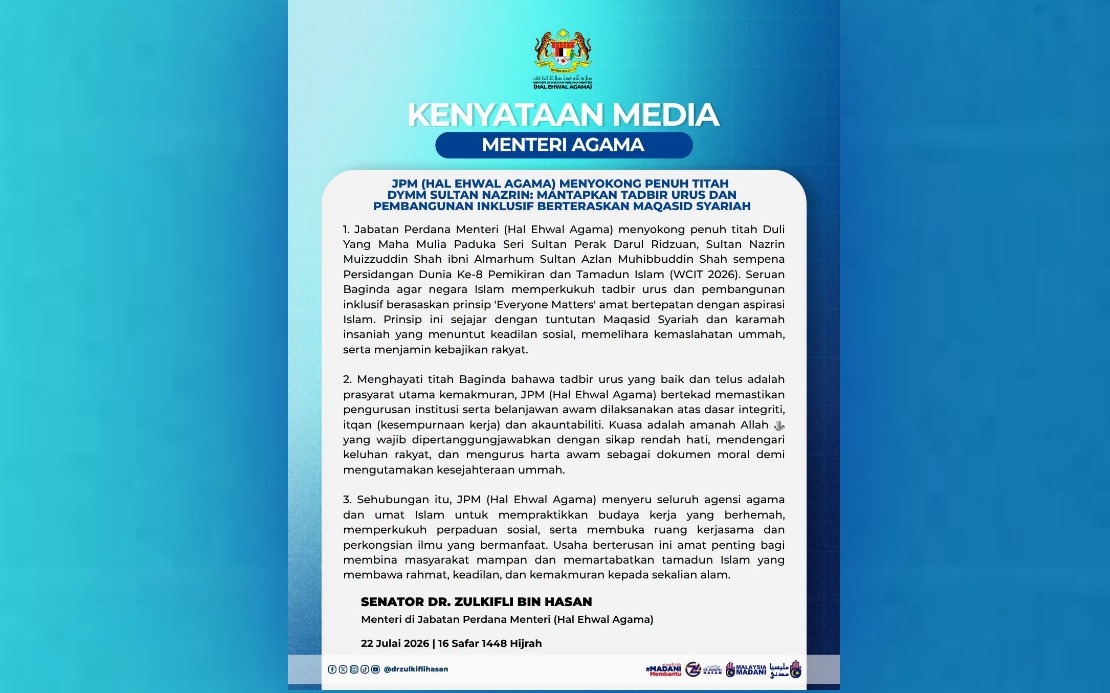
The Prime Minister's Department (Religious Affairs) is charting a new course for managing the nation's religious institutions, grounding its approach in the governance philosophy articulated by Sultan Nazrin Shah at a major international forum. This commitment represents a deliberate alignment between Malaysia's administrative machinery and the ethical principles the Perak ruler outlined during his address to the 8th World Conference on Islamic Thought and Civilisation (WCIT), emphasising that effective governance must prioritise every citizen regardless of their demographic background.
Minister in the Prime Minister's Department (Religious Affairs) Dr Zulkifli Hasan has formally endorsed this direction, positioning the department's work within a framework that combines Islamic jurisprudence with contemporary administrative best practices. The minister's statement articulates how Sultan Nazrin's "Everyone Matters" philosophy extends beyond mere rhetoric, connecting instead to established Islamic concepts such as Maqasid Syariah—the objectives and purposes underlying Islamic law—and karamah insaniah, the Islamic concept of human dignity that underpins protections for individual and collective welfare.
At the heart of this governance reorientation lies a recognition that religious institutions in Malaysia serve a plural society. Sultan Nazrin's address stressed that public services reflecting national unity must extend protection and attention to all citizens, irrespective of their religious affiliation or political persuasion. This principle gains particular significance in Malaysia's context, where religious affairs fall under federal jurisdiction but impact communities across diverse demographic and geographic boundaries. The sultan's emphasis on "humble leadership that listens to the people before making laws" suggests a consultative model that departs from top-down administrative approaches.
Dr Zulkifli has underscored that the department understands authority as a sacred trust—an amanah in Islamic terminology—that demands exercise with humility and accountability. This framing carries implications for how the department manages public funds allocated to religious purposes, institutional budgeting for religious education, and the administration of Islamic institutions. By anchoring these functions in principles of moral responsibility toward the ummah (Muslim community), the minister signals a shift toward outcomes-based accountability where success is measured not merely by procedural compliance but by genuine improvements in public welfare.
The doctrine of itqan, or excellence in work, introduced by Dr Zulkifli, represents another layer of this governance commitment. In Islamic tradition, itqan denotes meticulous attention to quality and precision in executing responsibilities, reflecting the belief that believers should perform duties to the highest standard. For a religious affairs ministry, this translates into demands for transparency in decision-making, competence in managing programmes, and responsiveness to stakeholders—whether they are Muslim communities seeking clarity on religious matters, non-Muslim citizens wanting assurance that religious administration does not encroach on their rights, or international partners observing Malaysia's religious governance practices.
Sultan Nazrin's broader commentary on prosperity and development introduces economic dimensions that the religious affairs portfolio cannot ignore. The Perak ruler observed that no nation can isolate itself from global economic forces, emphasising that trade, investment, knowledge transfer and technological advancement drive national prosperity. Religious institutions in Malaysia increasingly intersect with these domains—Islamic banking and finance, halal certification and trade, religious education and human capital development. A governance framework acknowledging global interdependence suggests the religious affairs ministry must position Malaysia's Islamic institutions as contributors to, rather than obstacles toward, competitive advantage in regional and global markets.
The call for a "courteous work culture" within religious agencies carries practical organisational implications. Malaysia's religious bureaucracy encompasses federal agencies, state-level religious authorities, judicial bodies applying Islamic law, and countless mosque committees and Islamic schools. Creating coherent cultural standards emphasising courtesy and respect across these disparate entities represents an ambitious undertaking. Yet such standardisation could improve public confidence in religious institutions, reduce friction between religious and secular administrative structures, and model interpersonal conduct that reflects Islamic values of adab (propriety) and ihsan (excellence in conduct).
Dr Zulkifli's invitation for religious agencies and Muslim communities to strengthen social unity and foster collaborative knowledge-sharing acknowledges fractures within Malaysia's religious establishment. Theological differences between mainstream and alternative Islamic movements, disputes over religious authority between federal and state bodies, and debates over the scope of Islamic law application have occasionally created public friction. By emphasising collaboration and beneficial knowledge exchange, the minister appears to endorse dialogue mechanisms and forums where diverse Islamic perspectives can be aired constructively rather than permitted to fester as institutional tensions.
The alignment with Maqasid Syariah proves particularly instructive for Malaysian policymakers. Islamic jurisprudence traditionally identifies five core objectives—preservation of religion, life, intellect, progeny and property. However, contemporary interpretations of Maqasid extend these foundational purposes to encompass social justice, environmental stewardship, and equitable distribution of resources. By explicitly linking governance principles to Maqasid, Dr Zulkifli positions the religious affairs ministry within an intellectual tradition that legitimises progressive, welfare-oriented administration grounded in Islamic sources.
For Malaysia's religious governance moving forward, this commitment suggests several practical directions. First, institutional reforms should emphasise transparency and public participation in decisions affecting religious communities. Second, religious agencies should integrate performance metrics reflecting public welfare outcomes rather than merely measuring activity levels. Third, inter-agency coordination between religious and secular authorities should deepen, ensuring religious governance supports rather than undermines broader national development objectives. Fourth, religious institutions should enhance their capacity to engage with contemporary challenges—from digital misinformation about Islam to questions about religious freedom and minority rights—in ways consistent with both Islamic principles and Malaysia's constitutional framework.
The "Everyone Matters" framework, properly implemented, offers Malaysia an opportunity to demonstrate that Islamic governance can coexist with pluralism, accountability and inclusive development. This becomes particularly significant given Malaysia's position as a Muslim-majority nation in a religiously diverse Southeast Asia and as a participant in global affairs where Islamic governance models attract scrutiny. By translating Sultan Nazrin's philosophical call into concrete administrative practices, the religious affairs ministry can potentially reshape regional perceptions of what modern Islamic institutional management entails.

