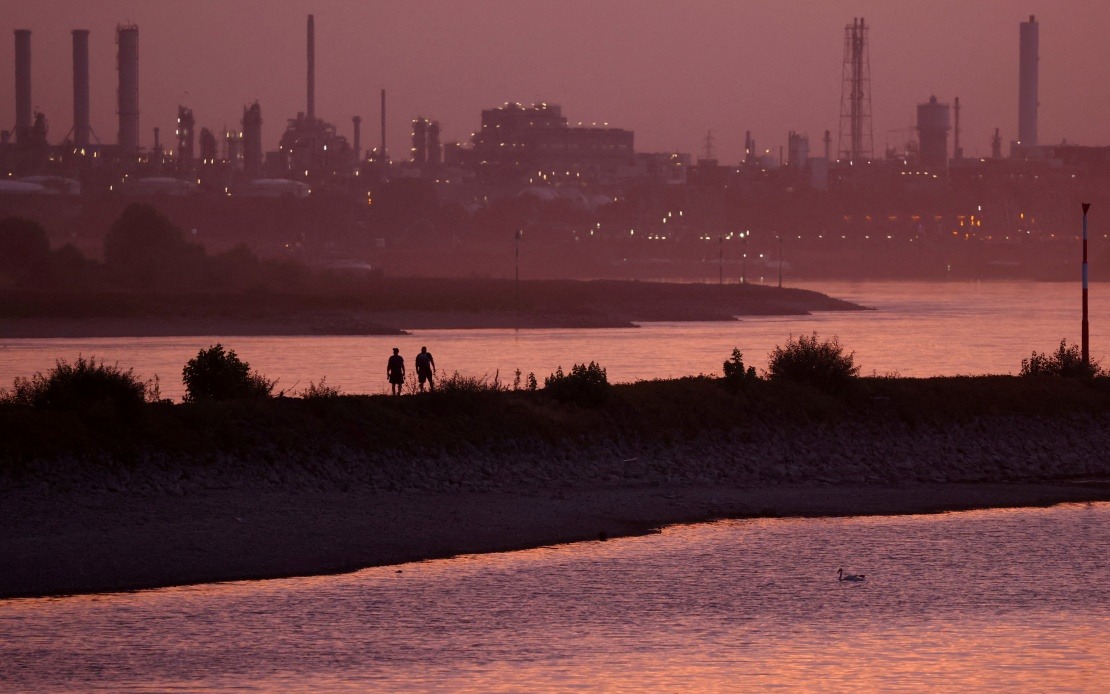
German explosives specialists were mobilising Thursday to neutralise a substantial Second World War ordnance discovered along the Rhine near Cologne, uncovered when the river's water level reached unprecedented lows following weeks of intense heat and drought conditions. The 500-kilogramme American aerial bomb surfaced Wednesday evening in the vicinity of Cologne's Rheinpark, prompting immediate security measures and preparations for a delicate defusing operation whose timing had not been finalised at the time of reporting.
The discovery underscores a grim reality facing Europe's industrial heartland: as climate patterns shift toward prolonged drought, historical remnants of conflict long entombed beneath major waterways are resurfacing. The Rhine, which serves as Germany's primary commercial artery for inland navigation, has proven particularly vulnerable to such low-water episodes. On Thursday, the river's depth gauge at Cologne registered just 67 centimetres—matching a record minimum set only days earlier—with forecasters predicting a further decline to 66 centimetres within hours. These measurements place current conditions among the most severe documented in modern records.
Authorities initiated evacuation protocols affecting approximately 360 individuals within a 400-metre safety perimeter centred on the bomb's location. Those displaced included residents of a retirement facility and personnel working at nearby RTL television studios, illustrating how wartime ordnance hazards continue to intersect with contemporary urban life across Germany. Municipal officials coordinated the relocation while specialists prepared their equipment, reflecting established procedures for handling such discoveries that, while alarming, occur with regularity in regions heavily targeted during the 1939-1945 conflict.
The timing of this discovery carries broader implications for European infrastructure and commerce. Low Rhine levels have already imposed substantial constraints on shipping operations, forcing barge operators to reduce cargo loads significantly—a disruption rippling through supply chains dependent on Germany's waterborne freight network. When water depth diminishes, vessels sit lower in the channel, creating navigational hazards and limiting payload capacity. The current crisis demonstrates how environmental stress can amplify economic vulnerability in sectors that have operated unchanged for generations.
For Southeast Asian observers, the Rhine situation offers instructive parallels regarding water resource management and climate resilience. Major regional waterways—the Mekong, Irrawaddy, and others—face similar pressures from irrigation demands, hydroelectric projects, and increasingly variable precipitation patterns. Germany's experience managing the intersection of wartime legacy hazards with modern drought stress suggests that tropical and subtropical nations must simultaneously address environmental adaptation while tackling historical risks embedded in river ecosystems.
The meteorological backdrop amplifying this crisis reflects broader European weather patterns. Prolonged heat waves and absent rainfall have degraded hydrological conditions across the continent, with the Rhine serving as a particularly sensitive indicator. Unlike regions with extensive reservoir systems providing buffering capacity, the Rhine's natural fluctuations translate immediately into visible water-level crises. Hydrologists noted that recovery would remain minimal over subsequent days, with no prospect of sustained improvement visible in available forecasts.
Historically, the Rhine's low-water episodes carry symbolic weight in German consciousness. Previous critical shortages have prompted national economic concern and animated policy debates regarding climate preparedness. The current episode, marked by the simultaneous exposure of undetonated ordnance, compounds anxieties about infrastructure vulnerability. Shipping companies have begun rerouting cargoes toward rail and road transport, accepting higher costs rather than risking delays on a compromised waterway.
The 500-kilogramme bomb itself represents ordinary ordnance by World War II standards, yet its unexploded status transforms it into a matter of acute public safety. American aerial campaigns systematically targeted German industrial capacity, resulting in countless tonnes of ordnance landing across the country—much of it failing to detonate. Decades later, as construction or natural events disturb soil and riverbed sediments, these devices emerge to confront modern societies with hazards their creators deposited eight decades prior.
Defusing operations, when conducted, typically proceed with meticulous caution. German explosive ordnance disposal teams possess extensive experience handling such discoveries, having managed thousands of similar cases since 1945. The 400-metre exclusion zone reflects standard safety protocols designed to contain potential detonation effects. Residents and workers within the perimeter would remain displaced until specialists confirmed the device's neutralisation or safe removal.
The convergence of climate stress, infrastructure strain, and latent wartime hazards reveals interconnected vulnerabilities characterising modern Europe. This episode near Cologne exemplifies how historical and contemporary challenges can reinforce one another, creating compound crises that demand coordinated response. As Rhine water levels fluctuate with increasing severity, discoveries of unexploded ordnance may accelerate, presenting recurring public safety and economic disruption scenarios across the German heartland.

