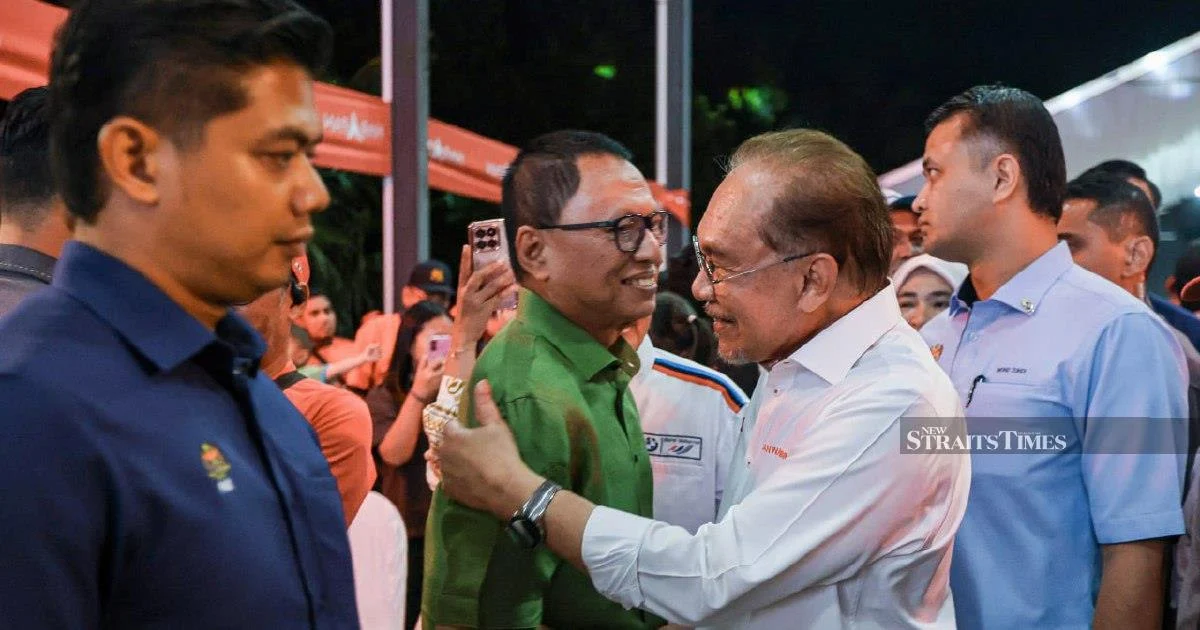
Bersama party leader Datuk Seri Rafizi Ramli has weighed in on recent political manoeuvres with a pointed jest about Datuk Dr Mohd Puad Zarkashi's apparent shift in allegiances. The barb came after Puad's conspicuous public show of affection with Prime Minister Anwar Ibrahim during an event held in Johor Baru on Saturday, a gesture that did not escape the notice of the ambitious political operator from Bersama.
The lighter-than-expected tone of Rafizi's remark—framed as humorous criticism rather than outright condemnation—reflects a broader pattern of political manoeuvring in Malaysian politics, where public displays of unity or distance from senior figures carry significant symbolic weight. In a political landscape where coalitions remain fluid and party loyalty constantly tested, such exchanges between rising figures carry implications beyond the immediate surface-level jesting.
Puad, a figure with roots in UMNO's institutional apparatus, has increasingly positioned himself within the reformist orbit surrounding Anwar Ibrahim's administration. The Saturday embrace appeared to formalise what had been gradual ideological and tactical drift across recent months. For Bersama, still consolidating its position as a new political entity carved from elements of the Mahathir-era establishment and reform-minded politicians, such developments signal potential erosion of the coalition's supporting cast.
Rafizi's quip about Puad exchanging his "portfolio" from one party to another employs the language of financial transaction to satirise what he views as mere opportunistic repositioning rather than principled political transformation. The wordplay—positioning political affiliation as a commodity to be traded rather than a genuine ideological commitment—underscores deep-seated tensions within Malaysia's coalition politics, where parties often lack distinct programmatic differences and individuals navigate between them based on patronage networks and factional advantage.
This particular exchange emerges during a period when the governing coalition led by Anwar Ibrahim's PKR has been actively consolidating support among potential allies and smaller party leaders. Each public endorsement or high-profile relationship carries tactical importance for maintaining legislative strength and projecting an image of broad-based backing. For Puad, any strengthened relationship with the Prime Minister translates directly into enhanced political capital and influence within decision-making structures.
Bersama, meanwhile, continues navigating the delicate position of being neither the dominant force within the coalition nor an insignificant player. Rafizi's intervention suggests mild irritation about the gravitational pull that Anwar Ibrahim and the Prime Minister's office exerts over potential allies and party members. The joke functions as both a genuine witticism and a subtle warning to others within his orbit about the risks of being perceived as insufficiently committed to collective party interests.
Puad's background spanning decades within UMNO's institutional structures provides context for understanding how his embrace of Anwar Ibrahim's reformist agenda might appear incongruous to political observers. Yet Malaysian politics has repeatedly demonstrated that ideological consistency matters far less than access to power and resources. Politicians who successfully navigate between these shifting coalitions, provided they avoid excessive public humiliation of former allies, often emerge with enhanced rather than diminished standing.
The Saturday event that prompted Rafizi's commentary illustrates the increasingly theatrical nature of Malaysian political signalling. Public embraces, seating arrangements, and carefully orchestrated photo opportunities constitute the primary language through which politicians communicate their alignment to both party loyalists and broader constituencies. In this context, Puad's embrace with Anwar Ibrahim broadcasts unambiguously to observers about his commitment to the current government.
For Malaysian and Southeast Asian observers monitoring political developments in Kuala Lumpur, such exchanges between political figures reveal the ongoing process of coalition realignment that characterises the post-2018 era of Malaysian politics. The initial shock of Mahathir's fall has given way to more pragmatic accommodation between various political forces, with ideological consistency yielding to questions of administrative capacity and electoral viability.
Rafizi's barb, while ostensibly lighthearted, also reflects broader concerns within Bersama about party consolidation at a time when Malaysian politics remains volatile. The party continues establishing credibility and a distinct political identity. When senior figures gravitate toward the dominant centre of power represented by the Prime Minister's office, it potentially constrains Bersama's ability to differentiate itself within an increasingly crowded political marketplace.
The dynamics at play here extend beyond mere personality clashes or factional rivalry. They represent fundamental questions about how coalitions cohere in Malaysian politics, what mechanisms prevent complete absorption of smaller parties by larger anchors, and whether ideological consistency or institutional loyalty ultimately drives political behaviour. Puad's journey across the political spectrum offers insights into these broader structural questions.

