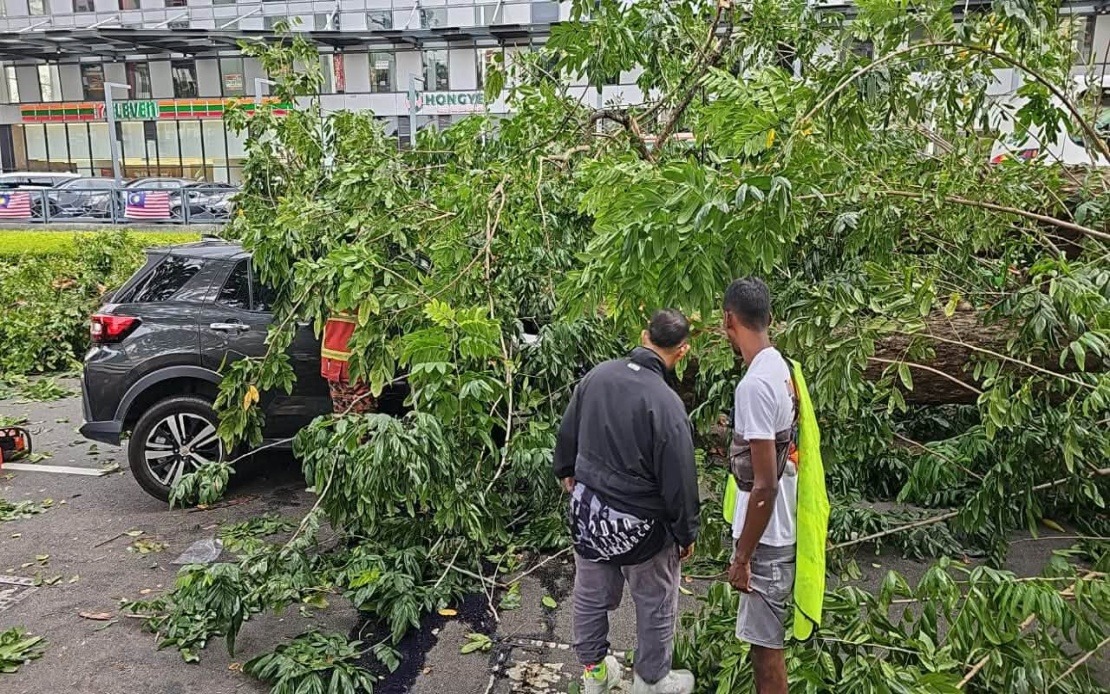
A family of three—an elderly couple and their granddaughter—had a fortunate escape on Friday morning when their Perodua Ativa was struck by a fallen tree on Jalan Macalister in George Town, Penang. The incident, which occurred around 9:12 am, served as a stark reminder of the dangers posed by large trees in urban areas during unpredictable weather conditions and the critical importance of community responsiveness in emergency situations.
The Malaysian Fire and Rescue Department (JBPM) received the emergency notification in the mid-morning hours and immediately dispatched a team of eight personnel from the Jalan Perak Fire and Rescue Station to respond. However, what could have been a far more serious outcome was prevented by the swift action of members of the public who were present in the vicinity. These quick-thinking bystanders managed to extricate the three trapped occupants from the damaged vehicle before professional rescue personnel could arrive at the location, potentially preventing injuries from worsening or additional complications from occurring during the extraction process.
According to a statement issued by Assistant Director of the Operations and Firefighting Division John Sagun Francis, the early intervention by members of the public was instrumental in ensuring the victims' safety. While the three occupants sustained injuries in the impact, their prompt removal from the vehicle meant they could receive medical treatment without unnecessary delay. All three were subsequently transported to hospital for assessment and care, though the extent of their injuries was not detailed in official reports.
Following the initial rescue effort, firefighting personnel and local authorities remained actively engaged at the scene throughout the day. As of midday, clearing operations continued with teams working to remove the fallen tree and any remaining debris blocking the roadway. These cleanup efforts were essential not only for restoring traffic flow but also for preventing further accidents and ensuring pedestrian safety in the area. The scale of the fallen tree required substantial cutting and removal work, preventing rapid clearance of the location.
Tanjong Member of Parliament Lim Hui Ying, who serves as Deputy Minister of Women, Family and Community Development, swiftly responded to news of the incident. Through a Facebook post, she indicated that her office had mobilised a team to visit the scene and gather additional information from relevant authorities while offering appropriate support to those affected. Her statement acknowledged the incident and encouraged road users to exercise caution in the affected area and comply with traffic management directives established by emergency personnel.
The accident created significant traffic disruptions in the George Town area, with authorities closing the road temporarily to enable comprehensive cleanup operations. This disruption highlighted how such incidents can have cascading effects beyond the immediate location, affecting commuter patterns and business activities in surrounding neighbourhoods. The combination of the road closure and the need for extensive tree removal meant that traffic congestion persisted for several hours as vehicles were redirected away from the incident scene.
The incident raises important questions about tree maintenance and urban forestry practices in Penang and other Malaysian cities. While fallen trees can occur due to natural causes such as strong winds or soil instability, proper maintenance protocols and regular inspection regimes are crucial for identifying potentially hazardous trees before they pose risks to road users and pedestrians. The costs associated with emergency response, medical treatment, and traffic disruption far exceed the expense of preventive arboricultural management.
From a broader perspective, this incident underscores the vulnerability of vehicle occupants to environmental hazards and the importance of maintaining situational awareness while driving, particularly in areas with mature tree canopies. The fortunate outcome—that bystanders were present and responded appropriately—cannot be relied upon as a substitute for systemic safety measures. The successful rescue operation, while commendable, should not distract from addressing the underlying conditions that contributed to the dangerous situation.
The response demonstrated the effectiveness of inter-agency coordination and public awareness in managing emergencies. The promptness of the fire department's dispatch, the decisive action of bystanders, and the official follow-up by the elected representative all contributed to minimising harm and ensuring appropriate care for the victims. Such coordination becomes increasingly important in densely populated urban areas like George Town, where proximity of residents and emergency services can make the difference between minor and catastrophic outcomes in accident situations.

