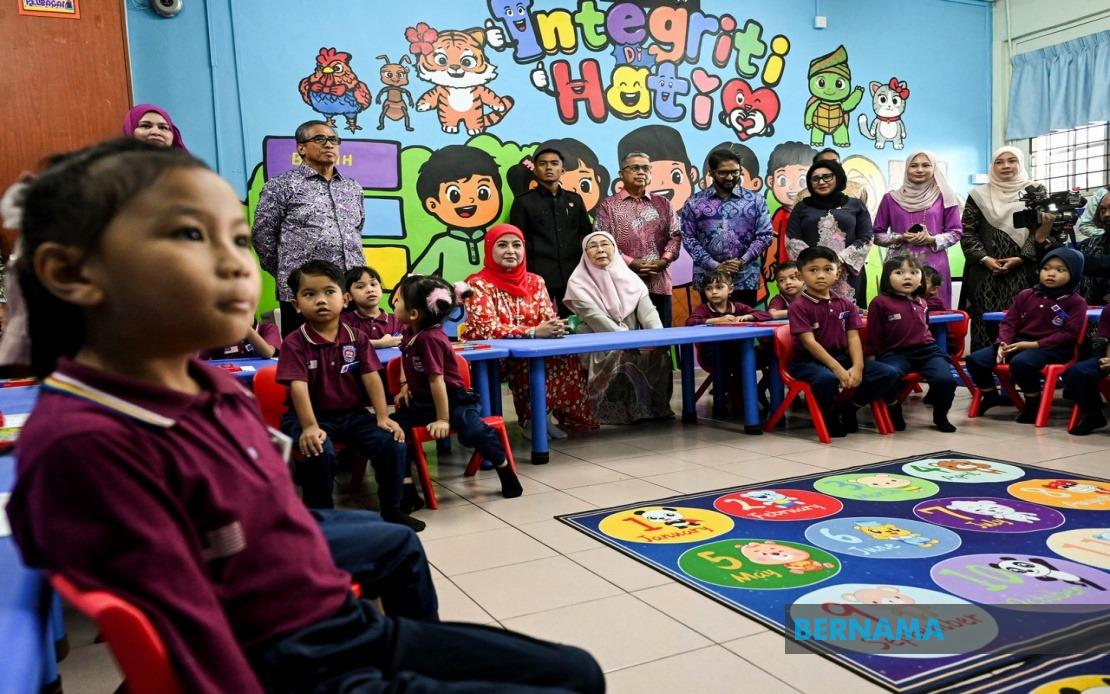
Her Majesty Queen Raja Zarith Sofiah officially launched the Children's Integrity Module (MIKa) at Tabika Perpaduan Taman Bukit Cheras in Kuala Lumpur on August 27, marking a significant milestone in Malaysia's efforts to embed moral education into early childhood development. The initiative represents a strategic pivot toward preventative character-building, recognising that foundational values established during the formative years prove substantially more resilient than those imposed through legislation alone in later life.
The royal patronage of this educational venture underscores the government's commitment to ethical nation-building at the grassroots level. Her Majesty's presence, accompanied by National Unity Minister Datuk Aaron Ago Dagang and Chief Secretary to the Government Tan Sri Shamsul Azri Abu Bakar, demonstrated the programme's elevation within Malaysia's policy hierarchy. The participation of Bandar Tun Razak Member of Parliament Datuk Seri Dr Wan Azizah Wan Ismail further reflected cross-party and multi-level governmental support, suggesting broad consensus on the necessity of institutionalised integrity education.
MIKa targets the youngest demographic within Malaysia's education system—children between two and six years old—a demographic whose cognitive and emotional development remains highly malleable. This age selection reflects contemporary developmental psychology, which emphasises that moral habits formed during early childhood create lasting neural pathways that shape subsequent decision-making patterns throughout adulthood. By intervening at this stage, policymakers seek to establish integrity as an intrinsic norm rather than an externally imposed constraint.
The Malaysian Institute of Integrity (IIM), under Tan Sri Shamsul Azri's stewardship, developed the module through a rigorous process commencing in 2024 that incorporated expertise from 35 early childhood education specialists. This collaborative approach ensured the curriculum integrated research-backed pedagogical methods with Malaysia's specific cultural and social contexts. The breadth of institutional involvement—spanning multiple ministries, government agencies, tertiary education providers, and civil society organisations—created a comprehensive ecosystem for the module's conceptualisation and refinement.
Among the programme's most ambitious dimensions is its scaling trajectory. The IIM has established 2030 as the target completion date for nationwide implementation across Malaysia's entire early childhood education landscape, encompassing more than 31,000 childcare centres, kindergartens, and preschools. This nationwide rollout presents a logistical undertaking of considerable magnitude, requiring standardised teacher training, curriculum adaptation, resource allocation, and ongoing quality assurance across geographically dispersed and often resource-constrained facilities.
Tan Sri Shamsul Azri articulated a philosophical foundation distinguishing MIKa from purely regulatory or punitive approaches to ethics. He emphasised that genuine integrity cannot be generated through legal enforcement or administrative directives alone; rather, it emerges when ethical behaviour becomes habitual, trustworthiness crystallises as an operational principle, and altruistic conduct transforms into normalised practice. This conceptualisation aligns with established behavioural science, which demonstrates that internalised values prove far more durable and consistent than compliance enforced through external penalties.
The module's content, witnessed during Her Majesty's classroom visit, employs interactive learning simulations that make abstract ethical concepts tangible and age-appropriate for young learners. Rather than lecturing on integrity, the pedagogical approach facilitates discovery through experiential engagement, allowing children to navigate ethical dilemmas within controlled environments and develop decision-making frameworks organically. This methodology contrasts sharply with traditional rote memorisation approaches, positioning MIKa as a modernised intervention aligned with contemporary educational best practices.
The launch occurs within a broader Malaysian context grappling with institutional integrity challenges. High-profile corruption cases, public sector inefficiency allegations, and corporate malfeasance have periodically undermined public trust in governmental and commercial institutions. By cultivating integrity consciousness from early childhood, policymakers seek to address these systemic challenges at their source—the formation of individual character and collective cultural norms—rather than exclusively through post-hoc enforcement mechanisms. This generational approach assumes that today's ethically-grounded children become tomorrow's trustworthy professionals and citizens.
Parental engagement emerges as an essential prerequisite for MIKa's success. Tan Sri Shamsul Azri explicitly acknowledged that educators alone cannot inculcate lasting ethical values without corresponding reinforcement within family environments. Parents functioning as behavioural role models and integrity exemplars create cognitive consistency between institutional learning and domestic experience. This recognition reflects an understanding that education operates most effectively as a multi-stakeholder endeavour rather than an exclusively school-based intervention.
For Southeast Asian policymakers observing Malaysia's initiative, MIKa presents a potential model for region-wide adoption. Many ASEAN nations confront comparable governance challenges and aspire toward enhanced institutional integrity. A standardised, culturally-adaptable framework for embedding ethical education within early childhood systems could facilitate coordinated regional efforts toward improved governance quality and citizen trustworthiness. The module's emphasis on foundational habit-formation resonates across diverse cultural contexts where ethical conduct underpins social cohesion.
The financial and human resource implications of scaling MIKa to 31,000 institutions warrant consideration. Substantial investment in teacher professional development, curriculum materials, monitoring systems, and programme evaluation will be essential. Whether the Malaysian government can sustain funding commitments across electoral cycles and competing budgetary priorities remains an open question affecting the initiative's long-term viability. Successful implementation requires not merely initial enthusiasm but institutionalised commitment transcending political transitions.
MIKa's ultimate efficacy will depend upon measurement and accountability mechanisms tracking whether early childhood exposure to integrity modules demonstrably correlates with enhanced ethical conduct, institutional trust, and reduced corruption across subsequent life stages. Longitudinal research following cohorts through adolescence and adulthood could generate empirical validation or identify necessary programme refinements. Without rigorous evaluation, MIKa risks becoming a well-intentioned initiative lacking evidence of substantive impact on national integrity levels.

