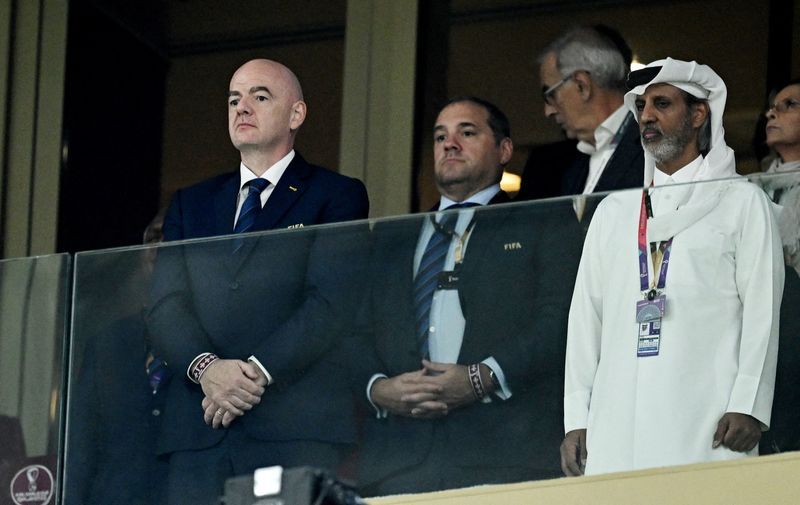
The Qatar Football Association has renewed its challenge to the Asian Football Confederation's decision-making processes, maintaining that AFC President Sheikh Salman bin Ebrahim Al-Khalifa overstepped his authority when signing a joint letter with UEFA and CONCACAF that criticised FIFA President Gianni Infantino's conduct and leadership. The public nature of this dispute represents an unusually candid airing of institutional tensions within Asian football's governing hierarchy, where political disagreements are typically resolved behind closed doors away from media scrutiny.
At the heart of the controversy lies a fundamental question about governance and consultation. QFA President Hamad bin Khalifa Al-Thani has contended that Sheikh Salman lacked the mandate to commit the AFC as a whole to the critical letter without first obtaining explicit approval from either the AFC executive committee or its individual member associations. In his latest correspondence, Al-Thani characterised the AFC's defence of its actions as inadequate, arguing that regardless of how thoroughly the confederation justified its position on substantive issues, it failed to address the core procedural concern regarding proper authorisation before issuing statements purporting to represent all 47 members.
The broader context involves FIFA President Infantino's controversial FIFA Forward Enterprise proposal, which sought to attract private investment into the World Cup. When the confederation chiefs signed their critical letter, they attacked both this initiative and Infantino's leadership style at a moment when the FIFA President faced mounting pressure ahead of his anticipated reelection campaign next year. The convergence of these institutional power struggles within global football governance reflects deeper tensions about transparency, consultation, and the balance between centralised executive authority and collective decision-making across football's confederations.
Qatar's position carries particular significance given its recent history with FIFA and the AFC. As host of the 2022 World Cup, Qatar navigated intense international criticism and geopolitical pressure, experiences that likely inform its current stance on procedural propriety and institutional accountability. Moreover, Qatar stands among only six AFC members that declared early support for Infantino during the escalating crisis triggered by the FFE proposal's rejection, positioning the Gulf nation as a staunch ally of the FIFA President even as other confederations moved to distance themselves from his agenda.
Sheikh Salman's defence rested on two pillars: first, his claim that he possessed inherent authority and responsibility as AFC President to act decisively in defence of Asian football's institutional interests, and second, his invocation of historical precedent. The Bahraini administrator reminded critics that the AFC had previously issued public statements on matters of continental importance, including coordinated backing for Qatar's World Cup hosting bid despite intense global opposition. He characterised Qatar's focus on procedural technicalities as a distraction from what he framed as the substantive good of the game.
However, Al-Thani's rejoinder articulated a crucial distinction about the nature of past statements. He argued that any previous AFC positions issued in support of Qatar's World Cup candidacy reflected the confederation's institutional self-interest as an organisation, not pronouncements issued unilaterally by the president without consultation. This distinction matters significantly because it suggests that support for a fellow member's major tournament hosting bid operates under different legitimacy principles than signed criticism of FIFA's leadership and strategic direction. The argument implies that continental solidarity on matters affecting the region's football prestige may warrant swifter executive decision-making, whereas institutional criticism of FIFA governance demands broader consensus-building.
The inclusion of Al-Thani as both a QFA President and member of the AFC executive committee adds another layer of institutional complexity to this dispute. His dual position theoretically should have afforded him direct access to consultations about the critical letter had Sheikh Salman pursued proper procedural channels. That no such consultation occurred—or, if it did, that Al-Thani felt unable to prevent the statement's issuance—underscores the question of whether the AFC President actually wielded the unilateral authority he claimed.
For Malaysian and broader Southeast Asian stakeholders in football governance, this public dispute carries instructive implications about institutional accountability within the AFC. Malaysia, alongside fellow ASEAN member Vietnam and other regional bodies, operates within confederation structures that depend on clear delineation of executive authority and member consultation mechanisms. The precedent established here—whether AFC presidents may unilaterally commit confederations to major public positions—could influence how regional football associations approach their own governance and their relationship with the overarching confederation.
The dispute also illuminates how broader geopolitical alignments within football's global governance structure reflect real power struggles. Qatar's unwavering support for Infantino, despite the FIFA President facing unprecedented institutional challenges, suggests the Gulf nation perceives strategic benefit in maintaining the status quo. Conversely, the decision by UEFA and CONCACAF to sign the critical letter alongside an AFC leadership that lacked clear mandate to speak for its members raises questions about verification of legitimacy in global football diplomacy and whether confederations properly validated their partners' authority to commit them to joint positions.
The AFC's silence following Al-Thani's latest correspondence speaks volumes. Rather than attempting further justification of Sheikh Salman's decision-making authority, the confederation appears to have recognised the limits of its public defence. This reticence may reflect internal discomfort with how the critical letter was executed, or alternatively, a strategic decision to avoid prolonging an embarrassing public exchange that undermines the confederation's image of unified leadership.
Moving forward, this controversy will likely influence how Asian football's leadership structures approach consultation and decision-making on sensitive institutional matters. Whether Sheikh Salman's actions receive retrospective validation through some form of AFC assembly affirmation, or whether the matter quietly recedes from public view, the dispute has already established that unilateral executive action on significant governance questions remains contested within Asian football. For a confederation representing nearly 50 member associations across vastly different political, economic, and sporting contexts, the tension between decisive leadership and inclusive consultation remains unresolved.

