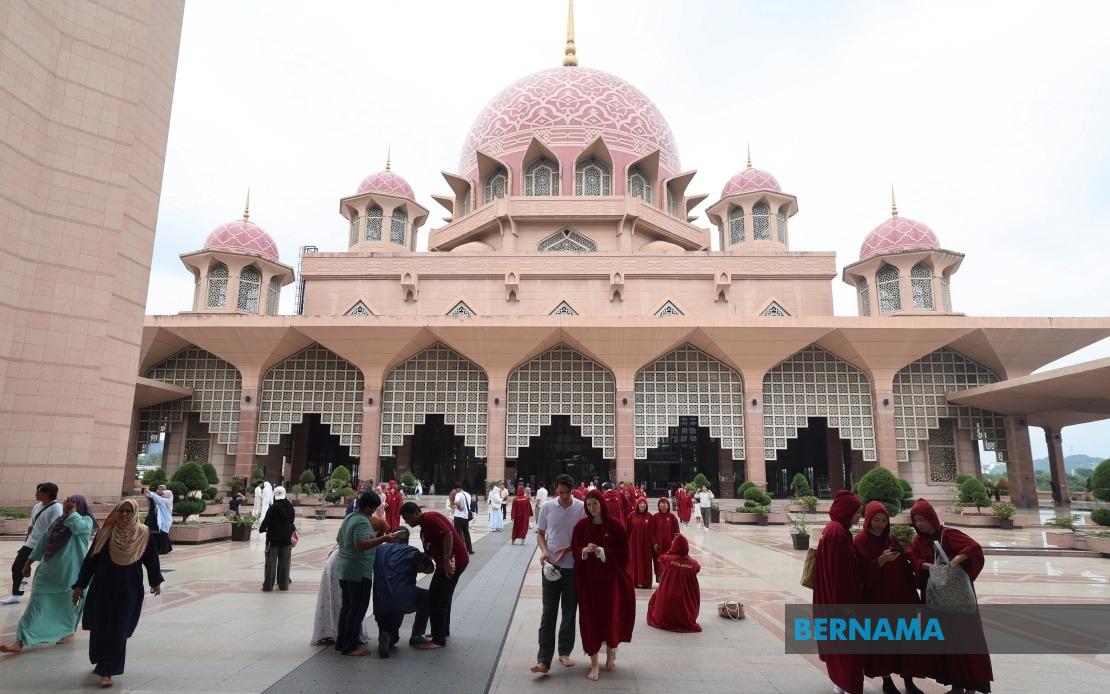
The Putra Mosque in Putrajaya became the focal point for Malaysia's observance of Maal Hijrah 1448H/2026M, drawing some 5,000 guests from across Malaysia and abroad for a significant religious and national celebration. Sultan of Perak Sultan Nazrin Shah presided over the event, which brought together government officials, diplomats, religious scholars and community leaders to commemorate the Islamic New Year and reflect upon the historical significance of Prophet Muhammad's migration to Medina.
The gathering represented a convergence of Malaysia's political and religious establishments. Among the high-level attendees were Deputy Prime Ministers Datuk Seri Ahmad Zahid Hamidi and Datuk Seri Fadillah Yusof, alongside numerous Cabinet ministers, foreign dignitaries, department heads and senior civil servants. This broad participation underscored the national importance accorded to Maal Hijrah, an occasion that transcends purely religious observance to encompass cultural and civic dimensions within Malaysia's Muslim-majority society.
Central to the ceremony was Sultan Nazrin Shah's royal address, a significant moment that carried particular weight given the sultanate's traditional custodial role over Islamic affairs in Malaysia's constitutional framework. The address provided an opportunity to articulate official perspectives on the relevance of the Hijrah narrative to contemporary Muslim societies and governance.
A cornerstone of the celebration involved conferring the National and International Tokoh Maal Hijrah Awards, honouring individuals who embody exceptional qualities aligned with Islamic leadership and development. These accolades are not distributed lightly; recipients must demonstrate comprehensive knowledge within their professional domains, exemplary moral character, and documented contributions toward advancing Islamic civilisation both domestically and on the global stage. The awards serve as recognition mechanisms for individuals who exemplify the integration of religious principles with tangible societal contributions.
The Department of Islamic Development Malaysia (JAKIM) deliberately selected this year's thematic framework to encourage Muslims to reconceptualise the Hijrah as more than a historical event. Instead, the emphasis centres on understanding Prophet Muhammad's migration as a pivotal moment that catalysed the development of Islamic civilisation itself. For contemporary Muslim communities, this messaging encourages reflection on how principles of migration, relocation and renewal might inspire spiritual and social transformation in modern contexts.
A notable innovation for this year's observance was the introduction of the Tausiyyah @ Maal Hijrah programme, held at Putra Mosque on the preceding day. This initiative shifted emphasis toward contemplative engagement with Quranic scripture, specifically through tadabbur—a practice emphasising deep reflection on Quranic verses rather than superficial recitation. Participants experienced Quranic recitations delivered by accomplished qari (reciters), yet the programme went beyond mere aesthetic appreciation of melodious rendition. Instead, it structured opportunities for attendees to grasp the underlying messages, extract moral wisdom and practical guidance embedded within the verses, and subsequently apply these teachings to their quotidian lives.
This pedagogical approach reflects evolving trends within Islamic education across Southeast Asia, where there is growing emphasis on making religious knowledge tangible and applicable rather than purely theoretical or ceremonial. The Tausiyyah programme exemplifies how Malaysia's religious institutions are adapting traditional Islamic learning methodologies to contemporary contexts, encouraging Muslims to view their faith as an active force for positive personal and communal change.
Further extending the celebration's reach and intellectual engagement was the scheduled National and International Tokoh Maal Hijrah Lecture 1448H/2026, to be conducted the following day at the Putrajaya Islamic Complex Auditorium. This forum provided award recipients with a platform to articulate and transmit their accumulated knowledge and lived experiences to broader audiences. Such lecture programmes serve dual purposes: they validate the standing and achievements of recognised Islamic leaders while simultaneously disseminating their insights and expertise to interested practitioners, scholars and students.
For Malaysia specifically, events of this magnitude underscore the nation's commitment to maintaining robust Islamic observances within a multicultural democratic framework. The involvement of federal and state-level leadership alongside international representatives reinforces Malaysia's positioning as a moderate Islamic nation and regional centre for Islamic thought and governance. The gathering at Putra Mosque represents the intersection of spiritual renewal and national identity, where religious significance aligns with state protocol and diplomatic engagement.
The emphasis on recognising both national and international contributors to Islamic advancement reflects Malaysia's aspiration to participate meaningfully in broader Muslim world discourses and leadership. By honouring individuals whose work transcends national boundaries, Malaysia signals its alignment with universal Islamic principles whilst maintaining distinct local religious institutional frameworks. For Southeast Asian observers, such celebrations demonstrate how Islamic observance can operate harmoniously within pluralistic governance structures and how religious occasions can catalyse meaningful dialogue among diverse stakeholder communities.
Looking forward, the Maal Hijrah observance exemplifies how Malaysia's religious administration continues evolving its approaches to Islamic practice and education. Rather than confining celebrations to ceremonial formalities, contemporary observances incorporate reflective, educational and intellectual dimensions that encourage believers to extrapolate theological principles into lived experience and social contribution. This multifaceted approach suggests emerging patterns in how Southeast Asian Islamic institutions are modernising traditional practices whilst preserving their essential spiritual and doctrinal content.