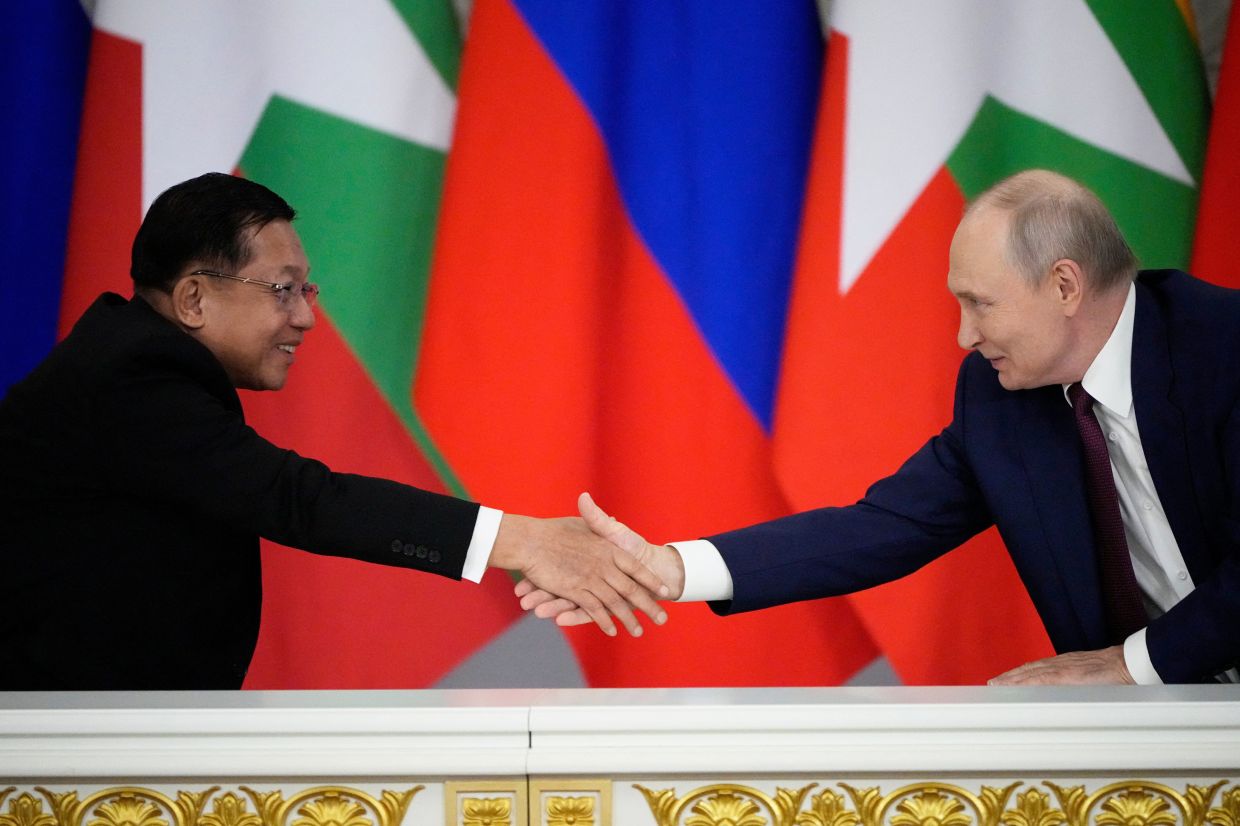
Russian President Vladimir Putin rolled out the diplomatic red carpet for Myanmar's Min Aung Hlaing during a high-profile Kremlin meeting on Tuesday, marking the Myanmar leader's first visit to Moscow since formally assuming the presidency in April. The encounter underscored Russia's commitment to maintaining its foothold in Southeast Asia despite widespread international isolation of Myanmar's military rulers, and signalled Moscow's determination to expand its influence through strategic partnerships in energy, defence and nuclear technology.
Putin characterised the bilateral relationship as having grown "especially trusting" in recent years, a phrasing that reflects the unusual closeness between the two governments at a time when most Western nations and their allies have distanced themselves from Myanmar's military establishment. The Russian leader's remarks came amid a broader diplomatic push by Min Aung Hlaing to rehabilitate his administration's international standing following a disputed election that drew criticism from Western democracies and the United Nations. For Russia, maintaining cordial ties with Myanmar serves strategic objectives beyond regional influence—the relationship provides Moscow with a foothold in a geopolitically significant corner of Asia as it navigates Western sanctions triggered by its invasion of Ukraine.
The substance of Putin's pitch to Min Aung Hlaing centred on ambitious infrastructure and resource development schemes. Russia has indicated interest in constructing a power plant and an oil refinery in southern Myanmar, while simultaneously seeking involvement in geological exploration and hydrocarbon extraction operations throughout the country. These economic ambitions reveal Russia's broader strategy of leveraging energy infrastructure projects as tools for deepening political relationships and securing long-term commercial advantages in regions where the West's influence has waned. For Myanmar, such partnerships offer access to capital and technical expertise at a time when international investment flows have been constrained by sanctions concerns.
Nuclear cooperation forms a particularly significant pillar of the Russia-Myanmar partnership. Myanmar is advancing plans with Russia's Rosatom State Corporation to develop a small nuclear power plant, a facility intended to serve as the foundation for applying nuclear technology across the healthcare, agricultural and industrial sectors. This collaboration reflects a broader pattern in which Russia has positioned itself as a reliable alternative partner for countries seeking to pursue nuclear programmes without facing the stringent conditions typically imposed by Western-aligned international institutions. The nuclear dimension also carries strategic implications, as it deepens Myanmar's technological dependence on Russia and reinforces political alignment between Naypyidaw and Moscow.
Defence cooperation represents another cornerstone of the bilateral relationship. Putin explicitly referenced Moscow's establishment of "close military and military-technical cooperation" with Myanmar, a characterisation supported by documented arms sales worth more than US$400 million since Myanmar's 2021 coup, according to United Nations assessments released in May 2023. Russia has emerged as Myanmar's primary advanced weapons supplier precisely because Western nations have largely ceased military assistance to the country following the military takeover. This dynamic has created a situation in which Myanmar's armed forces have become increasingly dependent on Russian military hardware and training, a dependency that translates into sustained political leverage for Moscow in regional affairs.
The delegation accompanying Min Aung Hlaing to Moscow underscored the comprehensive nature of the engagement. Beyond the president himself, the visiting party included multiple cabinet ministers and the head of Myanmar's Space Agency, alongside senior officials from defence, financial and energy sectors. This breadth of representation reflected Putin's mobilisation of his own government machinery, with the Russian president flanked by high-ranking officials overseeing foreign policy, defence, energy and financial matters. Min Aung Hlaing also utilised his Moscow visit to meet Prime Minister Mikhail Mishustin and Vyacheslav Volodin, the speaker of Russia's lower house, while participating in a Myanmar-Russia Business Forum designed to foster commercial linkages between the two nations.
The timing of this meeting carries particular significance within the context of Min Aung Hlaing's broader diplomatic offensive. Since his election as president, the Myanmar leader has embarked on an extensive round of international travels, visiting China, India, Laos and Thailand in efforts to secure greater acceptance of his administration and counter perceptions of isolation. These efforts reflect the military government's recognition that while Russia remains a reliable ally, Myanmar requires broader international engagement to sustain its economy and legitimacy. Russia's willingness to host Min Aung Hlaing prominently sends a signal to other nations that Myanmar's military leadership remains viable as a partner despite international criticism of the 2023 election's legitimacy.
Putin's emphasis on liquefied natural gas cooperation possibilities suggests that Russia perceives opportunities for positioning Myanmar as a potential hub or transit point for energy exports to regional markets. Such positioning would advance Moscow's strategic objective of reducing its dependence on European energy markets while simultaneously enhancing Myanmar's role as a critical node in Asian energy infrastructure. The prospect of LNG cooperation also reflects the practical constraints Russia faces in pursuing traditional energy exports to Western buyers, necessitating a reorientation toward Asian markets where political relationships remain less fraught.
This represents at least the fourth meeting between Min Aung Hlaing and Putin since Russia's invasion of Ukraine in February 2022, with the previous encounter occurring at the World Atomic Week Forum in Moscow during September. The frequency of these high-level engagements reflects the priority both governments assign to their relationship, despite the dramatic geopolitical shifts triggered by the Ukraine conflict. In February, Putin's senior security aide Sergei Shoigu had travelled to Myanmar, becoming the first major foreign official to visit following the controversial 2023 election—a symbolic gesture that underscored Russia's willingness to validate the military government's legitimacy when most other significant powers maintained distance.
For Malaysian and broader Southeast Asian observers, the strengthening Russia-Myanmar nexus carries important implications. The deepening partnership demonstrates how regional countries facing Western isolation can rapidly pivot toward alternative partnerships with non-aligned or competing powers, thereby complicating regional dynamics. Myanmar's strategic location, its resource endowments, and its importance to China have made it a focal point for great power competition that extends beyond traditional Cold War frameworks. As Russia expands its footprint in Myanmar through infrastructure, military sales and nuclear cooperation, it simultaneously constrains the flexibility of Southeast Asian nations navigating between the interests of established powers and rising alternatives.
The absence of meaningful Myanmar government engagement with Western nations on economic cooperation also suggests that isolation carries consequences that reorient such countries toward partners willing to disregard international criticism. For Asean, Myanmar's trajectory illustrates the limitations of consensus-based diplomatic pressure when powerful alternative patrons stand ready to provide strategic support. Russia's willingness to invest in Myanmar despite international condemnation of the military government reflects a broader pattern in which geopolitical competition increasingly trumps human rights and democratic governance concerns in determining international partnerships. This dynamic has implications for regional stability and the future orientation of Southeast Asian security architectures.

