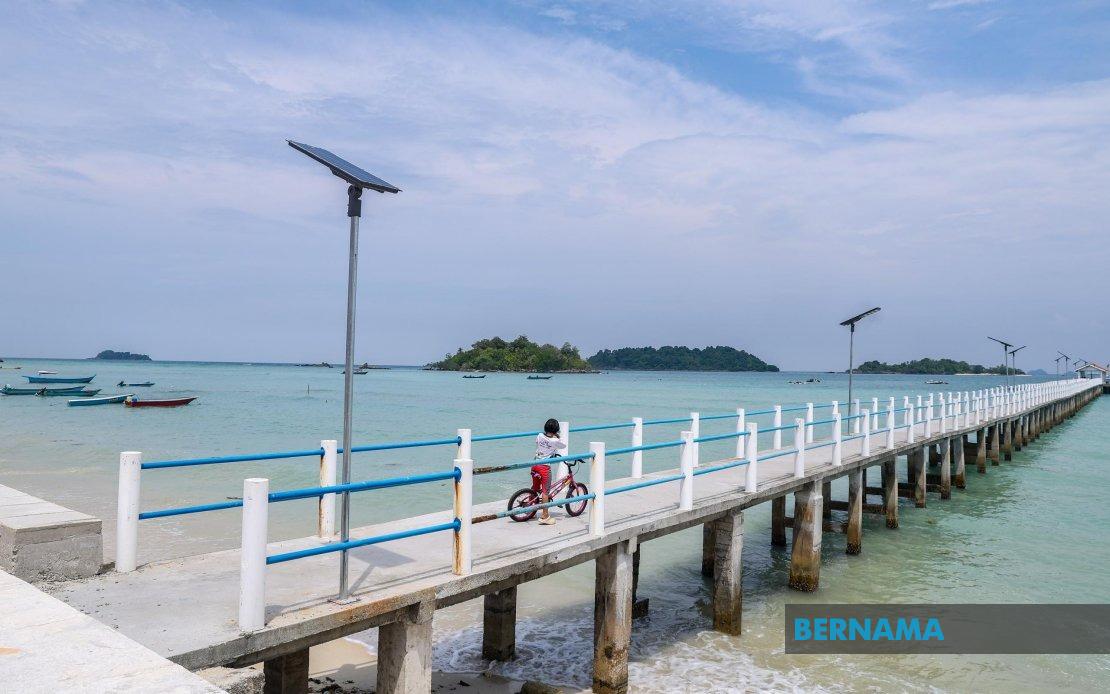
The small island community of Pulau Tinggi, located off the coast of Mersing, has made clear its expectations for the incoming Johor state representative, focusing attention on two critical issues that have plagued the locality for years: the urgent need to rehabilitate a crumbling jetty facility and the provision of housing support for economically disadvantaged fishing families. With approximately 2.7 million eligible voters across Johor preparing to cast ballots on Saturday to elect 56 state lawmakers, residents of this island settlement are among those hoping that infrastructure and social welfare will receive priority attention in the new administration's agenda.
The roughly 150-strong population scattered across Kampung Pasir Panjang and Kampung Tanjung Balang has identified the Kampung Pasir Panjang jetty as a matter of particular urgency. Originally serving as a vital access point for both tourism activity and the island's fishing community, the structure has deteriorated markedly since around 2017, leaving its daily users navigating safety risks that have persisted without resolution. Rossana Hussin, the 57-year-old village chief who assumed the role in 2024, explained that while residents continue to utilise the jetty despite its condition, they remain in a precarious situation awaiting government intervention. Applications for the jetty upgrade project were formally submitted to the Mersing District Office in March of this year and have apparently received positive signals from officials, yet the community remains uncertain about timelines and commitment levels.
Beyond physical infrastructure, the housing predicament affecting Kampung Tanjung Balang's B40 fishermen families represents another layer of hardship that local leaders believe warrants immediate attention from incoming state representatives. Rossana noted that many residents require either substantial housing repair assistance or completion of home renovation projects that have stalled due to financial constraints. The village chief framed these interventions not merely as welfare handouts but as investments in community wellbeing that would reduce financial strain on families already struggling with the irregular income patterns characteristic of fishing livelihoods.
The economic composition of Pulau Tinggi underscores why these specific demands carry such weight. The majority of the island's residents derive their income from fishing activities, placing them squarely within the bottom 40 percent income bracket that qualifies for government assistance schemes. Unlike more urbanised constituencies where diverse economic activities provide resilience, Pulau Tinggi's economy remains heavily dependent on maritime work, making residents particularly vulnerable to fluctuating catch volumes, fuel price volatility, and seasonal variations in tourist arrivals. This economic concentration explains why housing security and basic infrastructure quality have become central election-time grievances.
Rossana's comments during this election period also hint at broader demographic challenges affecting the island. She referenced the historical reality that Pulau Tinggi once supported a larger resident population that has since dwindled through outmigration. Young people, in particular, have moved away in search of employment opportunities in mainland Johor or have relocated to federal land development schemes such as Felda holdings. This exodus represents not merely a shift in population statistics but a gradual weakening of the island's social fabric and economic viability. Without targeted intervention to create local employment opportunities and improve living standards, this trend threatens to accelerate further depopulation.
Eighty-five-year-old Mariam Mamat articulated a vision that connects infrastructure development to economic revitalisation. She emphasised that rehabilitation of the jetty and resolution of housing issues should be accompanied by a concerted effort to revive Pulau Tinggi's tourism potential, which historically attracted visitors and provided supplementary income for island households. Her observation that fewer residents now call the island home, with many having departed in pursuit of employment elsewhere, reflects the interconnection between infrastructure quality, employment availability, and residential stability. From her perspective, the incoming state representative must adopt a holistic approach that simultaneously addresses immediate welfare needs while creating sustainable economic opportunities for younger generations.
The timing of these community demands carries particular significance within Malaysia's political calendar. The 16th Johor state election falls during a period of heightened public expectations regarding service delivery and development priorities. For constituencies comprising geographically isolated communities such as Pulau Tinggi, election campaigns represent rare moments when political representatives concentrate attention on localised grievances that might otherwise receive minimal consideration. Village leaders like Rossana have clearly understood this opportunity, framing their requests to elected officials in concrete, measurable terms that reference specific submission dates and office interactions, thereby creating accountability benchmarks against which future performance can be assessed.
The broader implications of Pulau Tinggi's situation extend beyond a single island community. Johor contains numerous coastal and island constituencies where fishing-dependent populations face comparable challenges of infrastructure decay and limited economic opportunity. The manner in which the incoming state government addresses issues like those raised by Pulau Tinggi residents will establish important precedents regarding the administration's commitment to peripheral communities and lower-income groups. Residents and observers across comparable constituencies will be watching closely to discern whether promises made during the election campaign translate into accelerated action once representatives assume office.
From a policy perspective, the Pulau Tinggi case study illuminates the importance of coordinated governance across multiple administrative levels. Both the Mersing District Office and the state government must align their development planning and budgeting processes to ensure that positive feedback at the district level translates into actual project implementation at the state level. Rossana's hope that the elected Tenggaroh state representative will serve as a coordinator connecting island residents with relevant governmental agencies reflects a realistic understanding that local-level persistence alone cannot overcome bureaucratic inertia or budgetary constraints without political backing.
The infrastructure and housing issues affecting Pulau Tinggi also reflect the need for more proactive, anticipatory governance frameworks. Rather than waiting for applications to be formally submitted before addressing deteriorating public facilities, development-oriented administrations might conduct regular assessments of infrastructure conditions across all constituencies and prepare preventive maintenance budgets that arrest decay before structures reach crisis stages. Similarly, housing assistance programmes might employ more systematic identification of eligible households facing immediate hardship, reducing delays between application submission and assistance disbursement.
As the election approaches and attention focuses on promises and campaign pledges, Pulau Tinggi's residents have articulated their priorities with measured clarity: restore the jetty that enables commerce and connectivity, provide housing support that alleviates poverty-driven hardship, and create economic conditions that allow young people to build sustainable livelihoods without departing the island. These demands speak to fundamental expectations of governance—that elected representatives will acknowledge historical neglect, prioritise tangible improvements in community conditions, and demonstrate through concrete action that island residents matter equally to the state's development agenda as their more numerous mainland counterparts. Whether the incoming Johor administration rises to meet these expectations will significantly influence both the island's trajectory and public confidence in the democratic process itself.

