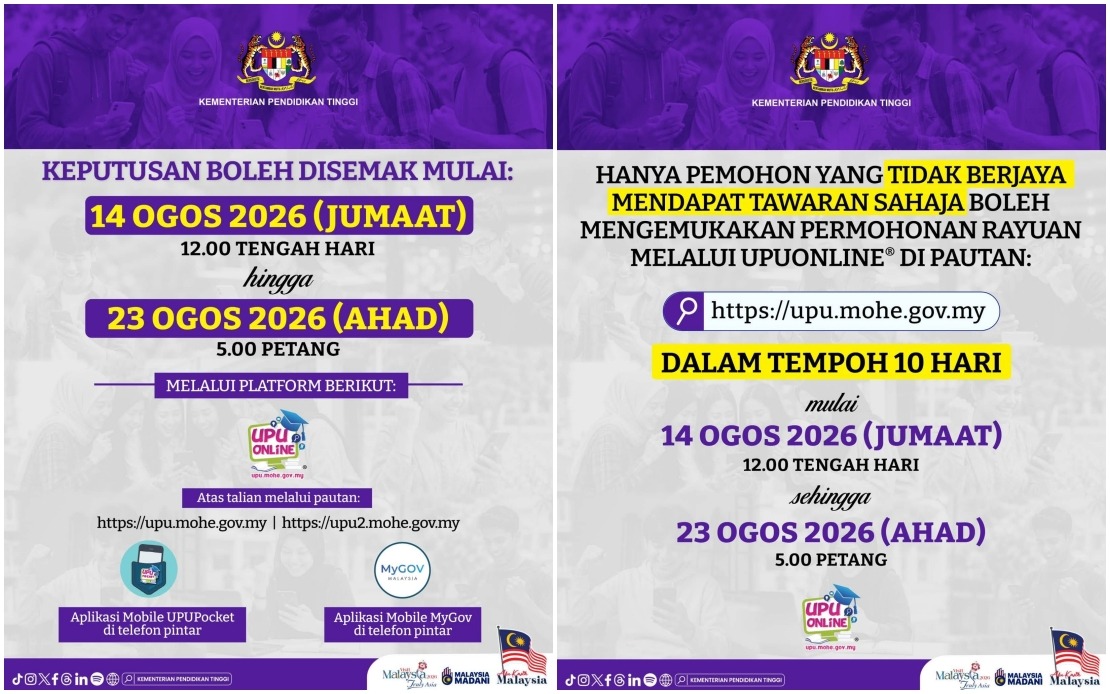
Malaysian students holding STPM or equivalent qualifications will learn their public university placement outcomes on August 14, when the Ministry of Higher Education releases admission results through multiple online channels. The announcement, made by the ministry in Putrajaya, marks a critical juncture for tens of thousands of school leavers seeking entry into the country's autonomous universities for the 2026/2027 academic session.
Prospective undergraduates can access their results beginning at noon on August 14 through a window that extends until 5 pm on August 23. The ministry has established three primary digital access points to manage the anticipated surge in traffic: the main UPUOnline portal at https://upu.mohe.gov.my, a secondary server at https://upu2.mohe.gov.my, and dedicated mobile applications including UPUPocket and MyGov available on smartphones. This multi-platform approach reflects lessons learned from previous admission cycles when single portals became overwhelmed, causing frustration among anxious applicants.
The confirmation phase follows immediately, with successful candidates required to formally accept or reject their offers between August 15 and August 23 through individual university websites. This nine-day window is deliberately tight, designed to maintain momentum in the enrollment process while allowing universities sufficient time to process acceptances before the academic year begins. Applicants who fail to confirm their acceptance within this period risk forfeiting their places, a consequence the ministry has emphasized in previous cycles to discourage procrastination.
Universities will begin issuing official offer letters to successful candidates on August 15, contingent upon each student confirming their willingness to accept the placement. These physical or digital documents serve as formal contracts between the institution and the student, establishing enrollment rights and academic obligations. The coordination between centralized UPU processing and individual university communications can sometimes create delays, but the August 15 start date provides a buffer before confirmation deadlines expire.
Applicants who do not receive an offer face a structured appeals process rather than automatic rejection. From August 14 to August 23, unsuccessful candidates may submit formal appeals through UPUOnline seeking reconsideration for vacancies that emerge following the main intake. Historically, these appeals processes yield placements for 5-10 percent of applicants, depending on program popularity and institutional capacity. The appeals track the same online infrastructure, meaning rejected candidates can monitor both their original result and any appeal outcome through familiar portals.
Crucially, the ministry has stipulated that placement offers for the 2026/2027 session are final and non-transferable. Students cannot request switches between different universities or undergraduate programs after receiving their initial allocations. This policy, criticized by some as inflexible, serves administrative efficiency by preventing cascading changes that would destabilize enrollment planning. However, the appeal mechanism provides partial recourse for genuinely unsuitable matches, allowing students with extenuating circumstances to seek alternative placements from available vacancies.
The appeal selection process operates under strict vacancy-based parameters. Universities can only fill appeal positions once new student registration is completed, meaning the pool of available spaces depends entirely on how many primary offer holders actually enroll. This creates unpredictability for appeal applicants, who may discover that their preferred program has become unavailable despite apparent capacity. The ministry has faced persistent pressure to increase transparency around vacancy projections, though detailed figures remain difficult to predict until late in the enrollment cycle.
For Malaysian applicants, this intake represents one of two major university entry points annually, alongside the separate pathway for Matriculation Program graduates. The public university system, comprising 20 autonomous institutions, has become increasingly selective as applications have risen faster than available places. STPM holders represent the traditional "academic stream" of secondary education, distinct from the vocational pathways, and tend to concentrate in high-demand fields including engineering, medicine, and business programs where competition is fiercest.
Regionally, Malaysia's centralized university admission system is relatively efficient compared to neighboring countries, though the August results timeline extends considerably beyond academic commencement dates in some programs. The September-October start date for most undergraduate courses means students have substantial time to arrange accommodation and prepare financially. However, international applicants and those from rural areas sometimes face logistical challenges during this compressed timeline, particularly regarding housing deposits and orientation schedules.
Prospective students who neither receive an initial offer nor succeed in appeals will need to explore alternative pathways, including private university options, diploma programs with articulation pathways, or workforce entry. The ministry has invested in guidance counseling resources to assist these students, recognizing that public university rejection carries significant psychological weight in Malaysian society where university qualification remains a primary criterion for graduate employment and social mobility.
Parents and educators have already begun preparing students for the August 14 announcement date, with schools organizing viewing sessions on institutional websites to help applicants understand campus facilities and program structures. This preparation phase, often called the "offer period orientation," helps students make rapid decisions during their compressed nine-day confirmation window. The ministry's decision to publicize dates well in advance has reduced previous complaints about insufficient notice, though some institutions continue to refine their digital infrastructure ahead of the anticipated traffic surge.

