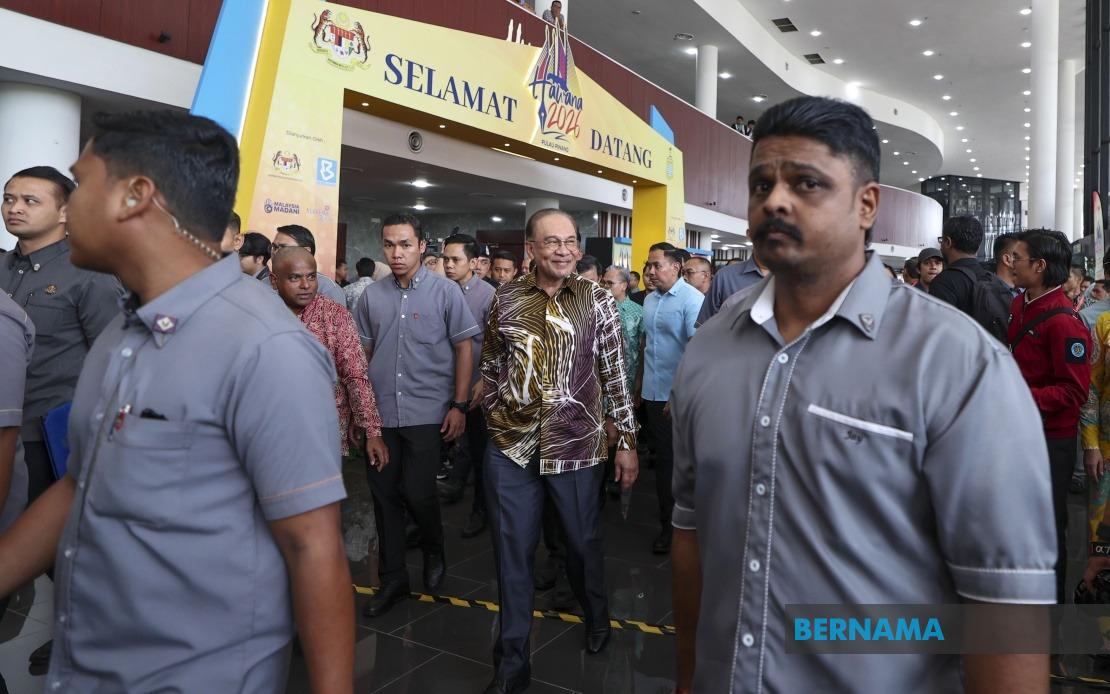
Prime Minister Datuk Seri Anwar Ibrahim arrived at the PICCA Convention Centre @ Butterworth Arena on June 20 to officiate the main event of the National Journalists' Day (HAWANA) 2026 celebration, marking a significant occasion for Malaysia's media community. His presence at the Penang-based gathering underscores the government's commitment to honouring journalism as a pillar of democratic discourse in the country. The Prime Minister was received upon arrival by Penang Chief Minister Chow Kon Yeow, Communications Minister Datuk Fahmi Fadzil, and Communications Ministry secretary-general Datuk Abdul Halim Hamzah, reflecting the official stature accorded to the event.
Taking full advantage of his visit to the venue, Anwar Ibrahim toured the exhibition booths and HAWANA 2026 Photo Gallery displayed in the foyer, demonstrating direct engagement with the contributions and initiatives being showcased by Malaysia's media fraternity. The walkthrough provided an opportunity for the Prime Minister to interact with journalists and media organisations displaying their work and developmental achievements. This kind of visible engagement by the nation's top elected official carries symbolic weight, reinforcing governmental recognition of the media sector's importance to national narrative-building and accountability mechanisms.
The gathering drew prominent figures from Malaysia's news establishment, including Malaysian National News Agency (Bernama) chairman Datuk Seri Wong Chun Wai, chief executive officer Datin Paduka Nur-ul Afida Kamaludin, and editor-in-chief Arul Rajoo Durar Raj. Their attendance alongside government ministers and international delegates created a high-level forum for discussion on the future direction of journalism and media practices across the region. Bernama, as the principal implementing agency alongside the Ministry of Communications, has positioned this year's celebration as a platform for advancing professional standards and collective reflection on the media's evolving role in contemporary society.
One of the most notable aspects of HAWANA 2026 was its regional dimension, attracting delegates from across Southeast Asia and beyond. Timor-Leste's delegation included Secretary of State for Social Communication Expedito Loro Dias Ximenes, alongside representatives from Cambodia, Laos, and other ASEAN neighbours. The presence of Cambodia's Undersecretary of State at the Ministry of Information Prak Thaveak Amida and Laos' Permanent Secretary of the Cabinet Office Phuangpasert Keosouvanh illustrated the event's function as a platform for diplomatic and professional exchange among regional media authorities. Additionally, international media organisations such as Indonesia's Antara News Agency, the Vietnam News Agency (VNA), and China's Xinhua News Agency sent representatives, demonstrating the gathering's recognition as an important convening point for Asian journalism communities.
The event welcomed approximately 1,000 media practitioners from Malaysia and abroad, creating an unprecedented gathering of journalists, editors, and media executives focused on shared professional challenges and opportunities. This scale of participation suggests that HAWANA 2026 has succeeded in positioning itself as a significant industry event capable of drawing both established and emerging voices in the media landscape. The convergence of such diverse participants provides opportunities for networking, knowledge exchange, and the establishment of collaborative relationships that can strengthen journalism across the region and beyond.
The overarching theme of HAWANA 2026, "Media Integrity Strengthens Credibility," addresses one of the most pressing concerns facing journalism in the digital age. As misinformation and disinformation proliferate across social media platforms and online channels, the emphasis on integrity serves as a clarion call for media practitioners to uphold editorial standards, fact-checking disciplines, and transparent sourcing practices. For Malaysian readers and media consumers, this thematic focus carries particular relevance given ongoing national conversations about information reliability and the public's ability to distinguish credible reporting from false narratives. By centering integrity, the event acknowledges that journalism's societal value depends fundamentally on the trustworthiness of what practitioners produce and disseminate.
During the ceremony, Prime Minister Anwar Ibrahim was scheduled to present the HAWANA Award and the Special HAWANA Award to individuals who have demonstrated exceptional dedication to journalism and contributed meaningfully to the development of public thought. These recognitions serve not merely as ceremonial honours but as institutional affirmations of excellence within the profession. By highlighting individual achievements, the awards mechanism encourages aspiring journalists and reinforce professional standards across the industry. The presentation of these accolades by the nation's top executive carries particular weight, signalling that the government and the state regard journalistic excellence as worthy of official recognition and celebration.
Beyond awards, the Prime Minister also distributed contributions from the Kasih@HAWANA Fund to deserving media veterans, a gesture that acknowledges the career sacrifices and contributions of those who have spent decades in the profession. This welfare component of the celebration reflects a broader social contract between the state and media practitioners, recognising that journalism can exact personal and financial costs. Supporting veteran journalists, many of whom may face financial hardship in their later years, demonstrates a commitment to safeguarding the wellbeing of those who have served the profession. For Malaysia's media community, such gestures reinforce the message that professional commitment to journalism is valued and that practitioners need not fear destitution following their active careers.
The HAWANA celebration has been organised by the Ministry of Communications with Bernama serving as the principal implementing agency, a structural arrangement that positions Malaysia's state news agency as the custodian of professional standards within the industry. This arrangement reflects the historical role Bernama has played as both a news provider and a standard-setter for journalistic practice in Malaysia. By entrusting Bernama with organisational responsibilities, the government has signalled its confidence in the agency's ability to lead professional discourse and facilitate industry development. However, this arrangement also raises questions about the relationship between state institutions and editorial independence—a tension that remains pertinent in discussions about media freedom and autonomy in Malaysia.
From a regional perspective, HAWANA 2026's success in attracting delegates from across ASEAN and beyond demonstrates Malaysia's positioning as a centre for media dialogue and professional development in Southeast Asia. The event provides a forum where journalists and media authorities from countries with varying political systems and press freedom records can engage in substantive discussions about professional standards, ethical practice, and the role of media in democratic societies. For Malaysian media practitioners, this international exposure offers opportunities to benchmark their work against regional counterparts and to participate in shaping regional journalism discourse. It also reflects Malaysia's broader aspiration to play a leadership role in regional affairs, extending beyond political and economic spheres into the cultural and professional domains that shape public discourse.
The significance of holding HAWANA 2026 in Penang, rather than in the capital, also warrants consideration. The Butterworth location underscores the government's recognition that media excellence and professional development extend beyond Kuala Lumpur and the federal centre. Penang, with its long history as a publishing and media hub, provides an apt setting for a national journalists' celebration. This geographic distribution of major national events also serves a symbolic function, reinforcing the idea that Malaysia's institutions and celebrations belong to all regions and that professional excellence is not concentrated in the capital city. For readers and media practitioners in states beyond the federal territories, hosting significant events in regional centres sends a message of inclusion and recognition.
Looking forward, the themes and discussions emerging from HAWANA 2026 will likely influence journalistic practice and professional standards across Malaysia and the region for years to come. The emphasis on media integrity as the foundation of credibility suggests that the industry is acknowledging the need to rebuild and strengthen public trust in news media at a time when traditional journalism faces unprecedented challenges from digital disruption, economic pressures, and the proliferation of competing information sources. For Malaysian media organisations and practitioners, engaging seriously with these discussions and implementing lessons learned from the celebration can contribute to the profession's long-term sustainability and societal relevance. As the media landscape continues to evolve, events like HAWANA serve as important moments for the industry to pause, reflect, and reaffirm shared commitments to professional excellence and public service.

