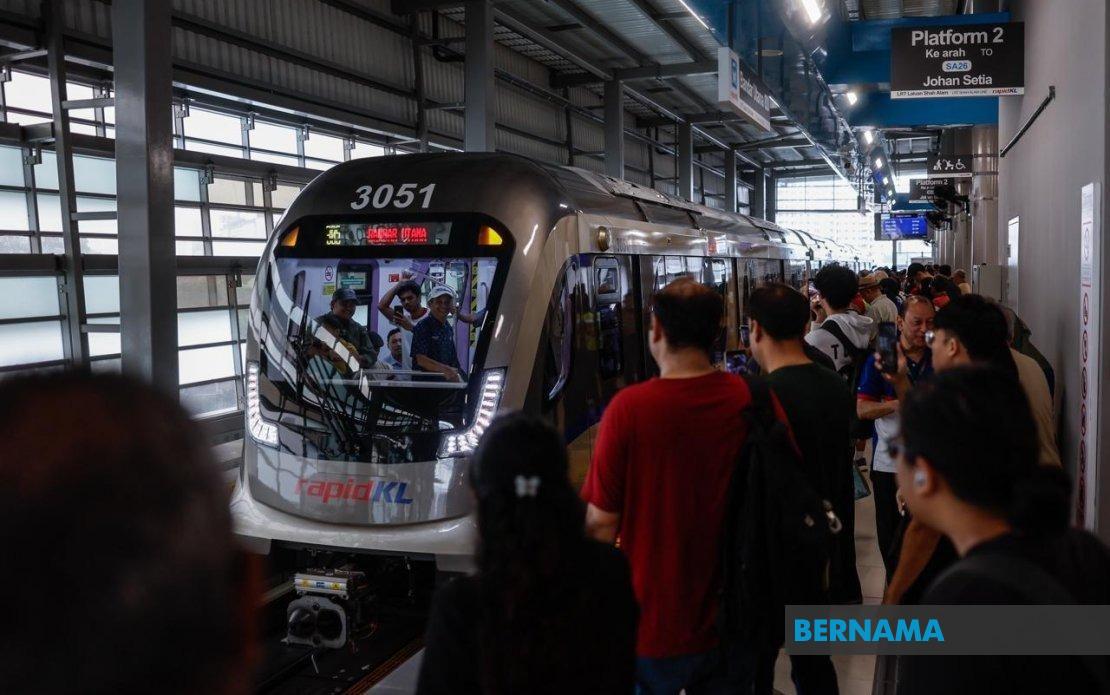
The Light Rail Transit 3 Shah Alam Line commenced operations at 6 am today, marking a significant expansion of Malaysia's public transportation network in the Selangor region. Prasarana Malaysia Berhad, the state-owned operator managing the service, estimates that between 5,000 and 10,000 passengers will travel on the new line during its opening day, a measured starting point for infrastructure that represents years of planning and investment in urban mobility.
Amir Hamdan, Prasarana's president and chief executive officer, has outlined an ambitious yet realistic trajectory for ridership growth. The operator projects daily passenger numbers will climb progressively toward a target of 67,000 within the first year of operations. This gradual increase reflects standard adoption patterns when new transport corridors debut; commuters typically require time to integrate fresh services into their travel routines and become familiar with stations, connections, and timetables. The projection acknowledges that early-stage usage figures rarely mirror eventual steady-state demand, a principle Prasarana appears to have learned from operating other lines across the Klang Valley.
The Shah Alam Line represents a crucial addition to the region's transit ecosystem, particularly for commuters seeking alternatives to private vehicle use. Initial feedback from passengers has been notably positive, with social media and direct comments reflecting appreciation for a more comfortable commuting option that sidesteps the perpetual congestion plaguing major highways and arterial roads in the Shah Alam and surrounding areas. This sentiment carries weight beyond mere convenience; reduced traffic congestion translates into lower emissions, decreased fuel consumption, and improved air quality for the broader metropolitan population. For a city wrestling with urban sprawl and transportation bottlenecks, the LRT3 offers potential relief that extends beyond individual rider satisfaction.
Operationally, Prasarana reports smooth performance throughout opening day, with train frequency set at approximately eight-minute intervals during peak periods. This headway—the time between successive vehicles—represents a standard approach for rapid transit systems in the region, balancing capacity needs against infrastructure constraints and operational costs. The operator has confirmed that all station facilities are functioning as designed, an important baseline for a service launch where technical glitches could undermine public confidence in the system's reliability and readiness.
Two interchange stations warrant particular attention in Prasarana's monitoring strategy. Glenmarie 2 serves as a connection point to the Kelana Jaya Line, one of the network's busiest corridors, while Bandar Utama links to the Kajang Line, another high-traffic route. These hubs are critical to the Shah Alam Line's viability; their ability to efficiently manage transfers and distribute passenger flows will largely determine whether the new route achieves its ridership targets. Prasarana's explicit focus on these junctions suggests awareness that network integration, not isolation, drives successful transit adoption.
The operator is currently prioritising fundamental elements of passenger experience during this early phase. Automatic fare gates, ticketing machines, and general station flow patterns are being continuously assessed. This methodical approach contrasts with the temptation to introduce bells and whistles prematurely; Prasarana appears committed to perfecting basics before layering additional refinements. Should demand warrant it, the operator stands ready to increase train frequency or introduce reserve stock positioned along high-demand segments during rush hours, scaling the service responsively rather than reactively.
One question that has not yet prompted action is the introduction of women-only coaches, a feature present on some transport systems globally and in parts of Asia. Prasarana has indicated no immediate need for such segregation but has signalled willingness to conduct studies as ridership patterns and user feedback accumulate. This measured stance allows data rather than assumption to guide policy, though it also leaves unexamined whether demand for dedicated-use coaches exists among Shah Alam Line's female commuters. Future decisions will likely rest on actual feedback rather than speculation.
A decisive factor in the Shah Alam Line's launch appeal is the one-month free-travel promotion announced by Prime Minister Datuk Seri Anwar Ibrahim. This initiative extends to all LRT3 services and includes Prasarana-operated feeder buses, running from today through July 31. Free fares remove initial cost barriers and encourage trial usage among potential commuters who might otherwise defer making the switch from personal vehicles. The subsidy effectively functions as a marketing campaign and demand-stimulation tool, offering Prasarana valuable data on peak usage windows, station preferences, and emerging travel patterns without requiring riders to commit financially upfront.
The Shah Alam Line's opening underscores Malaysia's ongoing investment in urban rail infrastructure, a sector that has experienced substantial development over two decades. For the Klang Valley specifically, the new line represents incremental progress toward a more integrated and comprehensive transit network, though challenges remain in achieving true system-wide connectivity and frequency that rivals the region's increasingly competitive regional competitors. The line's success will be measured not merely by opening-day crowds but by whether it sustains and grows its ridership base once initial novelty fades and commuters make permanent mode-shift decisions. Prasarana's patient approach to forecasting and scaling suggests the operator understands that durability matters more than spectacle in modern public transport. The coming months will reveal whether the Shah Alam Line becomes an essential artery in the region's mobility fabric or a moderately used peripheral service.

