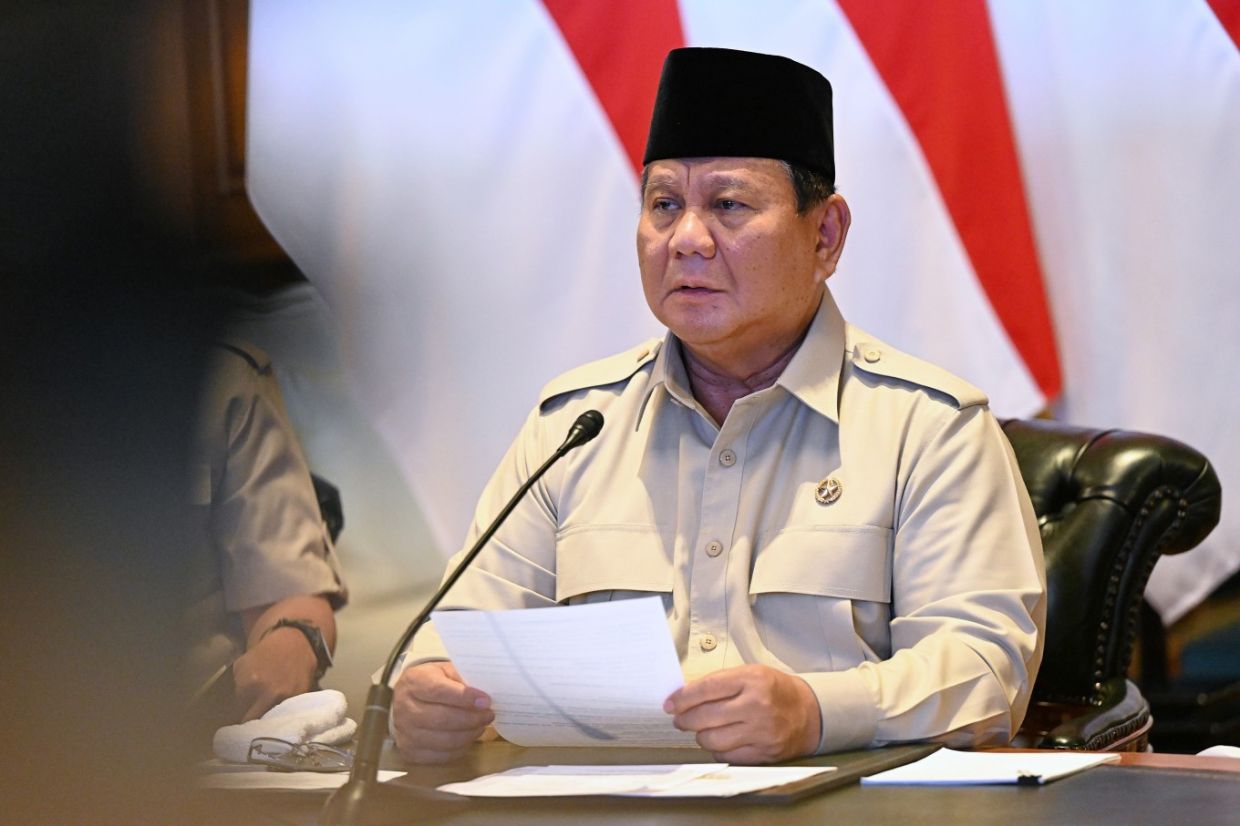
President Prabowo Subianto's exceptionally long political honeymoon has definitively ended, with his approval rating plummeting to 51.1 per cent in July 2026 according to the latest survey from Saiful Mujani Research and Consulting (SMRC), a sharp decline from the 81.2 per cent recorded just nine months earlier in November 2025. The fall from grace represents a seismic shift in public sentiment and marks a turning point in his presidency, even as the current level remains respectable by international standards and suggests Prabowo retains a narrow plurality of public support.
What made Prabowo's extended period of high approval ratings so unusual was not simply the bounce any newly elected leader typically receives, but rather the sheer duration and resilience of that support. The Indonesian president sustained ratings in the 70-80 per cent range throughout 2025, a plateau that even his predecessor Joko "Jokowi" Widodo failed to reach until deep into his second presidential term, when SMRC recorded Widodo's personal best of 81.7 per cent in May 2023. This historical context underscores just how formidable Prabowo's initial political position was, and conversely, how significant the current decline appears in comparative terms.
Multiple factors sustained Prabowo's popularity during his first year in office. Beyond the natural tailwinds that accompany victory at the ballot box, the administration implemented high-visibility social spending programmes designed to deliver tangible benefits to ordinary Indonesians. Most prominently, the free nutritious meal initiative launched in January 2025 captured public imagination and delivered on a core campaign promise. These programmes appeared to function as a form of political capital, extending goodwill at a time when voters might otherwise have begun scrutinising whether other campaign pledges were materialising.
The comparison with Prabowo's immediate predecessor illuminates how dramatically different trajectories can be. Jokowi's first term began at a comparable starting point with 62 per cent approval at inauguration, but then collapsed dramatically in the early months when a controversial fuel price increase triggered public backlash, sending his ratings plummeting to just 41 per cent according to Indikator data. Prabowo avoided any such early self-inflicted wound, instead managing his initial political capital with considerably more finesse. However, the current nine-month drop of 30 percentage points now approaches the scale of damage that fuel prices inflicted on his predecessor, suggesting that the honeymoon's end may be arriving through economic pressures beyond the government's immediate control.
From a regional and international perspective, Prabowo's current approval rating, while diminished, actually compares favourably to recent precedent among major world leaders. When Donald Trump began his second term as United States president in January 2025, he started with a historically low 47 per cent approval rating, while both Barack Obama and Joe Biden experienced steep early declines from their opening highs. Neither approached Prabowo's sustained 70-80 per cent plateau during his first year. This suggests that what Indonesia is experiencing is less an exceptional crisis and more a reassertion of normal democratic patterns, where initial enthusiasm gradually gives way to hardened partisan divides and performance-based judgement.
The underlying drivers of Prabowo's declining approval appear rooted in a widening chasm between campaign promises and measurable results. The President committed to aggressive corruption crackdowns and an ambitious target of lifting Indonesia's gross domestic product growth rate from the current range around 5 per cent to a more ambitious 8 per cent. These commitments are now being tested against tangible economic headwinds, including a weakening rupiah currency, sluggish stock market performance, and growing public anxieties about the sustainability of government spending and the independence of the central bank. For many ordinary Indonesians, these macroeconomic concerns translate into pocketbook issues: employment prospects, purchasing power, and the durability of programmes like subsidised meals.
SMRC's July 2026 survey, conducted between July 5-19 among 749 respondents, provides granular detail on the nature of public discontent. Dissatisfaction with Prabowo's performance surged to 46.9 per cent from approximately 16 per cent in November, indicating a nearly tripling of negative sentiment within a compressed timeframe. SMRC executive director Deni Irvani attributed this decline to deteriorating public perceptions across three critical domains: the economy, the political environment, and law enforcement. Specifically, positive assessments of economic conditions stood at just 15.7 per cent in July, while optimistic views of the political situation collapsed from 35.8 per cent in November to only 13.5 per cent by July. Perceptions of law enforcement performance proved more resilient at 26.4 per cent positive, but still reflected significant room for improvement.
Prabowo has not passively accepted the decline in his approval ratings. The President maintains a highly visible public profile through frequent televised speeches and a sophisticated communications apparatus designed to keep him prominent in media coverage and public consciousness. His willingness to respond directly and forcefully to critics, including journalists and political opponents, reflects a strategy aimed at dominating the narrative and maintaining control over the public conversation. This approach yielded dividends during the honeymoon period, when underlying economic conditions were stable enough that rhetorical force could fill gaps between promises and delivery. However, the July data suggest a ceiling has been reached beyond which greater media visibility cannot compensate for deteriorating lived experience among voters.
Criticism from rival political actors has focused on SMRC founder Saiful Mujani's increasingly vocal stance as a government critic, with officials from Prabowo's Gerindra Party questioning whether polling methodology might reflect the pollster's personal political preferences. This objection merits acknowledgement, though it does not automatically invalidate the findings. SMRC has maintained a reputation for methodological credibility over many years, including periods when its surveys produced results favourable to the previous Jokowi administration. More persuasively, SMRC's findings are not anomalous within the Indonesian polling landscape. Indikator Politik Indonesia, an independent survey organisation, conducted a larger poll of 4,250 respondents between July 14-24 and obtained strikingly similar results: satisfaction at 49.5 per cent, down from 68 per cent in April and 81 per cent in December 2025. When two separately managed polling operations converge on nearly identical trend lines, the "biased pollster" explanation becomes considerably more difficult to sustain.
Historical perspective suggests that Prabowo's current position, while diminished, is neither unprecedented nor necessarily catastrophic. Presidents have recovered from steeper approval collapses, and a rating hovering just above 50 per cent still provides a narrow foundation of majority support. The real question is whether the administration can reverse or stabilise the decline through tangible improvements in economic management and programme delivery. Officials from Prabowo's inner circle have reportedly engaged with the National Economic Council to develop policy responses, acknowledging that public satisfaction with economic stewardship has eroded markedly. Proposed measures include expansion of social assistance programmes and maintenance of fuel price stability amid forecasts of potentially disruptive El Niño weather patterns that could trigger food price inflation and broader economic turbulence.
Parallel to these policy discussions, Prabowo's closest advisers have also consulted with the campaign pollsters who orchestrated his successful 2024 presidential victory. These conversations reportedly generated recommendations for the President to sharpen public communications strategies and undertake a comprehensive audit of government programmes experiencing implementation difficulties. Both the free meal initiative and the Red and White Cooperatives project, which aimed to strengthen grassroots economic activity, have reportedly encountered delivery challenges that have disappointed beneficiaries and contributed to declining public perception. One pollster involved in these advisory discussions suggested that "public approval could recover if improvements are made within the President's inner circle," implying that the problem is not necessarily fundamental unpopularity but rather execution gaps and communication breakdowns.
The coming months will likely prove pivotal in determining whether Prabowo can stabilise his support or faces continued erosion. The gap between campaign rhetoric and administrative reality will ultimately be judged not by television appearances or rhetorical force, but by whether ordinary Indonesians experience improvements in their daily circumstances: stable or declining prices, stronger currency values, expanding job opportunities, and reliable delivery of promised social programmes. The honeymoon's end does not necessarily portend electoral disaster, but it does signal that Indonesia has entered a phase where the government must demonstrate substantive achievement rather than merely maintain high media visibility.

