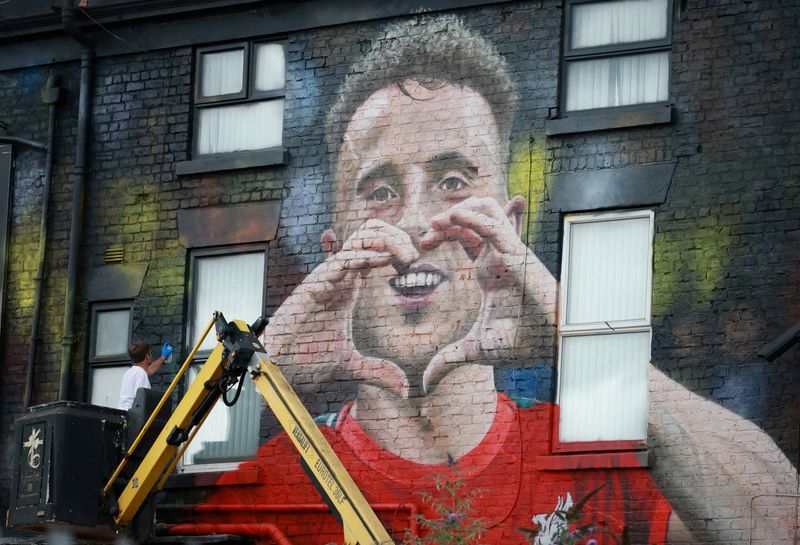
Portugal's World Cup campaign has taken on profound significance beyond the sport itself as the team prepares to face Croatia in the knockout stage on Thursday, a date that coincides with the first anniversary of Diogo Jota's death. The timing carries particular weight for the Portuguese delegation, as the match will kick off in Toronto but register as July 3 back home—the precise date marking a year since the Liverpool forward and his brother Andre Silva perished in a car crash in northwestern Spain. The tragedy, which occurred when their Lamborghini veered off the road and caught fire, shocked the nation and reverberated through the global football community.
Jota's prominence in Portuguese football made his loss especially devastating. At 28 years old, the skilled forward had established himself as a cornerstone of the national team's ambitions, having earned 49 caps and scored 14 crucial goals for Portugal. His combination of technical ability and goal-scoring prowess had made him indispensable to manager Roberto Martinez's vision for the squad. That a player of such calibre and promise was taken so suddenly created a void that extended far beyond the tactical dimensions of the game.
The Portuguese Football Federation and coaching staff have deliberately ensured that Jota's memory remains woven throughout their World Cup journey rather than relegated to a single commemorative moment. Manager Roberto Martinez elevated Jota to honorary squad membership and has spoken of him as "our light"—language that captures both his on-field brilliance and his significance to team morale and identity. This decision reflects how deeply the player's personality and commitment to the national cause had embedded itself within the squad's culture and sense of purpose.
The most visible tributes come through individual players who shared direct bonds with Jota. Midfielder Ruben Neves, described as Jota's close friend, has made the poignant choice to wear the number 21 jersey throughout the tournament, carrying his companion's numerical identity into every match. The symbolic weight of this gesture extends beyond superstition; it represents a daily, public acknowledgment of a friendship cut short. Prime Minister Luís Montenegro further sanctioned official remembrance by providing the players with wristbands bearing Jota's name, transforming a small piece of sporting equipment into a statement of national unity and grief.
Jota's parents, Isabel and Joaquim Silva, attended Portugal's opening World Cup match against DR Congo in Houston, where they witnessed an emotional tribute that moved them to tears. Their presence underscored how the tragedy had touched not only the professional football ecosystem but the entire family structure surrounding the national team. Such moments of shared mourning create bonds between supporters, families, and players that transcend normal sporting relationships.
The emotional intensity reached beyond Portugal's borders into Scotland's World Cup contingent. Liverpool teammate Andy Robertson, the Scottish captain, had his thoughts immediately turn to Jota when Scotland clinched their World Cup berth in November. The deep friendship between the two players became a bridge connecting different national squads through shared grief. When the tournament commenced, Jota's widow, Rute Cardoso, wrote directly to Robertson, delivering a message that transformed personal loss into collective strength. Her words—"When you step on to the pitch, Diogo will be with you in your thoughts, in your steps, in your heart"—demonstrated how the tragedy had created an extended family of remembrance spanning multiple teams and nations.
Defender Vitinha articulated the psychological and emotional dimensions of facing this particular match on this particular date. Speaking ahead of the Croatia encounter, he acknowledged that while the squad carried multiple sources of motivation—family, national pride, sporting ambition—the anniversary added a transcendent dimension. The convergence of professional obligation and personal commemoration creates a unique psychological state for athletes who must perform at the highest level while processing profound grief.
Jota's absence from this World Cup would have been keenly felt regardless of the tragic circumstances. Having missed the 2018 tournament in Russia due to a calf injury, he would almost certainly have featured prominently in the squad for North America. His presence as an active participant would have represented a natural progression of his international career. Instead, his influence exists through memory, through the choices his teammates make to honour his legacy, and through the motivational power of collective loss transformed into collective purpose.
The passage of time since July 3, 2023, has not substantially diminished the emotional resonance of his death, even as the football calendar has inexorably moved forward. This reflects how certain losses in sport transcend the typical mechanisms of recovery and closure that usually accompany athletes' careers. Jota was not merely a player in a statistical sense; he represented a generation of Portuguese football that had maintained the nation's position among Europe's elite, and he exemplified the character traits—reliability, dedication, clutch performance—that supporters deeply value.
Within Toronto's Little Portugal neighbourhood, the Portuguese-Canadian community has recognized how this match carries significance beyond typical sporting rivalry. Miguel De Silva, owner of Amigos da Dundas Sports Bar, noted that Jota's memory would serve as an additional motivational force, transforming personal tragedy into collective strength. This observation captures how football operates within communities as more than entertainment; it functions as a vessel for cultural identity, collective emotion, and the processing of shared experience.
As Portugal takes the pitch against Croatia, the symbolic dimensions of the encounter will weigh as heavily as tactical considerations. The players will carry not only their own ambitions but the accumulated grief, love, and memory of a nation that lost one of its brightest talents. The convergence of sporting performance and personal remembrance creates a narrative texture that extends the significance of the match far beyond the ninety minutes of play. For Portuguese supporters across Malaysia and Southeast Asia, this World Cup clash represents not merely a knockout-stage encounter but a collective moment of honouring a player whose impact on the sport and his nation transcended the field itself.

