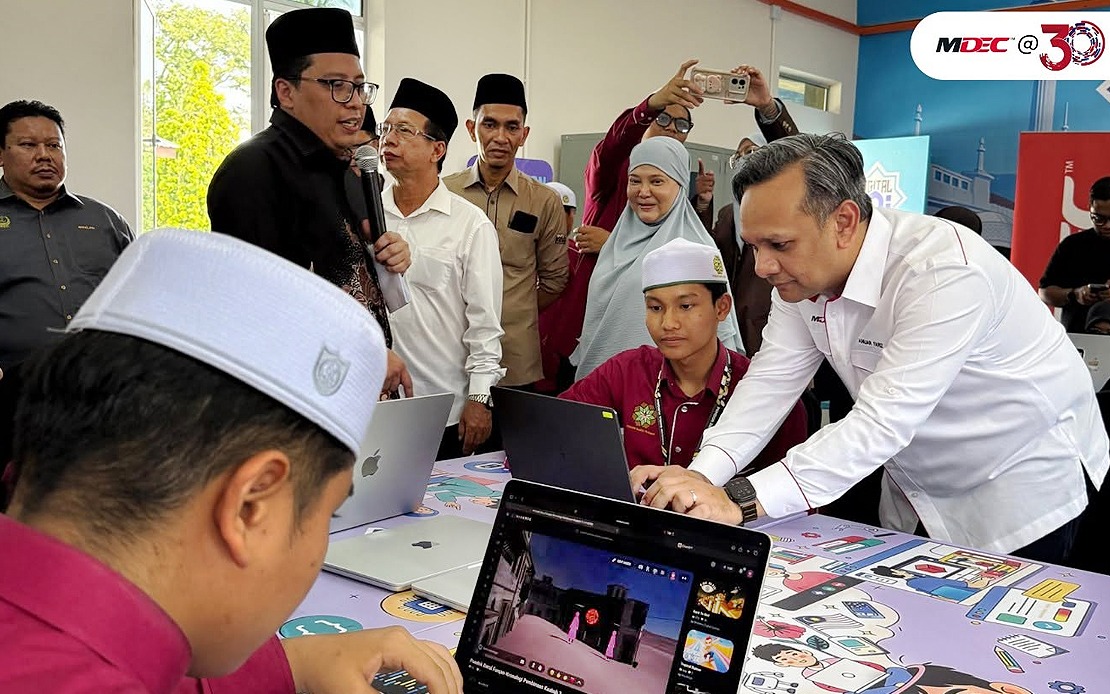
Malaysia's push to become an AI Nation by 2030 has reached into an unlikely sector: Islamic education institutions. The Malaysia Digital Economy Corporation (MDEC) formally established a Digital Maker Hub at Pondok Darul Furqan in Tambun, Ipoh, on July 13, marking a significant expansion of the nation's digital infrastructure beyond conventional educational settings. The facility represents a deliberate effort to ensure that students and educators within the Islamic education system gain hands-on exposure to cutting-edge technologies that will define economic participation over the coming decade.
The newly inaugurated hub functions as a purpose-built learning environment stocked with essential digital infrastructure. Beyond standard computing equipment, the facility houses smartboards for interactive instruction, robotics kits for practical engineering applications, and microcontroller systems that enable experiential technology learning. Internet connectivity threads through the space, allowing seamless access to digital resources and collaborative platforms. This physical infrastructure serves as the backbone for what MDEC envisions as a bridge between traditional Islamic pedagogy and contemporary technological literacy.
CEO Anuar Fariz Fadzil framed the initiative within Malaysia's broader economic transformation narrative. The expansion of digital access to all societal segments, including religious institutions, reflects recognition that economic competitiveness demands talent cultivation across traditional boundaries. The specific inclusion of Islamic education institutions signals government acknowledgment that these establishments, which serve substantial student populations nationwide, cannot be excluded from digital upskilling if Malaysia intends to realise its AI ambitions authentically. Without such inclusion, significant portions of the emerging workforce would lack foundational technology experience.
The Digital Maker Hub operates as the physical manifestation of the Islamic Education Institution Digital Transformation Programme, commonly known as Digital IPI. This national initiative materialised through partnership between MDEC and the Department of Islamic Development Malaysia (JAKIM), representing coordinated effort across government agencies to embed digital capability within religious education structures. Prime Minister Datuk Seri Anwar Ibrahim launched the broader programme in March, signalling high-level political commitment to the concept of technology-enabled Islamic education.
Contemplating the scope reveals ambition. Digital IPI targets transformation of over three thousand students and fifty educators across participating institutions through structured training modules. The curriculum encompasses digital literacy fundamentals and artificial intelligence basics, progressing to advanced topics including digital creativity techniques, immersive learning technologies, and metaverse applications. The programme explicitly addresses content creation capabilities, equipping participants to produce rather than merely consume digital material. This creator orientation distinguishes it from passive technology exposure.
Pondok Darul Furqan's students and staff experienced metaverse technology firsthand through the MetaSkool Metaverse Programme. Thirty students alongside five teachers participated in a two-day immersive learning session employing experiential methodology. The programme design prioritises interactive engagement and creative exploration rather than theoretical instruction, recognising that emerging technologies like the metaverse require embodied understanding. Participants encountered metaverse environments not as abstract concepts but as spaces they could navigate, manipulate, and utilise for problem-solving.
The pilot phase extends beyond Ipoh's boundaries. Four additional states receive Digital Maker Hubs under initial rollout: Kedah, Kelantan, Negeri Sembilan, Pahang, and Penang. This geographic distribution suggests deliberate effort to establish digital infrastructure across Malaysia's peninsular regions rather than concentrating resources in urban clusters. The dispersal strategy acknowledges that Islamic education institutions exist throughout the country and that equitable access to technology resources should reflect demographic reality.
For Malaysian stakeholders, this initiative carries particular relevance. Islamic education through pondoks and religious institutions educates substantial numbers of Malaysian youth, yet these sectors have historically lagged in technology infrastructure compared to conventional schools. The MDEC intervention addresses a genuine capacity gap that could otherwise marginalise graduates from religious institutions in digital economy competitions. Employers increasingly expect baseline technological competency; pondok graduates without such exposure face employment disadvantages that have nothing to do with religious knowledge or character.
The programme design attempts integration rather than segregation of religious and technological values. Rather than positioning technology as external to Islamic education, Digital IPI seeks organic synthesis incorporating Islamic principles such as trustworthiness into digital learning frameworks. This philosophical approach matters because it prevents false dichotomy between religious education and technological literacy—a particularly important message in Southeast Asian contexts where such tension sometimes surfaces in policy debates. The implicit argument is that Islamic institutions can authentically adopt technology while maintaining pedagogical integrity.
For Southeast Asia more broadly, Malaysia's approach offers instructive precedent. Many regional nations grapple with similar questions about technology access within diverse education systems. The Malaysian model of channelling resources through national digital economy structures while partnering with sectoral ministries demonstrates one potential governance approach. Whether other ASEAN nations adopt similar strategies may influence how equitably digital skills distribute across their populations.
The economic implications extend beyond individual graduate employability. Regions with better-trained workforces attract higher-value economic activity. If digital upskilling through Islamic institutions produces genuinely capable technology workers, then institutions like Pondok Darul Furqan contribute to Perak's economic competitiveness—relevant given that state's historical reliance on resource extraction industries. Digital skills represent economic diversification pathways that smaller states can pursue without massive infrastructure investment if existing educational institutions provide the human development foundation.
Successful implementation depends on sustained commitment beyond infrastructure provision. Equipment requires technical maintenance; teachers need continuous professional development as technology evolves; curricula must update regularly to remain relevant. The initial enthusiasm evident in the launch must translate into institutional practices that normalise technology engagement among Islamic educators. This requires patient, long-term investment rather than one-off initiatives.
Moving forward, stakeholders should monitor whether the pilot phase produces measurable improvements in graduate digital literacy and employment outcomes. Data demonstrating genuine impact would justify expansion to additional institutions nationwide. Conversely, implementation challenges in early phases would inform necessary adjustments before broader rollout. The Pondok Darul Furqan hub therefore functions not merely as educational infrastructure but as a policy experiment testing whether Malaysia's digital economy aspirations can meaningfully extend into institutions historically peripheral to technology policy conversations.

