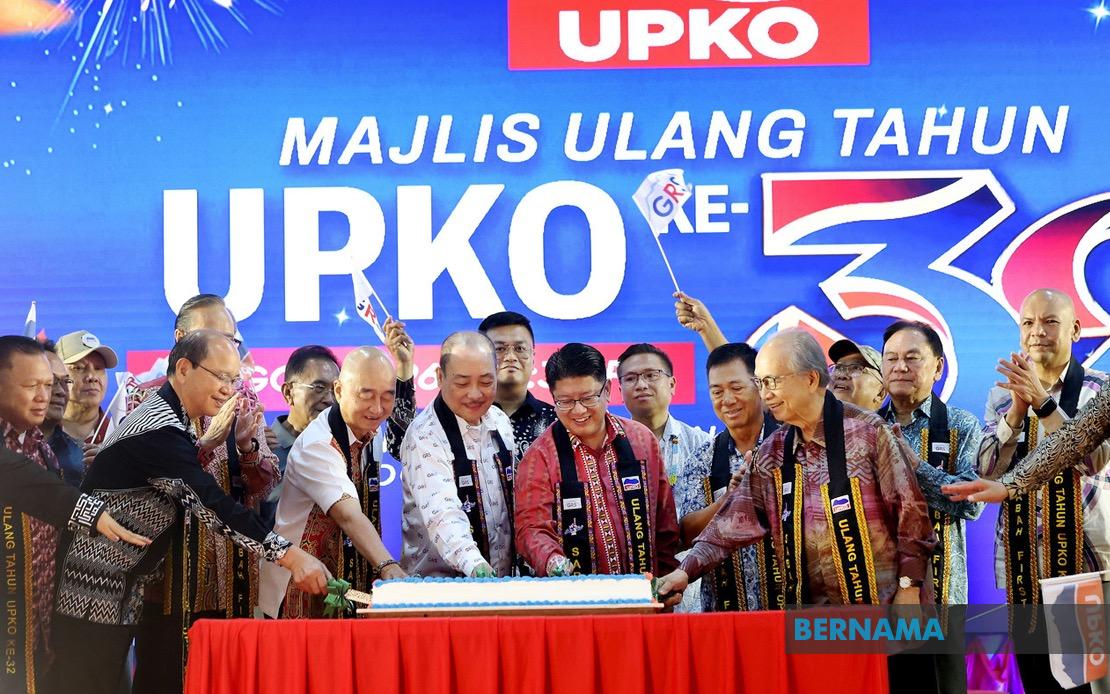
Political unity stands as the cornerstone for enabling Sabah's state government to concentrate on development agendas, economic advancement, and critical infrastructure projects, according to Chief Minister Datuk Seri Hajiji Noor. His remarks, delivered at the 32nd United Progressive Kinabalu Organisation (UPKO) anniversary celebration and the opening of the party's 17th Triennial Delegates Conference in Kota Kinabalu on August 9, highlight the government's conviction that internal political coherence directly facilitates progress on the ground.
Hajiji, who leads the Gabungan Rakyat Sabah (GRS) coalition, stressed that maintaining strong ties and coordinated efforts among the coalition's member parties forms an essential foundation for keeping Sabah on a sustainable trajectory of development and prosperity. The Chief Minister acknowledged that while GRS parties operate from diverse political and organisational backgrounds, their collective commitment to Sabah's future must supersede internal differences. This message carries particular significance in Malaysian federalism, where state-level coalitions often comprise parties with divergent ideological moorings yet shared electoral interests.
In his address, Hajiji employed evocative language to describe the coalition framework, characterising GRS as a communal structure that shelters all member parties under a unified purpose. He articulated the unity concept by noting that despite varied origins, all component parties "stand under the same roof, share the same sky and, more importantly, work for the same Sabah." This framing signals an effort to transcend factional tensions that periodically surface within multi-party coalitions, reminding members that their political home depends on collective stewardship and protection.
The Chief Minister's advocacy for cohesion gains added relevance following UPKO's recent admission into the GRS coalition on June 18. UPKO's incorporation expands the coalition to six component parties, now including Parti Gagasan Rakyat Sabah, Parti Bersatu Sabah, the Liberal Democratic Party, Parti Harapan Rakyat Sabah, and Parti Cinta Sabah alongside UPKO. This enlargement reflects a strategic broadening of the coalition's political base, though it simultaneously introduces additional stakeholder interests that coalition leadership must balance and coordinate.
UPKO's presence was represented at the event by party president Datuk Ewon Benedick, who simultaneously holds the position of Sabah Deputy Chief Minister III and Minister of Industrial Development, Entrepreneurship and Transportation. Benedick's dual roles exemplify how coalition arrangements distribute ministerial positions across member parties, a practice fundamental to maintaining equilibrium and demonstrating inclusive governance within multi-party structures.
For Malaysian observers and particularly Southeast Asian analysts tracking sub-national political dynamics, Sabah's coalition governance model illustrates both the promise and complexities of consensual regional politics. Coalition frameworks theoretically enable broader representation and distribute power across diverse constituencies, yet they demand continuous negotiation and coordination. The stability rhetoric employed by GRS leadership reflects awareness that frequent political realignments or coalition ruptures disrupt long-term planning and undermine investor confidence in state institutions.
Hajiji's emphasis on the link between political stability and development capacity resonates throughout Malaysia's federal system, where states depend on sustained coalition coherence to implement multi-year development plans, attract private investment, and maintain bureaucratic continuity. Frequent ministerial reshuffles, coalition fractures, or leadership disputes create uncertainty that permeates state administrations and slows decision-making on critical projects.
The Chief Minister directed an explicit appeal to UPKO's grassroots membership, calling upon party leaders and ordinary members to sustain collaborative momentum. His reference to the "Sabah First, Sabah United, Sabah Forward and Sabah Prosper" vision encapsulates the coalition's overarching developmental philosophy, positioning regional interest above party-specific agendas. Such messaging attempts to cultivate a political culture where intra-coalition disputes are managed privately rather than escalating into public confrontations that damage the coalition's credibility.
From a regional development standpoint, Sabah's pursuit of political stability aligns with broader Southeast Asian patterns where resource-rich or strategically positioned states invest heavily in maintaining predictable governance environments. Political predictability directly influences foreign direct investment flows, infrastructure development timelines, and the ability to execute long-term economic diversification strategies. Investors evaluating Sabah's climate monitor not merely macroeconomic indicators but also the stability of governing coalitions and ministerial continuity.
The UPKO event itself functioned as a coalition-building exercise, allowing Hajiji to reinforce narratives of unity while providing UPKO with a platform to consolidate its standing within the expanded coalition. Such ceremonial occasions serve practical political functions beyond their superficial dimensions, allowing coalition partners to demonstrate collaborative capacity to both their membership bases and the electorate.
Moving forward, the sustainability of GRS coherence will likely depend on how effectively the coalition distributes developmental benefits, manages competing party interests, and prevents any single member from dominating coalition decision-making. The six-party structure introduces complexity, as coordinating policy positions and resource allocation becomes increasingly intricate with each additional member. Hajiji's emphasis on shared purpose and collective stewardship suggests he recognises these inherent tensions and seeks to establish normative frameworks that privilege coalition stability over competitive behaviour among members.
For Malaysian political observers, particularly those tracking East Malaysian developments, the Sabah coalition's trajectory offers insights into how regional parties navigate intergovernmental relations, broker power-sharing arrangements, and maintain legitimacy across diverse constituencies. As Malaysia's political landscape continues evolving, with federal politics increasingly dependent on state-level coalitions and regional partnerships, Sabah's experience with multi-party governance provides both cautionary lessons and models worthy of examination.

