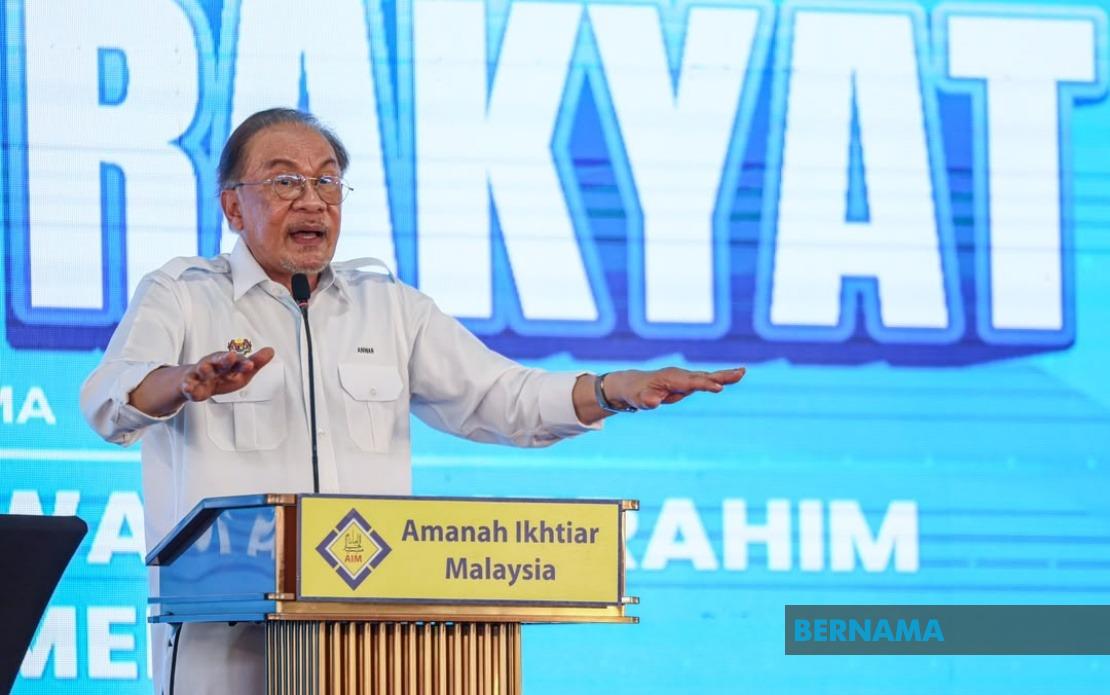
Prime Minister Datuk Seri Anwar Ibrahim contended yesterday that a coalition of political adversaries is mobilising against his administration specifically because the MADANI Government refuses to tolerate corruption or the misuse of official positions for personal enrichment. Speaking at a campaign event in Batu Pahat during the lead-up to Johor's state elections, Anwar framed the political pressure he faces not as routine opposition but as a direct consequence of his government's vigilant oversight of public finances and institutional integrity.
The Prime Minister's remarks underscore a deepening polarisation in Malaysian politics, where governance standards have become a flashpoint between competing coalitions. Anwar's assertion that his administration's strict approach has generated unease among rival parties reflects broader tensions over how public resources should be managed and who should benefit from state-facilitated opportunities. By linking political attacks against him to his anti-corruption posture, Anwar sought to recast the current political struggle as fundamentally about values rather than merely electoral competition or factional rivalry.
Anwar, also chairman of Pakatan Harapan, characterised his government's operational principle in stark terms: leaders must not exploit their positions to acquire property, monopolise lucrative contracts, obtain shareholdings in businesses, or accumulate personal wealth through their office. This framework represents a deliberate pivot away from the patronage networks and rent-seeking behaviour that characterised Malaysian governance during the previous administrations. However, the framing also carries implicit criticism of his opponents, suggesting they benefit from the looser enforcement standards they would presumably restore if returned to power.
The Prime Minister pointed to his own conduct as evidence of commitment to this principle, noting that despite numerous official visits to Johor throughout his tenure, he has neither accepted land offerings, secured projects, nor acquired shares in the state. This personal example serves as both a rhetorical device and a governance statement—implying that other leaders might behave differently when given comparable opportunities and institutional access. The underlying message to voters is that integrity must become embedded in the behaviour of elected officials if Malaysia is to achieve genuine development that benefits the broader population rather than concentrated elites.
Campaigning in Johor ahead of the July 11 state election, Anwar made a case for why voters should extend Pakatan Harapan's control to the state level. He argued that alignment between federal and state governments would enable more efficient implementation of welfare programmes and infrastructure projects. This argument reflects the practical reality of Malaysian federalism, where divided governance can complicate service delivery and create coordination challenges. However, it also implicitly criticises the current Johor state administration for underperformance, particularly regarding affordability of housing and basic services despite the state's resource wealth.
Criticising what he characterised as incomplete development outcomes in Johor, Anwar highlighted the paradox of billions of ringgit in infrastructure investment coexisting with unaffordable housing for ordinary residents and inadequate funding for essential public facilities. His diagnosis suggests that state-level governance has prioritised large capital projects over mechanisms that would improve living standards for the majority. This observation carries particular resonance in Johor, which generates substantial revenue but where wealth concentration remains problematic. The implicit argument is that Pakatan Harapan would reorient state spending toward direct public benefit rather than allowing resource extraction that enriches specific groups.
Addressing a persistent criticism from Malay-Muslim voters regarding Pakatan Harapan's partnership with the Democratic Action Party, Anwar stressed that DAP members serving in the federal Cabinet have never obstructed initiatives benefiting Malays or supporting Islamic institutions during his three-and-a-half-year tenure as Prime Minister. This defensive posture reflects real electoral vulnerability on this issue, as some Malay-Muslim constituencies harbour scepticism about multiracial coalitions. By emphasising the absence of opposition from DAP ministers to pro-Malay and pro-Islam programmes, Anwar attempted to neutralise claims that the coalition compromises the interests of the Malay-Muslim majority. The empirical claim itself invites scrutiny, but serves his immediate political purpose of reassuring this voter segment.
The campaign event itself, featuring enthusiastic crowd attendance despite extreme heat, provided visual confirmation of grassroots support for Pakatan Harapan in this particular locality. Anwar highlighted the genuine engagement of supporters as evidence of broader momentum, contrasting it with what he implied was more muted enthusiasm for rival parties. Such crowd dynamics, while observable in real time, reflect complex factors including local leadership, targeted mobilisation, and sometimes contingent circumstances rather than necessarily indicating predictive electoral momentum across an entire state.
The Johor state election encompasses 172 candidates competing for 56 seats, with polling scheduled for July 11 and early voting beginning July 7. The contest occurs within Malaysia's broader political context, where the federal government under Anwar's leadership has maintained a wafer-thin parliamentary majority dependent on cooperation from diverse partners. A significant Pakatan Harapan victory in Johor—Malaysia's second-largest state by population and historically a stronghold of the Barisan Nasional coalition—would materially strengthen Anwar's political standing and provide evidence that his governance model resonates with voters beyond the urban, educated demographics typically associated with his coalition.
For Malaysian observers and Southeast Asian analysts tracking democratic development in the region, the Johor election represents a substantive test of whether anti-corruption messaging and good governance commitments can overcome traditional voting patterns based on ethnicity, geography, and patronage networks. If Anwar's framing successfully mobilises voters concerned about institutional integrity and equitable development, it would suggest that governance quality has ascended as a meaningful electoral consideration in contemporary Malaysia. Conversely, if traditional loyalties predominate despite such messaging, it would indicate that the transformation of Malaysian politics around values-based competition remains incomplete.

