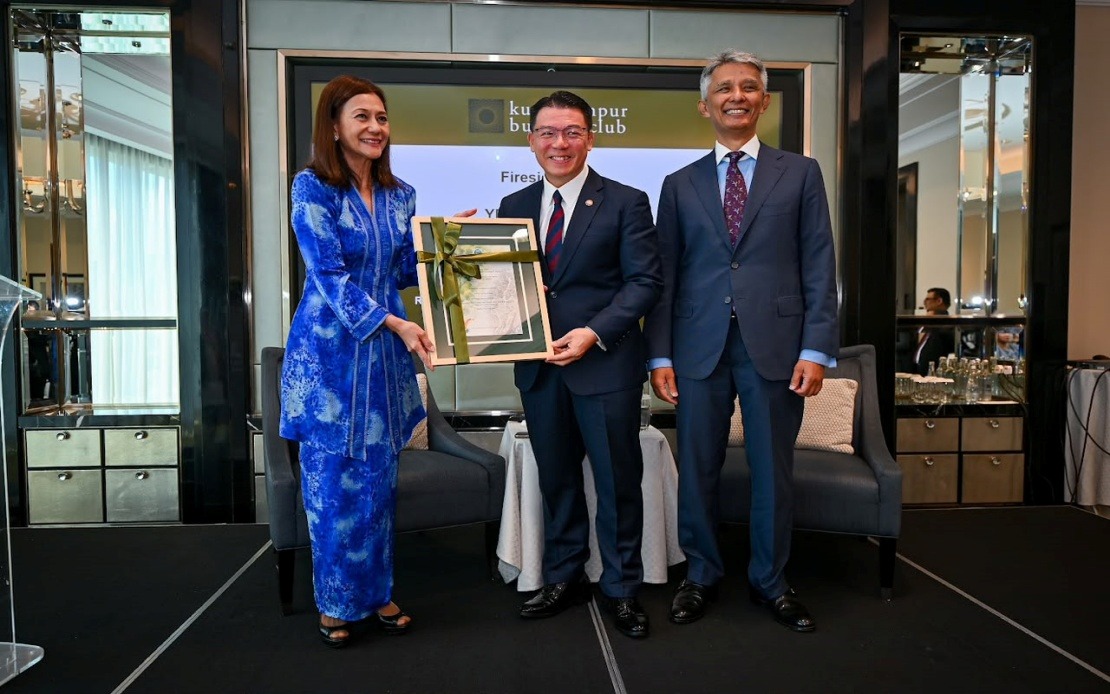
Housing and Local Government Minister Nga Kor Ming has underscored the importance of maintaining unwavering policy direction under the MADANI framework as a cornerstone for translating economic reforms into tangible, long-lasting prosperity. Speaking after a fireside chat at the Kuala Lumpur Business Club, Nga argued that governments cannot afford to abandon reform momentum midway through implementation cycles if they wish to see meaningful structural change take root across the economy.
The minister emphasised that investor confidence hinges not merely on promising rhetoric, but on demonstrable consistency in how governments execute their stated objectives. In Malaysia's competitive regional context, where multinational corporations and international fund managers constantly evaluate emerging market destinations, any perception of policy volatility or directional uncertainty can prompt capital reallocation toward markets perceived as more stable. Consistency in governance approach therefore represents far more than an administrative preference—it is a practical prerequisite for the sustained foreign direct investment flows that drive job creation and technological transfer across developing economies.
Nga indicated that a renewed electoral mandate would furnish the government with the political capital and temporal runway necessary to deepen ongoing structural reforms. This framing reflects a broader recognition within Malaysia's policymaking circles that transformative economic change requires patient capital and protected timeframes. Quick-cycle electoral politics can work against the long-term institutional building and sectoral repositioning that sustained development demands. The minister's reference to deepening structural reforms and strengthening institutional capacity suggests an awareness that Malaysia's transformation ambitions extend well beyond fiscal tweaks or cyclical adjustments.
Under Prime Minister Datuk Seri Anwar Ibrahim's stewardship, the MADANI government has pursued what Nga characterised as measurable progress across three interconnected domains: governance quality, economic management, and international diplomatic positioning. These three pillars reinforce one another in ways that matter for foreign investors and domestic entrepreneurs alike. Improved governance signals reduced transaction costs and predictability in dealing with bureaucracy; prudent economic management suggests resources will be allocated rationally rather than captured by political patronage networks; and active diplomatic engagement opens market access and partnership opportunities that extend Malaysian firms' reach beyond regional borders.
The minister highlighted Malaysia's improved standing on the Corruption Perceptions Index as a tangible outcome of governance reforms. This metric carries outsized significance in investment decision-making processes, as corruption risk directly affects the operating environment for multinationals and their ability to forecast costs and timelines. International credit rating agencies have similarly rewarded Malaysia's fiscal discipline with stronger assessments, lowering the government's cost of borrowing and signalling confidence in the nation's macroeconomic fundamentals. These technical improvements translate into concrete benefits for Malaysian development projects and infrastructure investments that depend on overseas financing.
On the trade front, Malaysia's resilience amid turbulent global economic conditions—marked by protectionist pressures, supply chain fragmentation, and geopolitical tensions—reflects both the underlying competitiveness of Malaysian manufacturers and the export-oriented policy framework that sustains this competitiveness. The government's ability to maintain robust trade performance while others contended with declining volumes suggests that Malaysia's economic model retains sufficient flexibility and structural advantages to weather external shocks. This resilience matters particularly for a nation whose prosperity depends substantially on maintaining open, predictable access to international markets.
The government's pursuit of strategic partnerships, exemplified by the RM52.73 billion partnership framework with Turkmenistan and energy collaboration initiatives with Russia, reflects a deliberate strategy to diversify Malaysia's economic partnerships and reduce over-reliance on traditional trading partners. Such initiatives carry particular significance in Southeast Asia's current geopolitical environment, where nations seek to maintain multiple credible partnerships while preserving strategic autonomy. Malaysia's approach suggests a recognition that economic transformation occurs most effectively when governments simultaneously manage domestic structural change and cultivate external partnerships that expand opportunities for domestic firms.
For Malaysian businesses and entrepreneurs, policy continuity under frameworks like MADANI offers tangible advantages beyond headline growth figures. Sustained commitment to institutional strengthening creates operational transparency and predictability that enables Malaysian companies to plan multi-year investments with greater confidence. When governments repeatedly shift policy directions, domestic firms face constant recalibration costs and strategic uncertainty that larger, more globally diversified competitors can better absorb. Policy consistency therefore favours local enterprises attempting to scale up and compete more effectively in regional and global markets.
The emphasis on governance consistency also speaks to Malaysia's ambitions to position itself as a regional hub for high-value economic activities—financial services, technology development, research and development—that require stable institutional environments. Multinational corporations making decisions about where to locate regional headquarters, innovation centres, or capital deployment hubs gravitate toward jurisdictions where governance quality and policy predictability minimise operational risks. Malaysia's efforts to improve its institutional credentials and maintain consistent policy direction reflect an implicit recognition that the nation's comparative advantage increasingly depends on institutional quality rather than labour cost advantages that are eroding across the region.
The evolution of Malaysia's economic strategy also illustrates broader challenges facing middle-income developing nations seeking to avoid middle-income traps. Transformation from commodity-dependent or labour-intensive manufacturing economies toward higher-value activities requires sustained investment in human capital, research infrastructure, and regulatory frameworks that cannot be built in electoral cycles. The minister's emphasis on the need for temporal continuity reflects this structural reality: sustainable development trajectories often extend beyond five-year election cycles, demanding that governments secure long-term political mandates or build cross-party consensus around core reform objectives.
For observers in other Southeast Asian nations grappling with similar transformation challenges, Malaysia's experience offers instructive lessons about the relationship between political continuity and economic reform. Thailand's repeated political instability, Vietnam's continued restrictions on private enterprise, and the Philippines' fragmented policy environment all illustrate how political uncertainty or institutional weakness can impede otherwise promising economies. Malaysia's choice to emphasise policy continuity as a foundation for transformation reflects a sophisticated understanding of how political economy factors shape development outcomes across the region.

