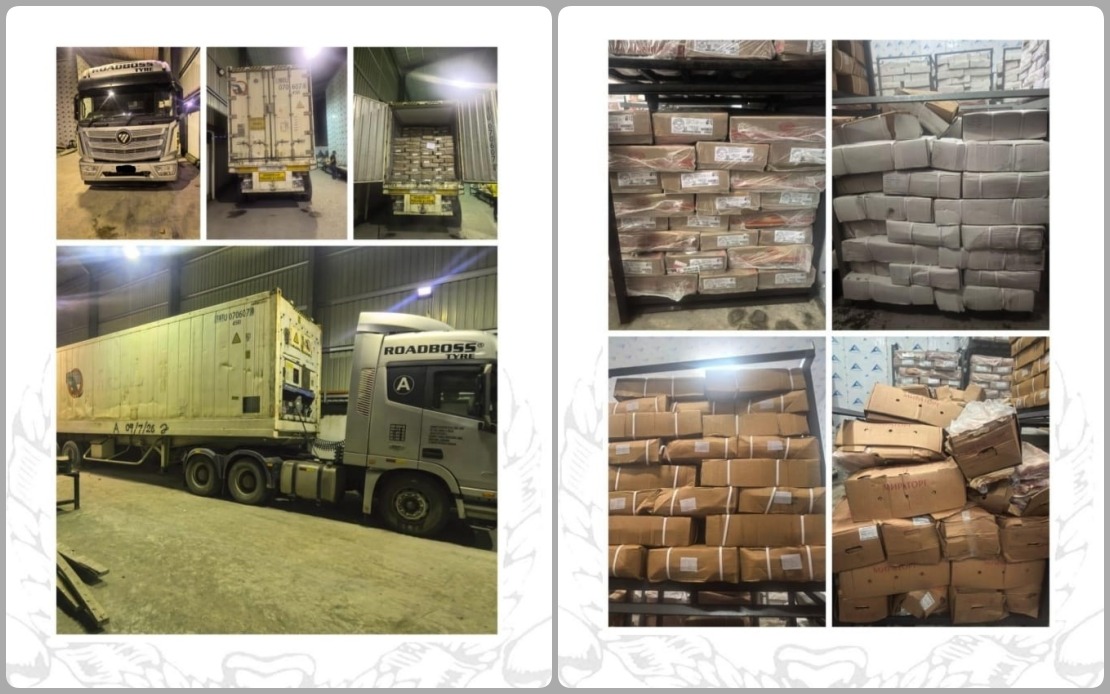
Police have arrested a 26-year-old local resident and seized approximately RM6.19 million worth of frozen pork products that lacked the necessary import permits during a enforcement operation conducted at a warehouse in Miri, Sarawak, on the evening of July 9. The coordinated raid, designated Operation Taring Chiller, represents part of a broader national strategy to prevent the circulation of food products whose halal status cannot be verified and to dismantle networks engaged in the distribution of illegally imported provisions.
Datuk Seri Mohd Yusri Hassan Basri, director of the Internal Security and Public Order Department, outlined the scope of materials discovered during the 8 pm operation. The warehouse inventory included 30,000 kilogrammes of prepared frozen pork large intestines, 18,000 kilograms of pork loin distributed across 15 pallets, 750 kilograms of pork occupying a single pallet, multiple pallets containing bone-in pork bellies complete with rind, and supplies of frozen pork shoulder. The sheer volume and diversity of products suggest an operation geared toward substantial distribution rather than personal consumption, pointing to an organised supply network.
The operation itself involved coordination between multiple enforcement bodies, reflecting the integrated approach Malaysian authorities have adopted toward food security and border control. The Wildlife Crime Bureau and Special Investigation Intelligence unit, operating under the JKDNKA, took the lead, with supplementary support provided by the Miri district police headquarters and the Sarawak Veterinary Services Department. This multi-agency response demonstrates how food smuggling investigations increasingly intersect with wildlife enforcement and public health concerns, as undocumented frozen products present dual risks—both regulatory violations and potential food safety hazards.
Investigators have proceeded under Sections 9(1) and 9(3) of the Veterinary Public Health Ordinance 1999, a framework designed to ensure that all meat entering or circulating within Malaysian markets meets established health and documentation standards. The authorities have simultaneously issued a compound notice of RM25,000 to the apprehended individual, providing an administrative penalty mechanism that complements the criminal investigation and reflects the range of enforcement tools available to regulatory agencies.
This seizure forms part of a significantly larger enforcement initiative spanning the opening months of 2024. Between January 1 and July 10, the WCB/PSK unit conducted 201 raids across the country, culminating in the arrest of 375 individuals linked to various contraband activities. The cumulative value of goods recovered during this period reached RM264.86 million, illustrating the scale of smuggling operations that continue to challenge Malaysia's border security and regulatory oversight. The seizures encompassed diverse categories of illicit trade, including non-duty-paid merchandise, diverted controlled goods and subsidised items, undocumented frozen provisions, illegal wildlife trafficking, and electronic waste—each representing distinct threats to the economy, public health, and environmental conservation.
The concentration of resources on frozen pork products reflects particular vulnerabilities within Malaysia's food import infrastructure. Pork, being a controlled commodity in a Muslim-majority nation with strict halal certification requirements, carries heightened regulatory significance. Undocumented imports bypass the certification pathways that would normally establish provenance, handling procedures, and compliance with Malaysian halal standards. Beyond religious considerations, the absence of proper documentation means these products have not undergone veterinary inspection, been subjected to food safety testing, or had their storage and transport conditions verified—creating potential public health risks for consumers unaware of the products' origins or safety history.
The geography of this operation—centred on Miri, a port town in Sarawak with proximity to Brunei and Indonesia—highlights how border regions become focal points for smuggling networks. Sarawak's position along major sea routes and its multiple entry points create both opportunity and necessity for intensive enforcement efforts. Miri's relatively lower population density compared to peninsular commercial hubs may have initially rendered it an attractive location for warehousing contraband, with operators assuming reduced surveillance compared to major urban centres like Kuala Lumpur or Penang.
The timing and scale of the operation reflect evolving police strategies emphasising intelligence-led enforcement. Rather than relying primarily on reactive inspections at recognised border checkpoints, Malaysian authorities have increasingly developed proactive monitoring capabilities, including financial tracking, telecommunications intelligence, and informant networks. The designation of Operation Taring Chiller suggests a targeted investigation that may have involved weeks or months of preliminary surveillance before the warehouse raid itself. This investigative depth, while resource-intensive, yields larger seizures and potentially disrupts established smuggling pipelines rather than merely intercepting individual shipments.
The arrest and subsequent investigation will likely extend beyond the single individual apprehended. Law enforcement agencies typically pursue investigations into the supply chain's upstream components—identifying the sources of shipment, intermediaries who facilitated transport, documentation forgers, and downstream distributors. Such network mapping can uncover organisational structures behind smuggling operations, potentially revealing connections to other illicit trade or organised crime entities. The compound notice issued simultaneously with the criminal investigation indicates authorities are pursuing parallel administrative and penal remedies.
For Malaysian consumers, this seizure underscores ongoing tensions between food security, price affordability, and regulatory compliance. Smuggled goods typically enter the market at prices undercutting legitimate imports, creating incentives for retailers and consumers to purchase undocumented products. The enforcement action aims to eliminate this price advantage by removing contraband supplies, though organised networks often respond by developing new routes or concealment methods. Sustained enforcement requires continuous adaptation to smugglers' tactics and sufficient resource allocation to maintain investigative pressure.
Moving forward, the Royal Malaysia Police have committed to intensifying intelligence gathering, monitoring operations, and coordinated enforcement initiatives to combat smuggling activities and organised crime more comprehensively. This declaration, while routine in official statements, reflects genuine operational pressures as authorities attempt to manage the volume and sophistication of cross-border contraband flows. The challenge remains particularly acute given Malaysia's extensive coastline, multiple land borders, and position within regional shipping networks that facilitate both legitimate commerce and illicit trade.

