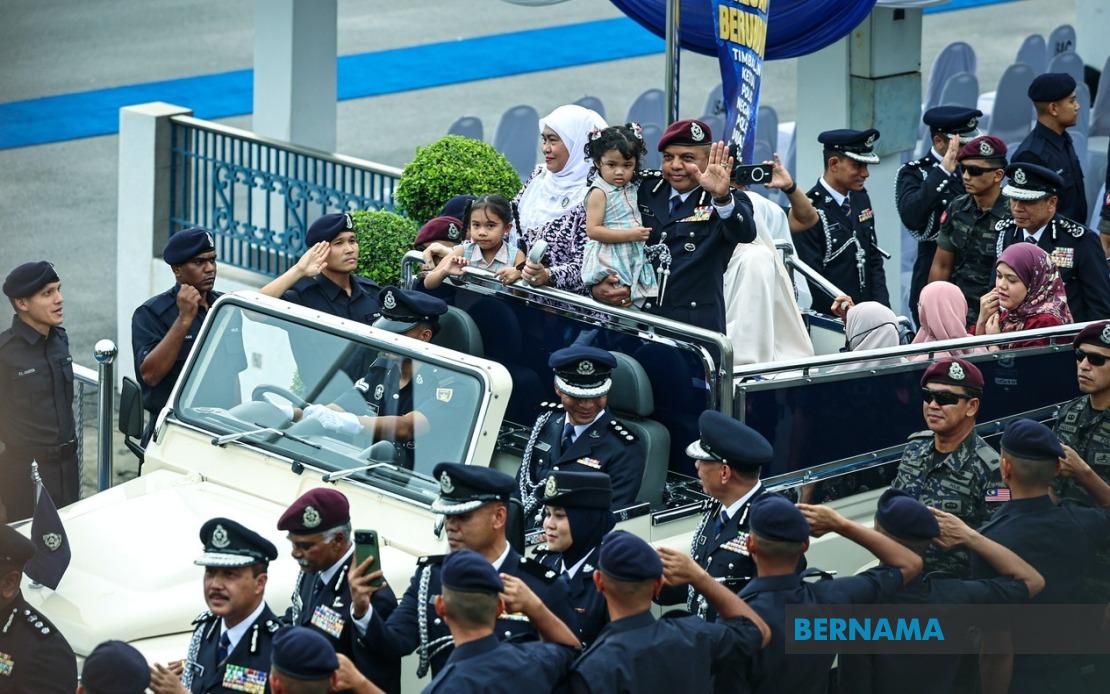
As Tan Sri Ayob Khan Mydin Pitchay prepares to step down after nearly 35 years with the Royal Malaysian Police, he has left the institution with a clear mandate: impartial law enforcement is the cornerstone of public confidence. Speaking at the handover ceremony for his successor at the Kuala Lumpur Police Training Centre on July 26, Ayob Khan underscored that PDRM cannot aspire to world-class policing standards unless it demonstrates the courage to apply the law consistently, regardless of who faces prosecution.
The incoming Acting Deputy Inspector-General, Datuk Seri Ibrahim Darus—currently director of Bukit Aman Special Branch—takes the helm amid persistent public scrutiny of the police force's impartiality. This transition occurs at a critical juncture in Malaysia's institutional development, where questions about the independence of law enforcement agencies have become increasingly prominent in political discourse and civil society debate. Ayob Khan's emphatic statement that the police should arrest lawbreakers whether they belong to the ruling coalition or opposition parties reflects an institutional challenge that has long plagued developing democracies across Southeast Asia.
The former Deputy IGP illustrated his position with a concrete example drawn from his tenure leading the Counter-Terrorism Division in 2019. When his division arrested approximately 14 to 15 individuals suspected of involvement with the Liberation Tigers of Tamil Eelam, the detentions included two State Assemblymen from the then-governing party. By publicly highlighting these arrests, Ayob Khan demonstrated that enforcing the law without preferential treatment need not compromise operational effectiveness or institutional hierarchy. This example carries particular weight in the Malaysian context, where perceptions of selective prosecution have historically damaged public confidence in state institutions.
Ayob Khan's distinction between politicians and statesmen provides additional insight into his philosophy of institutional leadership. He characterised politicians as individuals preoccupied with electoral cycles and near-term survival, while statesmen consider consequences spanning decades. This framing suggests that truly professional police leadership must transcend partisan considerations and embrace long-term institutional integrity. In Southeast Asia's competitive political environment, where democratic institutions often face pressure from multiple directions, such principled frameworks become increasingly valuable. The distinction resonates particularly in Malaysia, where alternating governments and shifting political coalitions have created opportunities for institutional capture if not carefully guarded.
The retiring officer's explicit denial of political ambitions carries significance beyond mere personal reassurance. Across the region, former security officials have sometimes leveraged their institutional positions to transition into political careers, raising questions about divided loyalties and institutional independence. By stating categorically that he harbours no intentions to enter electoral politics, Ayob Khan reinforces the notion that professional policing and political activity represent fundamentally distinct domains. This separation, while seemingly obvious in principle, requires constant vigilance and public articulation in systems where the line occasionally blurs.
During his extensive career, Ayob Khan occupied numerous sensitive positions within PDRM's hierarchy. Beyond his Counter-Terrorism Division leadership, he served as Johor police chief, oversaw the Narcotics Criminal Investigation Department, and directed Bukit Aman's Criminal Investigation Division. This breadth of experience positioned him uniquely to observe institutional vulnerabilities and the pressures that test police independence. His ascent to Deputy Inspector-General in June 2023 placed him directly below the Inspector-General, making his departure a notable transition within Malaysia's top police leadership.
The timing of this handover coincides with broader regional discussions about police reform and institutional strengthening. Several Southeast Asian nations have undertaken substantial efforts to professionalise their law enforcement agencies, recognising that legitimacy depends fundamentally on consistent, equitable application of law. Thailand, Indonesia, and the Philippines have all launched initiatives to reduce corruption and improve public trust, though with varying degrees of success. Malaysia's PDRM, as one of the region's more established and structured police services, faces expectations to model best practices in impartial enforcement.
The incoming Acting Deputy IGP Ibrahim Darus assumes leadership of an institution facing multiple contemporary challenges. Rising cyber-crime, human trafficking networks spanning borders, drug-related organised crime, and terrorism remain persistent threats requiring sophisticated responses. Simultaneously, PDRM must maintain the everyday law enforcement functions that directly affect public safety and perceptions of institutional legitimacy. Ibrahim Darus's background in special branch operations provides intelligence-gathering and strategic analysis expertise, though his track record regarding impartial enforcement will likely face scrutiny from civil society observers and opposition political figures.
Public perception of police impartiality directly influences citizen cooperation with law enforcement. Communities more confident in equitable treatment are more likely to report crimes, serve as witnesses, and support police initiatives. Conversely, populations fearing selective prosecution become more insular, hindering legitimate police work. For developing democracies pursuing economic advancement and social stability, this dynamic proves consequential. Malaysia's aspirations toward developed-nation status require not merely economic metrics but also institutional quality reflected in professional, trustworthy governance.
Ayob Khan's emphasis on allowing police space to enforce law independently suggests awareness of external pressures that sometimes compromise operational decisions. Whether such pressures originate from political figures, business interests, or other sources, their influence weakens institutional integrity. The outgoing Deputy IGP appears to advocate for structural protections insulating PDRM from such interference, though he carefully avoids identifying specific instances or actors. This discretion reflects the delicate position of serving security officials navigating institutional politics.
The transition from Ayob Khan to Ibrahim Darus will reveal whether PDRM's institutional culture has genuinely internalised the message that impartial enforcement constitutes the foundation of legitimacy. Individual officers' commitment to this principle will be tested continuously through routine enforcement decisions, high-profile investigations, and responses to political events. Civil society organisations, media scrutiny, and international assessments will monitor whether the institution matches rhetoric with consistent practice.
Moving forward, Malaysia's police leadership must recognise that world-class status cannot be proclaimed but must be earned through demonstrated commitment to principles transcending partisan politics. Ayob Khan's final messages emphasise this demanding path, requiring sustained institutional discipline and individual integrity across ranks. For PDRM and for Southeast Asian law enforcement more broadly, this represents the authentic challenge of professional policing in democratic societies.

