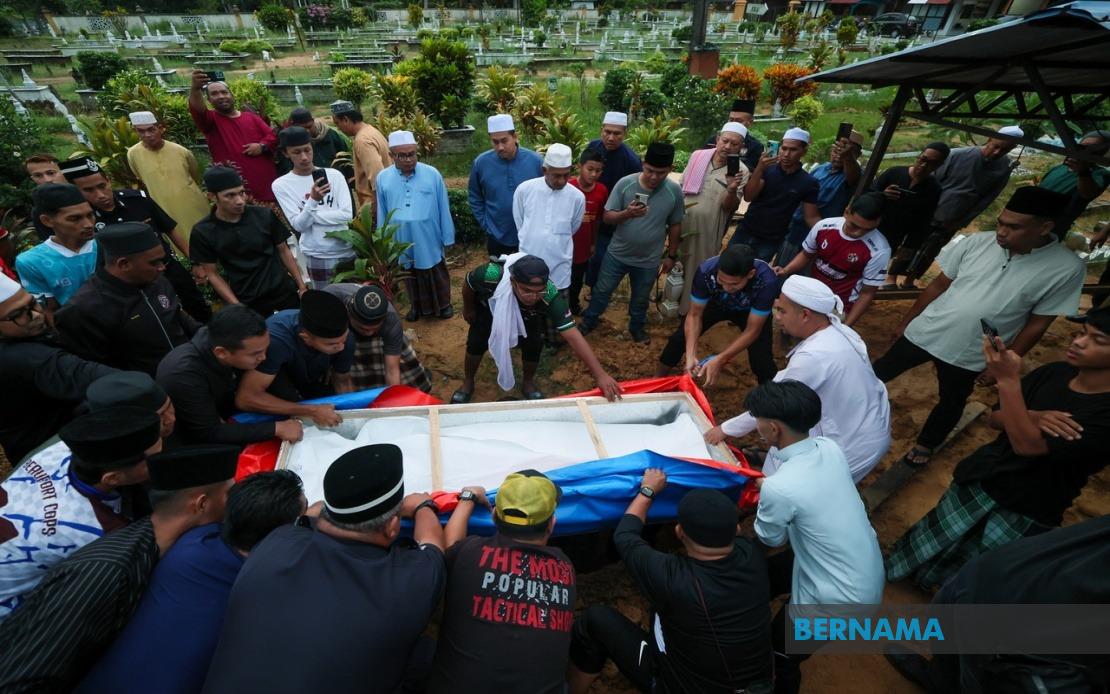
Corporal Mohamad Nur Hafiz Rahim, a 29-year-old officer with the Royal Malaysia Police, was buried in his native Kelantan on Thursday morning following funeral rites held at his family residence. The ceremony took place at Kampung Pangkal Kuang Muslim Cemetery in Ketereh, concluding a tragic chapter that has reverberated through Malaysia's law enforcement community and raised urgent questions about workplace safety protocols.
The burial came less than 24 hours after Mohamad Nur Hafiz and two colleagues succumbed to electrical injuries while performing routine duties at Weston Police Station in Beaufort, Sabah. The incident, which occurred at 5.50 pm on Wednesday, claimed the lives of Corporal Chiu Teck Siong, 40, from Sarawak and Constable Muhammad Raimi Ismarubee, 26, from Terengganu. All three men were fatally electrocuted while attempting to move a 29-foot metal pole designed for harvesting coconuts, which had apparently made contact with a power line situated near the station grounds adjacent to Sekolah Kebangsaan Weston.
Nurlella Rahim, Mohamad Nur Hafiz's eldest sister and 34 years old herself, expressed gratitude to police headquarters for coordinating the logistical arrangements that enabled her brother's body to be returned to Kelantan swiftly. Speaking to media representatives at the cemetery, she noted that her family's remains vehicle arrived early Thursday morning at 4.45 am, facilitating the same-day funeral observance. The gesture reflected the institutional support extended by the force to bereaved families during crisis situations, demonstrating the hierarchical bonds that characterise Malaysia's policing structure.
The grieving sister painted a portrait of familial closeness that transcended geographical separation. Despite Nurlella's residence in Ipoh, Perak, and her brother's posting in the eastern Malaysian state of Sabah, the five siblings maintained near-constant digital contact. Daily video calls formed the backbone of their family communications, supplemented by social media interactions and coordinated group conversations via the family WhatsApp channel. This routine of regular check-ins made the sudden loss all the more acute, as relatives were accustomed to frequent visual and voice contact across the country's dispersed regions.
The final interactions between Mohamad Nur Hafiz and his immediate family carried poignant significance in retrospect. His last video conversation with their mother occurred on Thursday afternoon, during which he appeared fatigued and less engaged than usual, though he managed to project reassurance before excusing himself to prepare for his evening shift. Even during brief work interludes, he would carve out moments to reach out to relatives via mobile phone calls, demonstrating a commitment to maintaining family bonds despite demanding professional obligations. Nurlella's most recent contact with her brother took place on Sunday, when he had transmitted video footage of an outing to the beach with his wife, Fatimah Shahira, and their young child—a moment of family leisure that would prove to be among the final memories his relatives would possess.
The workplace fatality at Weston Police Station has triggered immediate scrutiny from the nation's highest political echelons. Prime Minister Datuk Seri Anwar Ibrahim issued directives on Thursday demanding a comprehensive, transparent, and expedited investigation into the circumstances surrounding the electrocution deaths. Through a Facebook statement, Anwar emphasised that such an inquiry held paramount importance not merely for establishing causation, but for implementing systemic improvements designed to prevent recurrence of such catastrophic incidents. His intervention signals the Malaysian government's recognition that occupational safety deficiencies within law enforcement facilities demand urgent remedial action.
The incident highlights a critical vulnerability in the operational protocols governing police stations across Malaysia's diverse geography. The seemingly routine task of relocating agricultural harvesting equipment resulted in contact with electrical infrastructure, suggesting inadequate hazard identification, insufficient safety briefings, or gaps in risk assessment procedures. For a country managing multiple police stations across varied landscapes—from Peninsular Malaysia's developed urban centres to Sabah and Sarawak's remoter postings—standardising and enforcing occupational health and safety measures represents an ongoing challenge. The deaths of three trained officers underscore that even experienced personnel remain vulnerable when working conditions lack adequate protective frameworks.
The Beaufort incident occurs within a broader Southeast Asian context of workplace electrocution incidents claiming lives across the region. Malaysia's development trajectory has accelerated infrastructure expansion, yet corresponding attention to electrical safety in government facilities has not consistently matched pace. Police stations, often staffed by personnel with military-style hierarchies and protocols, may inadvertently foster cultures where questioning orders or flagging safety concerns encounters implicit resistance. The deaths of Mohamad Nur Hafiz, Chiu Teck Siong, and Muhammad Raimi Ismarubee represent not merely individual tragedies, but systemic failures warranting institutional overhaul.
For Malaysian police personnel serving in distant postings, the Beaufort tragedy resonates with particular poignancy. Officers accept postings to remote or less-developed stations, often enduring separations from family support networks, in service of national security objectives. These personnel frequently encounter substandard facilities, logistical constraints, and occasional safety oversights that their counterparts in developed urban areas might avoid. Mohamad Nur Hafiz's maintained connections with his Kelantan-based family, despite Sabah's distance and the emotional toll of separation, reflected the sacrifices inherent in policing careers distributed across the Malaysian archipelago.
The investigation mandated by Prime Minister Anwar must examine not only the immediate electrical hazard that claimed three lives, but the broader ecosystem governing workplace safety in Malaysian police establishments. Questions requiring answers include whether adequate hazard assessments preceded the coconut-harvesting equipment operation, whether staff received appropriate safety training, whether electrical lines were properly insulated or shielded, and whether supervisory protocols included safeguards for high-risk activities. Additionally, the inquiry should assess whether disparities in facility maintenance, safety investment, or oversight procedures exist between stations in developed areas and those in Sabah and Sarawak.
The implications of this tragedy extend to Malaysia's human resource management within law enforcement. Young, dedicated officers like Mohamad Nur Hafiz represent significant institutional investments in training, equipment provision, and operational capability development. Each death eliminates accumulated expertise, disrupts team cohesion, and sends reverberations through family units and peer networks. The three officers' deaths constitute not abstract statistics but concrete losses of personnel who had committed their careers to national service and institutional stability.
Moving forward, the Royal Malaysia Police must demonstrate tangible commitment to remedying identified deficiencies. This encompasses conducting facility-wide electrical safety audits across all stations, implementing mandatory refresher training for field operations, establishing clear protocols for hazard reporting without fear of censure, and ensuring that risk assessments precede non-standard work activities. Sabah and Sarawak's geographical and infrastructural characteristics may necessitate tailored safety frameworks distinct from Peninsular Malaysia's approaches, yet the commitment to officer protection must remain absolute.
The burial of Corporal Mohamad Nur Hafiz Rahim represents a moment for institutional reflection and resolve. His family's dignified observance of funeral rites, their expressed appreciation for official support, and their maintenance of close bonds across the nation exemplify the human dimensions underlying police service. As the investigation unfolds, Malaysia's leadership must ensure that the sacrifices made by Mohamad Nur Hafiz, Chiu Teck Siong, and Muhammad Raimi Ismarubee catalyse meaningful safety improvements protecting future generations of law enforcement personnel.

