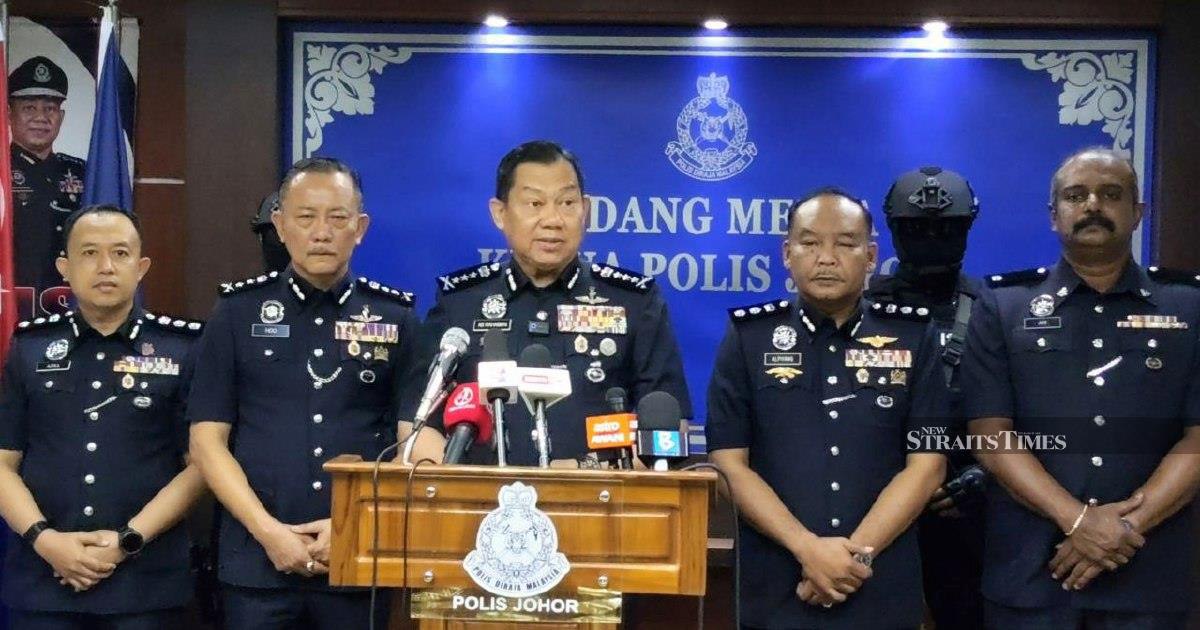
Johor Baru police have dismantled a methamphetamine trafficking operation, seizing 60.78 kilogrammes of the illicit substance worth RM3.04 million during coordinated raids conducted on Saturday. The enforcement action resulted in the arrest of eight individuals suspected of involvement in the drug distribution network, including a teenage school leaver who was operating as a courier for the syndicate. The scale of the seizure and the profile of those detained underscore growing concerns about how organised trafficking groups increasingly recruit young, vulnerable individuals for field operations while maintaining their distribution infrastructure.
The use of a school dropout as a transporter reflects a troubling trend in Malaysian drug crime, where syndicates deliberately target youths without stable employment or educational prospects. Such individuals are comparatively easy to recruit through modest financial incentives, and their relative anonymity in public spaces makes detection more challenging for law enforcement. This strategy allows established criminals to insulate themselves from direct involvement in high-risk logistics operations, creating organisational layers that complicate investigations and prosecutions. For Malaysian authorities, the implications are significant: combating methamphetamine trafficking increasingly requires not only interdicting drugs and apprehending senior operatives but also addressing the root causes driving youth recruitment into criminal supply chains.
The RM3.04 million street value attributed to the seized methamphetamine represents a substantial haul by regional standards, though such figures merit careful interpretation. Valuation metrics employed by law enforcement agencies typically reflect retail or wholesale-adjacent pricing rather than prices at the point of manufacture or initial distribution, meaning actual financial impact on syndicate operations may differ. Nevertheless, the quantity seized—nearly 61 kilogrammes—indicates a distribution operation of considerable scope, likely servicing multiple outlets across Johor Baru and potentially beyond. Methamphetamine remains among Southeast Asia's most prevalent manufactured drugs, with production facilities operating across the region, and Malaysian seizures have trended upward in recent years as enforcement capacity has improved.
Saturday's enforcement action demonstrates Johor Baru's significance in Malaysia's drug trafficking landscape. Located adjacent to Singapore, a major consumer market with stringent enforcement and comparatively higher street prices, Johor Baru functions as a crucial nodal point for both distribution and transnational smuggling. Police operations in the state have frequently uncovered methamphetamine stocks destined for export as well as supplies servicing local consumption. The eight arrests suggest the network was sufficiently embedded to warrant coordinated rather than opportunistic raids, indicating intelligence-led operation planning by state police. Such precision targeting, when successful, can temporarily disrupt supply chains, though experience across the region demonstrates that dismantled networks are often reconstituted through remaining operatives or rival syndicates moving to fill market gaps.
The involvement of multiple suspects—eight individuals from what may be a larger organisational structure—underscores the networked nature of contemporary drug trafficking in Malaysia. Rather than lone operators or small two-person teams, distribution generally involves specialised roles: procurement coordinators, couriers, local dealers, and sometimes money laundering facilitators. This compartmentalisation makes prosecution complex, as removing one tier does not necessarily incapacitate the entire operation. The fact that authorities apprehended both a teenage transporter and presumably more senior figures suggests the investigations may have penetrated multiple levels, potentially yielding intelligence on upstream suppliers or downstream distribution networks. Such intelligence often becomes the foundation for subsequent operations, creating cascading effects beyond the immediate arrests.
School dropouts and other youth without credentials occupy particularly precarious positions within the economy, making them vulnerable to recruitment by criminal syndicates offering quick income. Malaysia's education system, despite expanding access, still produces cohorts of young people with limited employment prospects outside informal sectors. While macroeconomic factors remain beyond police mandate, the pattern of youth involvement in drug trafficking suggests that prevention programmes centred on educational engagement, vocational training, and economic opportunity might complement enforcement efforts. Some Southeast Asian jurisdictions have experimented with such dual approaches, though systematic evaluation of outcomes remains limited.
The street value metric, while commonly cited in press releases and official statements, warrants deeper consideration when assessing enforcement impact. A RM3.04 million seizure sounds substantial to general audiences, yet actual disruption to supply depends on whether the seized shipment represented days, weeks, or months of street-level distribution. If this quantity supplied the Johor market for extended periods, its removal could create temporary shortage conditions; if it represented a small fraction of weekly throughput, market impacts may be negligible. Police statements rarely provide such context, partly because estimating total trafficking volumes independently remains methodologically challenging and politically sensitive.
Regional context remains essential for interpreting Malaysian drug enforcement outcomes. Methamphetamine has achieved widespread prevalence across Southeast Asia, with production facilities operating in Myanmar, Cambodia, and Laos supplying markets from Thailand to Indonesia to Malaysia. Individual seizures, while operationally significant, represent marginal impacts on overall supply so long as upstream production capacity remains largely uncontested. International efforts to constrain precursor chemical flows and dismantle clandestine laboratories have achieved only moderate success, with manufacturers adapting sourcing strategies and techniques in response. Malaysia's focus on demand reduction and street-level enforcement, while necessary, ultimately faces structural limitations without parallel action against production infrastructure across the region.
The Johor Baru bust exemplifies both the capabilities and constraints of contemporary Malaysian drug enforcement. Police demonstrated capacity to identify trafficking operations, conduct coordinated multi-target raids, and apprehend multiple suspects with substantial quantities. Yet the persistence of methamphetamine availability despite consistent seizures suggests enforcement, standing alone, cannot resolve supply dynamics. Future effectiveness likely depends on enhanced intelligence sharing across regional borders, investment in community-based prevention targeting vulnerable youth, and sustained pressure on production sites in neighbouring countries—objectives requiring resources, political commitment, and international cooperation at scales currently evident in the region's response frameworks. The teenage transporter arrested Saturday represents both a tactical interdiction success and a sobering reminder of ongoing vulnerability among Malaysia's youth to criminal recruitment.

