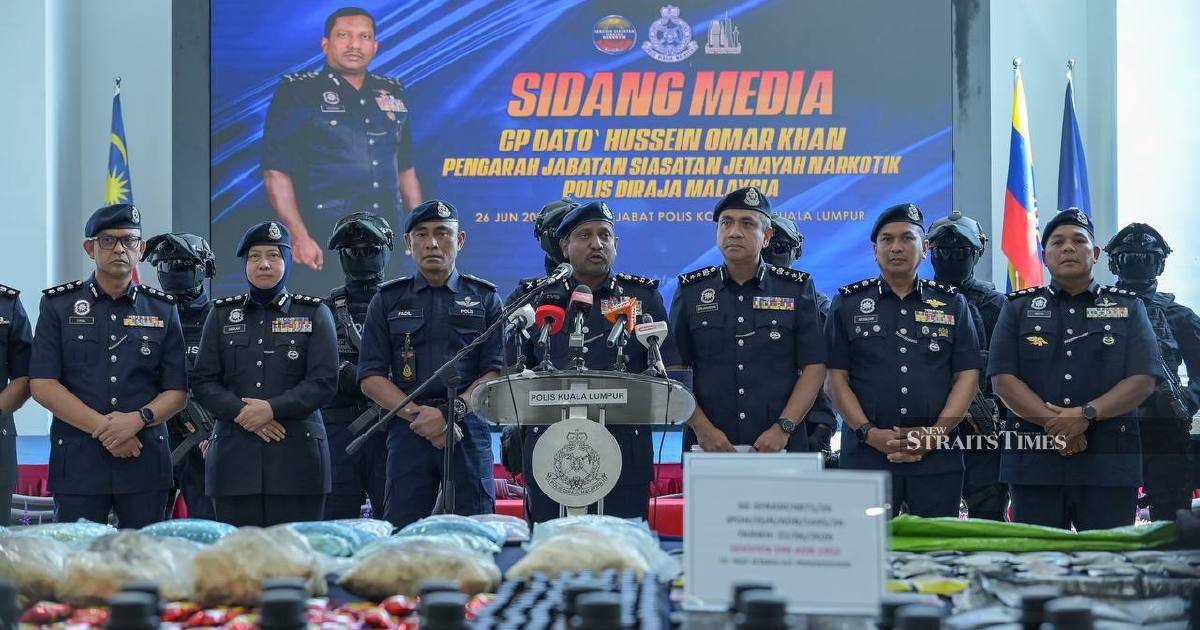
Police in Malaysia have dismantled what investigators believe to be a significant drug trafficking operation following a series of coordinated raids across Cheras on June 20, resulting in the seizure of narcotics estimated to be worth RM135.63 million and the apprehension of seven individuals believed connected to the smuggling network.
The magnitude of the haul underscores the persistent challenge law enforcement faces in combating organised drug trafficking throughout Malaysia. The three-pronged operation in the Cheras district reflects a growing strategy by the Royal Malaysia Police to employ simultaneous raid tactics designed to prevent suspects from coordinating escape routes or destroying incriminating evidence. Such coordinated approaches have become increasingly common as criminal networks adopt more sophisticated counter-surveillance measures.
The arrests represent a significant blow to what authorities characterise as an attempt to saturate the local market with large quantities of illicit drugs. This type of operation typically indicates distribution networks already established within Malaysia, with traffickers seeking to expand their market penetration through bulk importation. The scale of the seizure—more than RM135 million—suggests the network possessed considerable financial resources and logistical capacity to move such volumes of contraband across the country.
For Malaysian readers, such major police operations serve as a reminder of the ongoing battle against drug-related crime that continues to affect communities nationwide. Drug trafficking remains one of the most persistent criminal challenges faced by law enforcement agencies, with organised syndicates continually adapting their methodologies to evade detection. The Cheras operation demonstrates that despite these challenges, police intelligence and coordinated enforcement efforts can still yield substantial results that disrupt distribution chains.
The timing and scale of this operation also highlight the resource allocation decisions made by Malaysian law enforcement in recent months. Mounting such an intensive three-location raid requires extensive planning, intelligence gathering, and deployment of personnel—resources that could otherwise be deployed elsewhere. The decision to commit these assets to this particular operation suggests police had developed considerable confidence in intelligence regarding the network's activities and location, likely through months of surveillance and informant feedback.
Within the broader Southeast Asian context, Malaysia's drug trafficking challenges exist alongside similar pressures in neighbouring countries. Trafficking networks often operate across borders, utilising established smuggling routes that connect to sources in the Golden Triangle and other production regions. The capture of seven suspects in a single operation provides investigators with potential intelligence sources who may reveal information about cross-border supplier relationships and distribution networks extending beyond Cheras.
The value assessment of RM135.63 million attached to the seized drugs reflects standard police methodology in estimating street value based on typical retail pricing of various drug classes. This figure serves multiple purposes: it communicates the scale of the operation to the public, assists in legal proceedings against the accused, and provides statistical data for annual crime reporting. However, the actual cost to traffickers—their acquisition price from suppliers—would typically be considerably lower, though still representing substantial losses for criminal organisations.
For Malaysia's law enforcement community, this operation underscores both progress and persistent vulnerability. While the ability to execute coordinated raids and apprehend organised traffickers demonstrates operational capability, the frequency and scale of major drug operations suggest that criminal networks maintain sufficient resources and local connections to continue attempting large-scale importations. The struggle against narcotics trafficking remains fundamentally asymmetrical, with law enforcement required to prevent smuggling along an entire country's borders and within thousands of potential distribution points, while traffickers need only succeed periodically to remain profitable.
The investigation that follows these arrests will likely prove as significant as the raids themselves. The seven suspects detained will presumably undergo interrogation regarding supplier networks, financial arrangements, distribution channels, and the intended consumer markets for the seized narcotics. Such intelligence can provide investigators with leads extending far beyond Cheras, potentially implicating additional suspects or revealing operational patterns that inform future enforcement priorities.
The successful operation also raises questions about how such substantial quantities of drugs managed to reach the point of domestic distribution without earlier interdiction. Understanding whether the narcotics were recently imported or had been stored locally will inform assessments of the timeframe during which this network operated undetected. Enhanced border controls, port security measures, and intelligence sharing between agencies all contribute to preventing similar operations, yet determined trafficking organisations continue finding methods to penetrate Malaysia's defences.
As investigations proceed and court proceedings begin against the arrested suspects, the Cheras operation will likely become a significant case study in Malaysian organised crime prosecution. The outcome—in terms of charges laid, sentences imposed, and subsequent appeals—will carry implications for how future trafficking cases are prosecuted. Additionally, the intelligence gathered may contribute to strategic assessments of trafficking routes, criminal organisational structures, and the identification of still-active networks requiring law enforcement attention.

