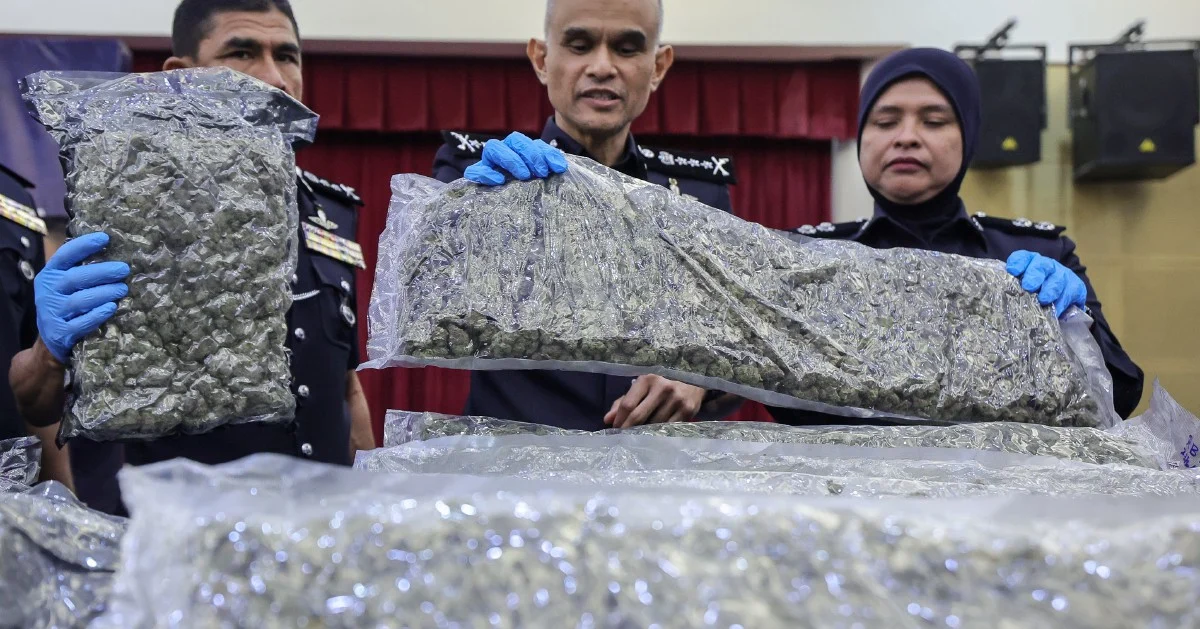
Law enforcement agencies have taken down a substantial narcotics operation targeting Malaysia's busiest aviation hub, securing 650 kilograms of cannabis buds at Kuala Lumpur International Airport since the start of the year. The coordinated effort has culminated in the apprehension of 38 individuals, among them foreign nationals, who are suspected of orchestrating the smuggling and distribution network. The scale of the seizure underscores the persistent vulnerability of Malaysia's borders to transnational drug trafficking despite heightened airport security measures.
The investigation represents a critical victory in Malaysia's ongoing war against narcotics, revealing sophisticated methods employed by traffickers to conceal illicit cargo within the country's main international gateway. KLIA, processing approximately 100 million passengers annually, has historically served as both an entry and transit point for contraband destined for regional markets. The revelation that such a large quantity successfully passed through airport checkpoints before detection raises fresh concerns about potential gaps in screening protocols and the adaptability of criminal networks to circumvent detection systems.
The involvement of foreign nationals in the operation points to the internationalised nature of Southeast Asian drug trafficking networks, where criminal syndicates leverage international travel and cross-border connections to move merchandise. Intelligence suggests that the arrested individuals operated along established supply chains linking producing regions to distribution hubs across Malaysia and neighbouring countries. This interconnected structure, with participants from multiple nationalities, indicates coordination between organised crime groups operating across jurisdictional boundaries, complicating law enforcement efforts across the region.
Cannabis remains a commodity of particular concern within Malaysia's broader drug problem, occupying a growing market segment as criminal groups diversify their portfolios beyond traditional narcotics. The drug has increasingly attracted younger demographics and urban consumers, altering consumption patterns and creating fresh distribution demands. The KLIA seizure, while headline-grabbing, likely represents only a fraction of the total volume transiting through Malaysian airports and ports, according to narcotics experts who suggest successful interdiction rates remain modest compared to estimated total trafficking volumes.
The investigation's genesis and progression reveal intelligence agencies' capability to identify suspicious movements and track networks through multiple checkpoints. Authorities likely coordinated with customs inspectors, airport security personnel, and international law enforcement partners to unravel the trafficking structure. The sequential arrests suggest methodical dismantling rather than isolated interdictions, implying that investigators followed leads systematically from airport detection points backwards through the supply chain to identify key operatives and support networks.
For Malaysian security officials, the case underscores the resource-intensive nature of combating sophisticated smuggling operations. The sheer volume involved—650 kilograms represents substantial profit at distribution value—demonstrates the financial incentives driving criminal participation despite considerable legal risks. Each arrest within the network provides investigators with intelligence leading to further dismantling of associated structures, creating cascading effects that may disrupt broader trafficking activities.
The apprehensions carry significant implications for the detained individuals, particularly foreign nationals who face prosecution under Malaysia's stringent narcotics laws. Convictions for trafficking in controlled drugs carry penalties ranging from lengthy custodial sentences to capital punishment depending on quantities involved, making such arrests severe consequences for participants in the criminal enterprise. The legal framework reflects Malaysia's zero-tolerance stance towards drug trafficking, positioning the nation as relatively strict within regional comparisons.
From a regional perspective, the KLIA operation highlights the interconnected drug markets and trafficking routes spanning Southeast Asia, where production in countries like Myanmar, Laos, and Thailand feeds consumption in Malaysia, Singapore, and beyond. Malaysian enforcement agencies have increasingly coordinated with counterparts throughout the region and beyond to disrupt these networks at multiple points simultaneously. Transnational task forces and intelligence sharing arrangements have become essential tools in combating drug trafficking that respects no borders.
The ongoing investigation aspect deserves particular attention, as it suggests authorities continue pursuing additional leads and suspect individuals. The 38 arrests may not represent the complete scale of the operation, with investigations potentially expanding to identify higher-level organisers, financial facilitators, and logistical coordinators. Such continued pursuit often yields additional seizures and arrests as investigators methodically work through seized communications, financial records, and suspect networks to map the full extent of trafficking operations.
For the broader Malaysian public, incidents like the KLIA seizure serve as reassuring evidence that law enforcement maintains vigilance at critical infrastructure points, though critics argue that enforcement responses remain reactive rather than preventative. The steady flow of drugs through airports and ports, despite high-profile seizures, suggests that addressing trafficking requires coordinated strategies encompassing supply-side interdiction, demand reduction initiatives, and international cooperation rather than border enforcement alone.