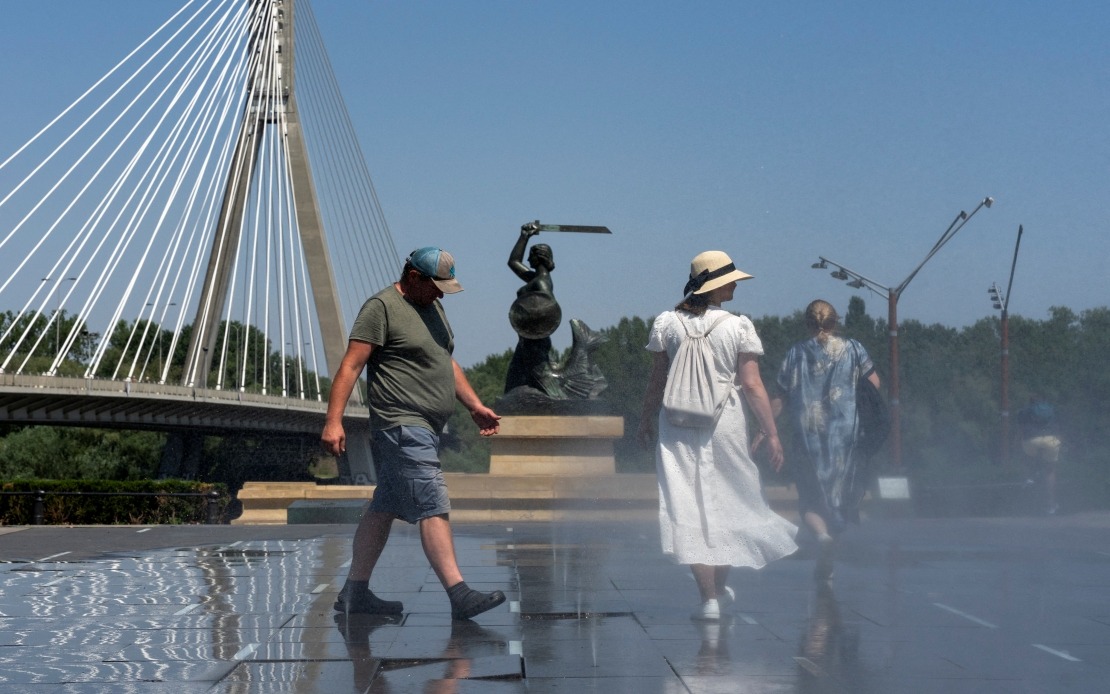
Poland's meteorological records were rewritten on Sunday when the western border town of Slubice recorded a staggering 40.5 degrees Celsius, obliterating a temperature record that had remained standing since July 1921. The previous national high of 40.2C, logged in Proszkow near Opole in southwestern Poland more than a century ago, fell to the intense summer conditions sweeping across Central Europe. Preliminary readings from the state meteorological agency IMGW also documented 40.3C in Torun, with spokeswoman Agnieszka Prasek confirming that operational data indicated the long-standing benchmark had been exceeded, pending formal verification of the measurements.
The magnitude of the temperature surge becomes apparent when considering how rapidly the heat intensified across Polish territories. Just a day earlier, Slubice itself had set what was thought to be a new June record of 38.9C, underscoring the ferocity with which this weather system developed. The doubling down of records within such a short timeframe suggests meteorological conditions of exceptional severity, rather than a gradual warming trend. For Southeast Asian readers accustomed to tropical temperatures year-round, the significance of this moment for a Central European nation cannot be overstated: such heat represents a departure from historical norms that creates genuine public health emergencies in regions unaccustomed to sustained extreme warmth.
The Polish government responded with urgency befitting a national crisis, issuing widespread safety advisories that urged citizens to minimise exposure to direct sunlight, maintain consistent hydration, and refrain from strenuous outdoor labour. Warsaw and other major urban centres activated public infrastructure designed specifically for heat mitigation, deploying misting stations and water curtains in public spaces to provide relief from the oppressive conditions. Emergency services across the country elevated their operational status, bracing for anticipated surges in heat-related medical emergencies including heatstroke and acute dehydration cases. This coordinated response underscores how seriously Polish authorities regarded the immediate threat posed by the temperature extremes.
Beyond the immediate public health dimension lies a broader environmental concern that weather specialists are flagging. Meteorologists have warned that the abrupt transition from extreme heat represents only half of the climatic equation, with severe thunderstorms anticipated to develop as cooler air masses begin penetrating the region early in the following week. This collision of weather systems creates dangerous conditions characterised by torrential rainfall, potentially destructive wind gusts, and localised flooding—precisely the kind of dangerous weather pattern that can follow multi-day heat accumulation. For Polish regions already stressed by days of exceptional temperatures, the prospect of rapid weather destabilisation compounds the challenge facing emergency response infrastructure.
This Polish heat event carries relevance for Southeast Asian observers monitoring broader European climate patterns. The continent's ongoing struggle with temperature extremes reflects global climatic shifts affecting weather systems worldwide. Malaysia and its neighbouring states, while experiencing more consistent heat throughout the year, face their own intensifying challenges from extreme precipitation and monsoon variability—phenomena increasingly attributed to the same underlying atmospheric mechanisms. The speed and magnitude of Polish temperature records being shattered suggests that historical climate baselines are becoming less reliable guides for future conditions.
The 1921 record that held for 105 years represents a different meteorological era, one in which extreme heat waves were sufficiently uncommon in Central Europe that such temperatures proved genuinely exceptional. The ease with which this benchmark was surpassed raises uncomfortable questions about whether contemporary heat waves represent one-off phenomena or indicative markers of shifting climate normals. Polish climate scientists will likely conduct detailed analyses examining whether this event represents an outlier or part of an accelerating trend, conclusions that hold implications for long-term planning across sectors from agriculture to infrastructure design.
The human cost of extreme temperatures remains incompletely quantified in most media coverage. Behind the meteorological statistics lie individuals struggling with the physiological stress of sustained heat exposure—elderly persons in inadequate housing, outdoor workers unable to suspend labour, individuals with pre-existing health vulnerabilities. The Polish government's emphasis on public misting stations and hydration messaging acknowledges these realities, though such interventions often prove insufficient when temperatures remain elevated for extended periods. Urban heat islands within cities like Warsaw compound the challenge, as built environments absorb and retain heat far more intensely than surrounding countryside.
The forest fire risk that authorities flagged represents another dimension of the hazard landscape during extreme heat events. Dried vegetation becomes increasingly flammable as temperatures soar and humidity plummets, creating conditions where relatively minor ignition sources can trigger rapidly spreading conflagrations. This concern becomes particularly acute in regions with extensive woodland cover, and Polish authorities' heightened alertness reflects hard-won lessons from previous fire seasons across Europe. The potential for simultaneous heat emergencies, flooding from subsequent storms, and wildfire threats creates compound challenges that strain emergency response capabilities.
Looking forward, this temperature record will likely prompt renewed discussions within Poland and across the European Union regarding climate adaptation strategies, building standards for extreme heat resilience, and occupational safety regulations governing work during dangerous weather. Whether framed as climate change impact or simply unprecedented weather, the reality remains that infrastructure and social systems designed around historical temperature parameters may require substantial modification. For Malaysian policymakers observing these developments, the Polish experience offers cautionary lessons regarding the cascading consequences of extreme weather events, even in wealthy nations with sophisticated emergency response systems.

