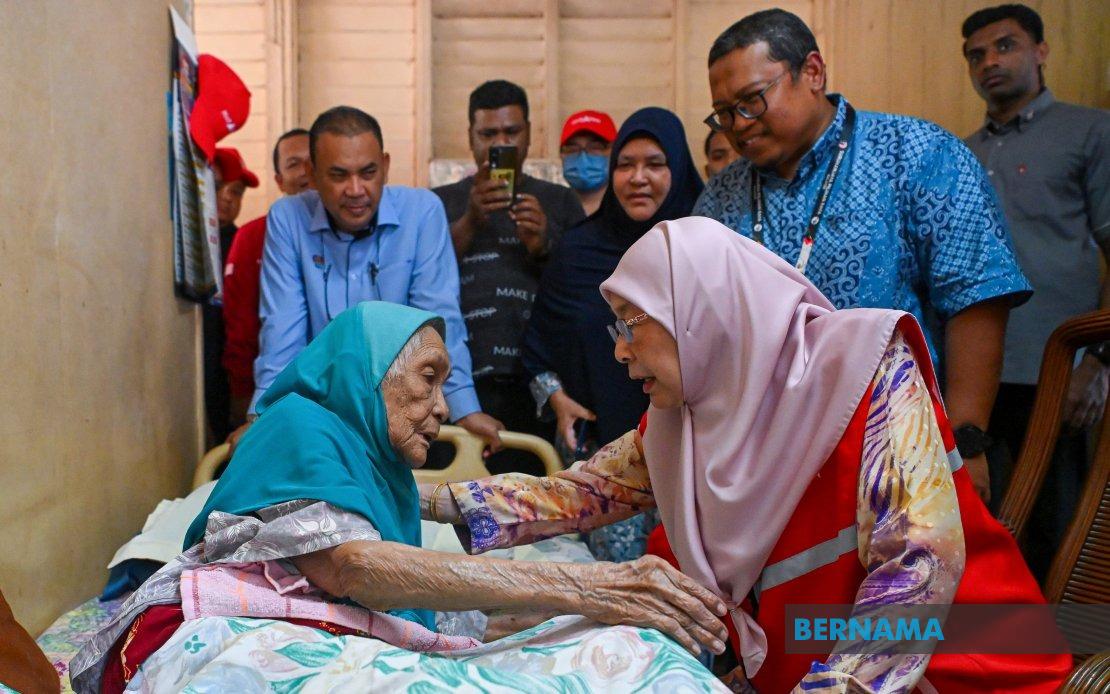
Datuk Seri Dr Wan Azizah Wan Ismail, wife of the Prime Minister, undertook a series of compassionate home visits in the Tanjung Ipoh neighbourhood of Kuala Pilah on July 30, reaching out to some of the most vulnerable members of the community. The initiative formed part of the broader Ziarah Kasih programme, a grassroots engagement effort designed to build personal connections between political leadership and residents facing hardship. The visits underscored Pakatan Harapan's strategy of combining welfare outreach with electoral mobilisation, particularly as the coalition campaigns for state seats in the region.
The morning itinerary centred on direct contact with bedridden senior citizens who have been largely isolated from public life due to age-related ailments and chronic conditions. Among those visited was Hasnah Mat Sil, a 94-year-old resident who has been confined to bed for the past three years as her health has deteriorated. The visit offered not merely symbolic recognition of her existence but also practical engagement, with Dr Wan Azizah inquiring about her circumstances and overall welfare. Such encounters, though brief, carry significant weight in rural and semi-rural communities where elderly residents often feel neglected by the machinery of national governance.
Another stop brought the delegation to the home of Faridah Salleh, an 80-year-old woman managing a bone-related condition that has rendered her immobile. Dr Wan Azizah's presence at her bedside represented a rare moment of personal attention from a figure of national prominence, and the provision of assistance—material or otherwise—signalled that asnaf (eligible zakat recipient) families within the constituency retain a claim on the political establishment's resources and concern. These interactions reflect an evolving approach to political engagement in Malaysia, where top-tier political figures increasingly prioritise direct community contact to supplement traditional rallies and formal campaign events.
The emotional impact of such visits on residents became evident through the testimony of Azidah Aziz, a 69-year-old resident who expressed genuine amazement at receiving a visit from a national leader. Her comment—that this was her first encounter with a senior politician in her own home, having previously encountered such figures only through television—highlights the profound isolation experienced by many elderly Malaysians in provincial areas. The sense of recognition and dignity conferred by such an interaction transcends the immediate practical benefits, addressing a psychological need for inclusion within the national community that is often overlooked in discussions of political strategy.
The Ziarah Kasih programme incorporated a health component that extended its reach beyond symbolic gestures. Pakatan Harapan's medical team conducted basic health screenings for the senior citizens encountered during the visits, addressing a practical gap in healthcare access for populations in peripheral areas. For residents with limited mobility and financial constraints, such in-home screening represents a valuable service that can identify emerging health problems before they become acute. This integration of medical support with political outreach reflects an understanding that electoral credibility among vulnerable populations depends partly on demonstrated capacity to address everyday material needs.
The campaign strategy extended beyond individual home visits to encompass neighbourhood-level engagement. Prior to the Tanjung Ipoh visits, Dr Wan Azizah had spent time in the Desa Kiara area, where the Ziarah Kasih programme facilitated encounters with four additional households containing residents confronting health challenges. These earlier stops allowed the delegation to meet a broader cross-section of constituents and to offer family members words of encouragement as they managed the stresses of caring for ill relatives. The repetition of these visits across multiple locations within the constituency demonstrates the methodical nature of Pakatan Harapan's ground campaign.
Beyond the welfare visits, Dr Wan Azizah's schedule included an afternoon engagement with party operatives and local supporters. This gathering functioned simultaneously as a morale-building exercise for campaign workers and as a forum for substantive exchange with residents about constituent concerns. By interleaving vulnerable-population outreach with internal party activity, the programme created multiple entry points for political engagement across different demographic segments. The deliberate cultivation of personal relationships between leadership and supporters at the grassroots level represents a recognition that electoral success in Malaysian state contests depends substantially on the quality of local party machinery.
The visits occurred within the context of Pakatan Harapan's campaign efforts in the Seremban area, where the coalition fielded candidates for multiple state seats including Seri Menanti and Sikamat. Kamarul Arifin Wafa, the PH candidate for Seri Menanti, accompanied Dr Wan Azizah throughout the Tanjung Ipoh visits, creating visual and personal association between the national leadership's endorsement and the local candidate's campaign. Similarly, Dr Wan Azizah's separate engagement in support of Nor Azman Mohamad, the PH candidate for the Sikamat seat, extended this strategy across multiple constituencies. Such coordinated leadership involvement signals to local voters that the coalition takes the state contest seriously and has allocated senior resources to campaign efforts.
The programme's emphasis on asnaf families reflects the coalition's engagement with religious and social welfare frameworks that carry particular resonance in Negeri Sembilan, a state with a substantial Muslim-majority population. By connecting Ziarah Kasih activities to zakat distribution networks and asnaf targeting, Pakatan Harapan positioned itself within established Islamic welfare traditions, thereby lending the campaign moral and spiritual dimensions beyond conventional political messaging. This approach acknowledges that political legitimacy in Malaysian context increasingly depends on demonstrated alignment with Islamic social values and welfare obligations.
The broader significance of these visits extends to patterns of political engagement observable across Southeast Asia, where national leaders increasingly employ direct community contact to build electoral coalitions. In Malaysia's context of declining party membership and growing voter volatility, such personal interactions serve to re-establish bonds of trust and reciprocity that formal party structures have sometimes failed to maintain. The Ziarah Kasih programme exemplifies this shift toward experiential politics, wherein voters' direct encounters with leaders and their representatives carry greater weight than abstract policy commitments.
Dr Wan Azizah's profile as Prime Minister's wife afforded the campaign particular amplification, as media coverage of her activities generated publicity that would be difficult to achieve through conventional candidate-level campaigning. Her participation legitimised the Seremban campaign as a matter of national political significance rather than merely local electoral importance. By investing senior leadership time in state-level elections, Pakatan Harapan signalled organisational health and confidence in its candidates' viability, messages that resonate with voters evaluating party stability and electoral prospects. The visit thus served multiple simultaneous functions: direct service delivery to vulnerable populations, morale-building for campaign operatives, media generation, and demonstration of leadership commitment to state-level contests.

