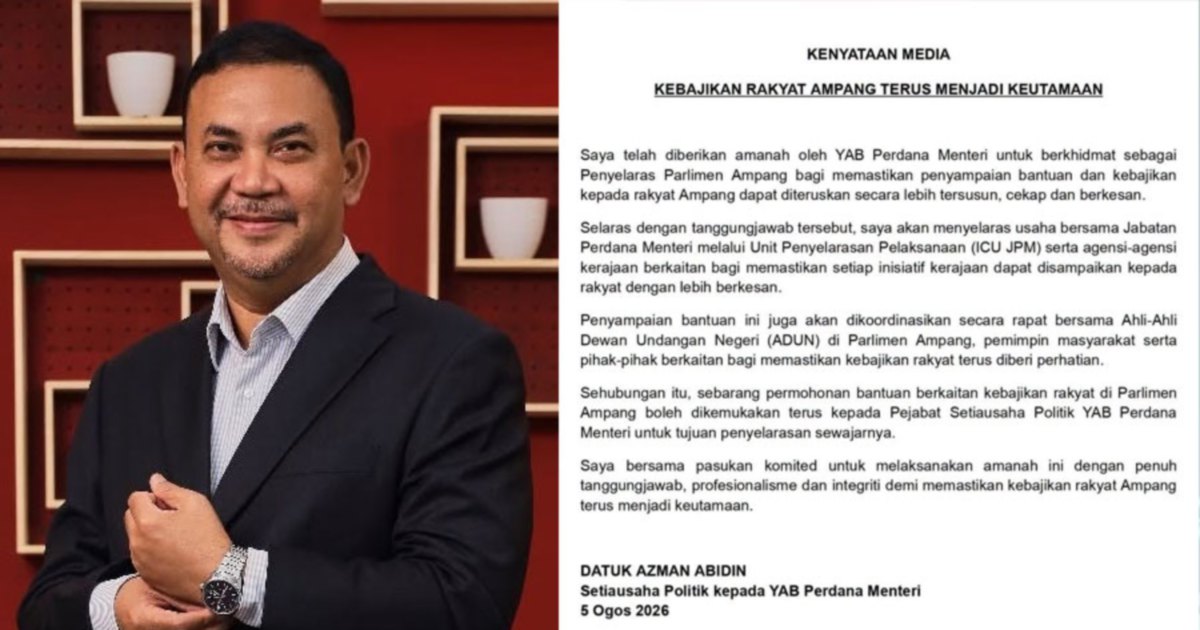
Prime Minister Datuk Seri Anwar Ibrahim's office has moved to reorganise parliamentary coordination in Ampang, appointing one of the premier's senior political secretaries to the newly created role following significant administrative changes affecting the constituency's elected representative. The decision follows the suspension of PKR lawmaker Rodziah Ismail from the MyKhas constituency allocation system, a digital platform that distributes development funds to Members of Parliament for grassroots projects and community initiatives.
The appointment signals a period of turbulence within PKR's internal structures, where tensions between the party leadership and some backbenchers have occasionally surfaced over resource allocation and political decision-making. Rodziah Ismail, who represents the Ampang constituency, has been barred from accessing the MyKhas system, effectively curtailing her ability to distribute funds directly to constituents for local projects and community development. This suspension represents a significant constraint on her parliamentary functions and her capacity to serve her electorate through targeted developmental assistance.
The MyKhas system, launched several years ago, forms a cornerstone of Malaysia's contemporary parliamentary service delivery mechanism. Designed to streamline the allocation of constituency development funds, it allows MPs to identify and prioritise local projects ranging from infrastructural improvements to educational and welfare initiatives. By centralising these decisions, the system theoretically enhances transparency and reduces bureaucratic delays. For backbench MPs like Ismail, access to these funds constitutes a vital tool for maintaining constituents' confidence and demonstrating tangible returns from parliamentary representation.
The involvement of a prime ministerial political secretary in a backbench coordination role appears to represent an escalation of centralised oversight within the executive structure. Political secretaries typically serve as extensions of the prime minister's office, handling sensitive political matters and ensuring alignment with the premier's broader strategic objectives. Deploying such a figure to manage parliamentary coordination in a single constituency suggests either extraordinary circumstances warranting close executive supervision or a deliberate consolidation of control over political movements at the grassroots level.
For Malaysian readers monitoring intra-party dynamics, this development carries implications for how power is wielded within the current administration. PKR, which forms part of the ruling coalition government, maintains a reputation for relatively more decentralised decision-making compared to some other major parties, though this trait has occasionally manifested in internal disputes and factionalism. The appointment in Ampang may signal a shift towards tighter central control, particularly over how parliamentary resources are deployed and who exercises authority over constituency-level matters.
The timing of Ismail's suspension from MyKhas remains significant. Such actions are rarely taken without careful political calculation, often reflecting either serious administrative violations or factional manoeuvring during periods of internal party recalibration. The limited official commentary surrounding the decision leaves room for speculation about underlying causes, whether they relate to procedural irregularities, political disagreements, or broader restructuring within PKR's parliamentary delegation.
Constituency allocation systems like MyKhas represent one of the few direct mechanisms through which individual MPs can demonstrate responsiveness to their voters' immediate needs. When MPs lose access to these systems, their effectiveness as local advocates diminishes substantially. Constituents in Ampang may find their development requests proceeding through alternative channels or experiencing delays, potentially affecting the MP's standing among residents who depend on parliamentary intervention for addressing community infrastructure gaps.
The appointment also reflects how modern Malaysian governance frequently operates through layered hierarchies of political authority. Prime ministerial political secretaries occupy a twilight zone between the civil bureaucracy and partisan politics, wielding substantial influence over parliamentary and party matters while nominally serving administrative functions. Their deployment to specific constituencies suggests that the executive considers particular areas sufficiently important or problematic to warrant direct supervision from the prime minister's immediate circle.
Regional observers and political analysts within Southeast Asia may find this restructuring instructive regarding how coalition governments maintain internal discipline while preserving formal democratic structures. Malaysia's complicated political landscape requires constant negotiation between centralised executive authority and the devolved powers of individual MPs, between party discipline and parliamentary independence. This Ampang appointment exemplifies how such negotiations sometimes manifest in concrete organisational adjustments.
The suspension of Ismail's MyKhas access, combined with the appointment of a prime ministerial aide to coordinate the constituency, raises broader questions about representation and accountability. Constituents who elected Ismail expect her to exercise the full range of parliamentary powers on their behalf, including resource allocation. When those powers become constrained through administrative suspension, the nature of the representative relationship shifts, even if the MP technically retains her parliamentary seat.
Political commentators within Malaysia will likely monitor whether this Ampang arrangement represents a temporary measure or signals a permanent reconfiguration of how certain constituencies are administered. If other PKR MPs face similar suspensions and parallel appointments of prime ministerial secretaries, a systemic pattern would emerge suggesting deliberate restructuring of parliamentary oversight mechanisms. Alternatively, if this remains an isolated incident, it may reflect specific circumstances particular to Ampang's political situation.
The development underscores how Malaysia's contemporary political system continues evolving in response to coalition pressures and power-sharing arrangements. Rather than proceeding through formal amendments to parliamentary procedures or party constitutions, significant changes often materialise through administrative appointments and access restrictions that achieve substantive shifts in political authority without requiring extensive public justification or legislative endorsement. For Malaysian citizens and regional observers, understanding such moves proves essential for comprehending how actual political power flows beneath the surface of formal institutions.

