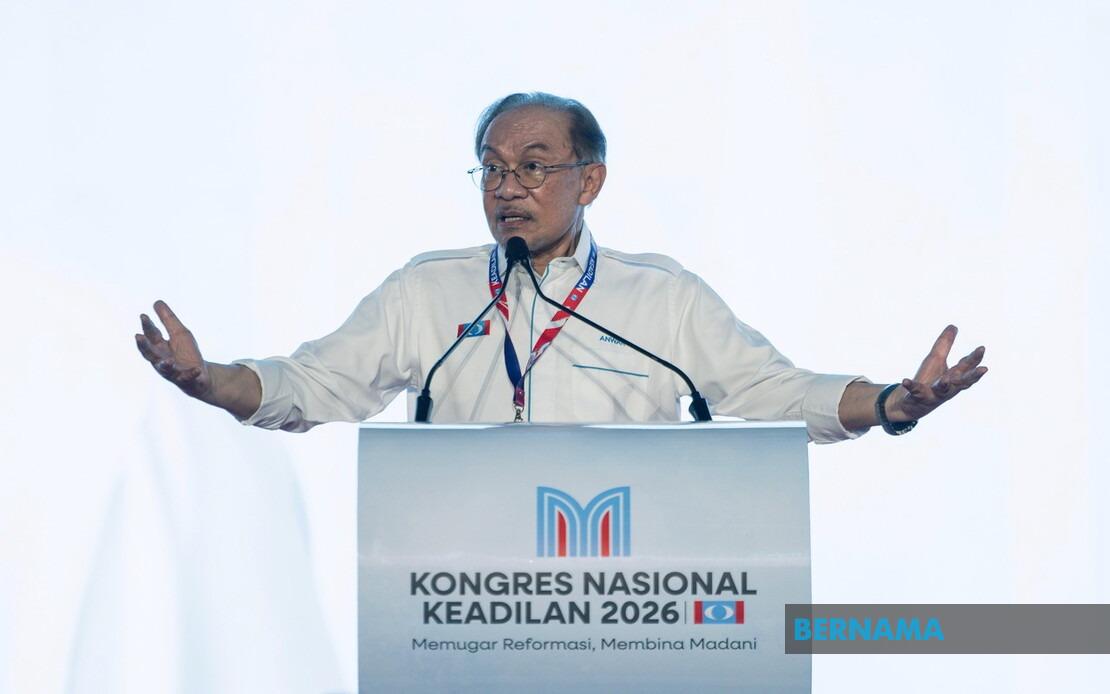
Prime Minister Datuk Seri Anwar Ibrahim has unveiled a fresh injection of RM1 million per parliamentary constituency across the nation, earmarked for direct deployment towards pressing community requirements and immediate relief efforts. The announcement, made during his closing address at the 2026 PKR National Congress in Melaka, signals the government's determination to tackle grassroots challenges with greater speed and efficiency. By routing funds directly to constituencies rather than funnelling them through layered administrative channels, the initiative seeks to eliminate the procedural obstacles that traditionally slow welfare delivery to those in need.
The fresh allocation represents a meaningful commitment from the MADANI Government to strengthen its welfare footprint at the local level. Anwar, who doubles as Finance Minister, framed the move as evidence that resource commitments to constituencies remain robust and are actually being expanded rather than trimmed. Speaking at the Melaka International Trade Centre, he stressed that the funds would address community welfare demands, essential infrastructure gaps, and localised social concerns—the precise pain points that residents encounter in their daily lives but which often struggle to gain traction within centralised bureaucratic systems.
This new monetary pledge sits alongside a broader constellation of assistance programmes already deployed nationwide. The government's existing social safety net encompasses initiatives such as the Sumbangan Tunai Rahmah and Sumbangan Asas Rahmah schemes, which together represent a RM16 billion investment in household support. The additional RM1 million per constituency should therefore be understood not as the sole pillar of government welfare strategy but rather as a complementary layer designed to address acute, time-sensitive requirements that fixed annual programmes may not adequately cover. For Malaysian constituencies, this dual-track approach creates more flexibility in responding to emergent community issues.
The timing of this announcement carries particular significance against the backdrop of Malaysia's evolving economic narrative. The government has successfully reduced the hardcore poverty rate to just 0.09 per cent, a metric that underscores real progress in absolute deprivation reduction. However, the broader cost-of-living challenge continues to weigh heavily on households across income brackets. Anwar's emphasis on translating macroeconomic gains into tangible household improvements reflects an acknowledgement that statistical economic success often masks persistent anxiety among ordinary Malaysians grappling with transport, food, utilities, and housing costs. The RM1 million allocation strategy attempts to bridge this perception gap by demonstrating that growth benefits are being channelled downwards to street level.
The Prime Minister's reference to inclusivity across income segments—spanning both the Bottom 40 per cent and Middle 40 per cent—reveals an administration conscious of a broadening squeeze on middle-class purchasing power. School assistance, subsidised Rahmah sales outlets, and housing finance support packages are presented as comprehensive interventions that avoid stigmatising assistance as purely for the poorest households. This framing matters for social cohesion and political sustainability. When middle-income families perceive government support as geared exclusively towards the poorest, resentment can fester. By positioning aid as a universal social infrastructure benefiting the bulk of the population, the government constructs a more resilient political coalition.
For individual constituencies, the practical implications are substantial. A parliamentary seat representing perhaps 150,000 voters now has RM1 million in discretionary resources to deploy towards pressing local needs without waiting for centralised budget cycles or navigating complex procurement processes. Members of Parliament effectively gain enhanced capacity to respond rapidly to constituent requests, whether funding a community centre repair, supporting a local welfare initiative, or addressing infrastructure bottlenecks that state or federal budgets may have overlooked. This decentralisation of spending authority can amplify the responsiveness of the political system, though it equally creates potential for patronage if transparency safeguards are weak.
The structural design of the initiative warrants scrutiny from a Malaysian governance perspective. Channelling funds directly to constituencies rather than through state governments or federal ministries represents a deliberate assertion of parliamentary primacy in welfare distribution. This choice reflects both the centrality of the constituency in Malaysian political culture and perhaps also a calculation that the House of Representatives remains the most accessible institutional touchpoint for voters seeking redress. However, coordination challenges may emerge if state governments simultaneously pursue overlapping community development priorities, risking duplication or gaps in coverage across constituencies with different political alignments.
Anwar's exhortation to party machinery at branch and grassroots levels to actively educate communities about available assistance programmes reveals an understanding that policy announcements alone rarely translate into uptake. Information asymmetries often mean that vulnerable populations remain unaware of support schemes for which they qualify. By tasking PKR party structures to undertake ground-level advocacy, the government attempts to address this implementation gap, though the partisan nature of this dissemination mechanism may encounter skepticism in constituencies governed by opposition parties. The success of the initiative may therefore hinge partly on how effectively non-PKR constituency representatives also mobilise information about the RM1 million allocation to their constituents.
Regionally, Malaysia's approach offers an interesting contrast to welfare delivery models adopted by neighbouring Southeast Asian governments. While some nations concentrate social spending through central agencies to maximise efficiency and consistency, Malaysia's stratified system—combining national programmes with constituency-level discretion—reflects the country's complex federal architecture and the political premium placed on parliamentary representation. For observers in the region watching Malaysian governance evolution, this allocation decision underscores how even ostensibly technocratic resource decisions carry profound political logic.
Looking forward, the RM1 million per-constituency allocation will require robust monitoring to ensure funds reach intended beneficiaries and are deployed transparently. Public reporting on how each constituency utilises its allocation would strengthen accountability and allow for performance benchmarking across regions. Questions about replenishment—whether this is a one-off or recurring allocation—also merit clarification, as constituencies will need funding certainty to plan community interventions effectively. The announcement's long-term impact will ultimately depend not merely on the generosity of the allocation but on the institutional mechanisms established to govern its distribution and the commitment of political actors across party lines to prioritise constituent welfare over narrow partisan advantage.
The initiative reflects a government seeking to demonstrate tangible gains for ordinary Malaysians as economic conditions remain tight for many households despite headline GDP growth. By placing fresh resources in the hands of elected representatives closest to communities, the MADANI Government wagers that proximity to decision-making power will yield greater satisfaction than distant, centralised welfare administration. Whether this gamble pays off will become evident as constituencies implement their allocations and voters assess whether the RM1 million genuinely accelerates solutions to the problems that matter most to them.

