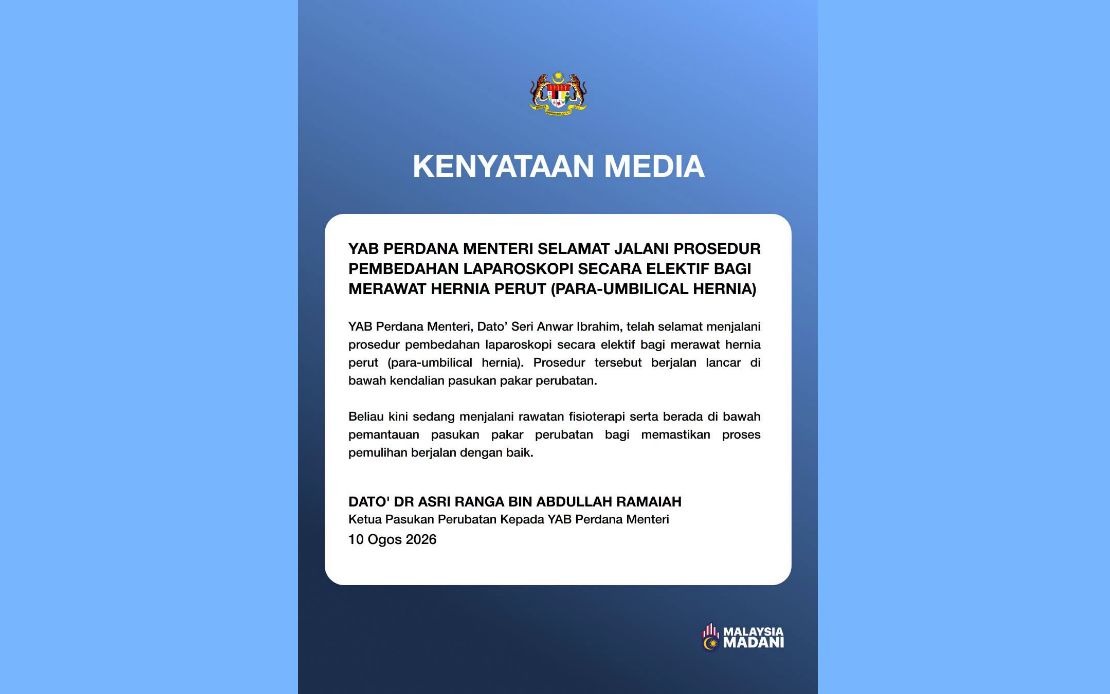
Prime Minister Datuk Seri Anwar Ibrahim has successfully completed an elective surgical procedure to address a para-umbilical hernia, a condition affecting the abdominal wall near the navel. The laparoscopic intervention, performed on August 10, proceeded without complications under the care of a specialist surgical team, marking a routine medical intervention for the nation's leader.
The procedure represents a minimally invasive approach to treating the hernia, a common abdominal condition where tissue protrudes through a weakness in the muscle wall. Laparoscopic surgery, which uses small incisions and camera guidance rather than open surgery, typically results in faster recovery times and reduced post-operative discomfort—advantages that are particularly significant for individuals with demanding schedules such as those in high government office.
According to Datuk Dr Asri Ranga Abdullah Ramaiah, head of the Prime Minister's Medical Team, the operation proceeded smoothly and without incident. Dr Asri indicated that all aspects of the surgical intervention adhered to established medical protocols and specialist oversight, reflecting the comprehensive medical infrastructure available to Malaysia's premier. The successful completion of the procedure signals that the medical team managing the Prime Minister's health maintains access to contemporary surgical facilities and experienced specialists capable of managing such conditions.
Following the operation, Anwar has entered the recovery phase, currently undergoing physiotherapy to rebuild strength and mobility after the surgical intervention. Physiotherapy following abdominal surgery is a standard precautionary measure designed to prevent complications, promote healing, and restore normal physical function. The Prime Minister remains under the continuous observation of the medical specialist team charged with monitoring his post-operative progress and ensuring adherence to recovery protocols.
The Prime Minister's senior press secretary, Tunku Nashrul Abaidah, had previously communicated that Anwar would require approximately two days of hospital observation following the procedure. This timeframe aligns with standard post-operative monitoring for laparoscopic hernia repair, during which medical teams assess pain management, infection risk, and overall recovery trajectory. The decision to maintain supervised observation reflects appropriate medical caution for ensuring optimal healing without complications.
The announcement of the surgery comes against the backdrop of Anwar's continued political responsibilities heading the government during a challenging economic and social landscape. His absence, though temporary and planned, highlights the practical reality that even national leaders require medical attention and recovery time. The transparency with which the government communicated this procedure demonstrates a commitment to keeping the public informed about their leader's wellbeing, reducing speculation and maintaining confidence in governmental continuity.
For Malaysian governance structures, the successful completion of routine surgical procedures by high-ranking officials underscores the importance of medical succession planning and institutional resilience. While Anwar's condition required only minor surgical intervention, the episode serves as a reminder of the vulnerability inherent in any system relying heavily on a single individual's presence. The smooth functioning of government during periods when the Prime Minister requires medical attention depends on robust institutional frameworks and delegated authority structures.
The public expression of support requested through prayer and well-wishes reflects cultural and religious norms within Malaysian society. The Prime Minister's office actively encouraged citizens to offer spiritual support during the medical procedure, a gesture that resonates across Malaysia's diverse religious communities. Such communication strategies help maintain public connection to leadership during periods of physical challenge or absence from public duties.
Anwar's expected return to full governmental duties in the near term signals confidence within the medical team regarding his recovery prospects. Para-umbilical hernias, while requiring surgical intervention, are not life-threatening conditions and respond well to laparoscopic treatment, with most patients returning to normal activities within two to four weeks. For a political leader, this timeline suggests minimal disruption to his executive functions, though some restriction on strenuous activity may persist during the immediate recovery window.
The incident also reflects broader healthcare quality considerations in Malaysia. Access to laparoscopic surgical facilities and specialist teams capable of managing abdominal conditions represents a marker of the nation's healthcare infrastructure development. Such capabilities are increasingly available beyond private facilities, indicating the growing sophistication of Malaysia's public and private medical sectors in providing contemporary surgical interventions.

