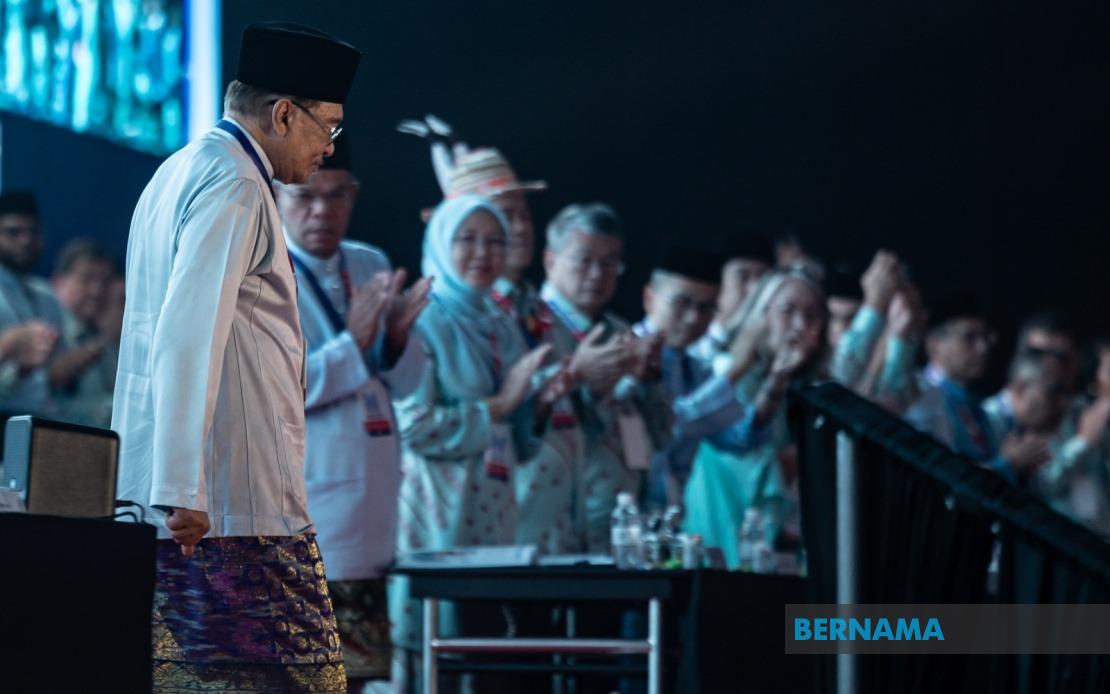
Prime Minister Datuk Seri Anwar Ibrahim has firmly rejected suggestions that the MADANI Government treats certain states unfairly, declaring instead that federal allocations have risen meaningfully across the country during his tenure. Speaking at the 2026 PKR National Congress in Melaka on August 15, Anwar presented detailed figures to counter claims of regional disparity, emphasising that budget decisions reflect varying development priorities rather than political favouritism or neglect.
The Prime Minister's remarks came as he delivered his Presidential Policy Speech at the Melaka International Trade Centre in Ayer Keroh, using the platform to set the record straight on contentious allegations about resource distribution. His intervention signals that concerns about unequal treatment between states have gained sufficient traction to warrant a direct, data-driven response from the highest office. This defensive posture underscores the political sensitivity surrounding fiscal federalism in Malaysia, where questions about equity between states—particularly those governed by opposition parties—frequently ignite debate.
Anwar highlighted Sabah's situation as a case study, noting that federal expenditure in the state has climbed by 35 per cent over the three years since the MADANI Government assumed office in 2022. He pointedly questioned whether previous administrations had similarly increased allocations to Sabah, implying that the current trajectory represents genuine improvement. This framing attempts to reset expectations by comparing his government's performance against historical baselines rather than abstract standards of fairness.
The allocation figures presented paint a picture of broad-based increases across multiple states. Terengganu's budget grew from RM6 billion in 2022 to RM8.1 billion in the current fiscal year, representing a 35 per cent rise. Johor, Malaysia's southernmost state, experienced even more dramatic growth, with allocations expanding from RM10.2 billion in 2022 to RM14.6 billion projected for 2026—a 43 per cent increase. Sarawak, the largest Malaysian state by area, received RM10.2 billion in 2022 and saw this rise to RM15.1 billion, marking a 48 per cent jump. Sabah's federal allocation specifically climbed from RM13 billion to RM17.6 billion, again reflecting the 35 per cent growth cited.
Perhaps most significantly for the narrative of equitable treatment, Anwar mentioned that Perlis, Kedah, and Kelantan have also benefited from rising allocations under his administration. These states span different political alignments, suggesting that budget increases have not been confined to states governed by MADANI coalition partners. The inclusion of Kelantan, traditionally a Parti Islam Se-Malaysia stronghold, appears particularly deliberate in countering charges of partisan distribution.
The underlying tension in Anwar's remarks reveals a fundamental challenge in federal budgeting: explaining why allocations differ between states without implying that some regions receive inferior treatment. His argument—that allocations reflect priorities rather than neglect—requires accepting that not all states have identical needs or development stages. This approach risks appearing inadequate to states feeling relatively disadvantaged, particularly if their leaders attribute lower allocations to political opposition rather than genuine policy reasoning.
From a Southeast Asian perspective, Malaysia's federal distribution system faces scrutiny comparable to challenges in other large, multi-state democracies. Indonesia, the Philippines, and Thailand all wrestle with regional equity questions. Malaysia's federal system, however, grants states substantial autonomy over certain matters, making transparent, defensible budget allocation criteria especially important. When the Prime Minister must publicly defend against sidelining accusations, it suggests that confidence in the fairness of the allocation mechanism may have eroded.
The political context matters significantly here. State governments controlled by opposition parties sometimes claim discrimination in federal fund distribution, while federal governments often counter that such claims reflect partisan grievance rather than reality. Anwar's presentation of figures attempts to move the debate from anecdotal complaint to empirical ground. Yet the effectiveness of this strategy depends on whether stakeholders trust the underlying data and accept the methodology for comparing allocations across different state situations.
For Malaysian readers and policymakers, the broader implication concerns governance credibility. When a Prime Minister feels compelled to defend budget allocations with itemised figures, it reflects either genuine concerns about fairness or effective opposition messaging—possibly both. The specific inclusion of percentage increases, rather than absolute figures alone, suggests an attempt to show that even states starting from lower baselines have experienced proportionally significant growth. This rhetorical move acknowledges that absolute amounts matter less than growth trajectories when assessing equitable treatment.
Looking forward, the MADANI Government's success in addressing regional allocation concerns will likely depend on sustained budget increases and transparent communication about the criteria underlying fiscal decisions. As Malaysia navigates demographic changes, economic restructuring, and climate resilience investments, how federal resources are distributed will remain central to national cohesion. States perceiving themselves as neglected may seek greater autonomy or political realignment, making Anwar's emphasis on rising allocations more than merely financial—it carries implications for Malaysia's political stability and federal architecture.
The Prime Minister's defence also reflects broader economic conditions. Rising allocations to states become easier to achieve during periods of fiscal expansion, but become contentious when growth slows or austerity looms. MADANI's ability to maintain the upward trajectory it has presented will ultimately determine whether current allocations are remembered as evidence of fair treatment or viewed retrospectively as insufficient compensation for prior imbalances.

