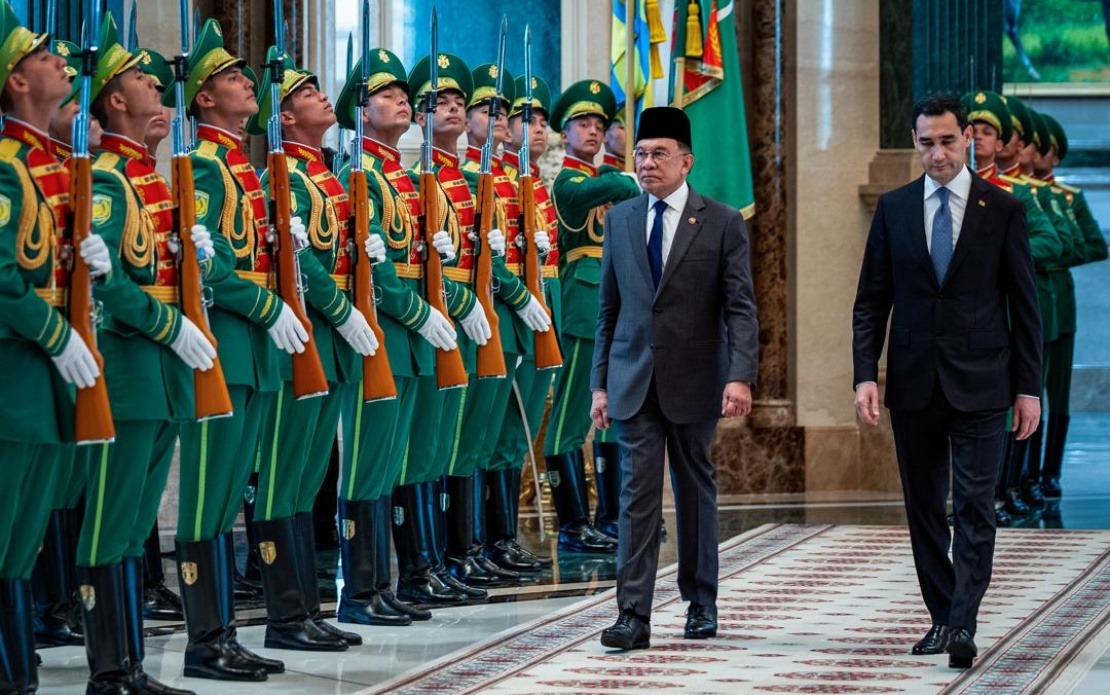
Prime Minister Datuk Seri Anwar Ibrahim was given a ceremonial reception at the Turkmenistan Presidential Palace in Ashgabat on June 19, underscoring the diplomatic importance of his inaugural official visit to the Central Asian nation since assuming Malaysia's highest political office. The welcome included full state protocol, featuring a formal guard of honour and the simultaneous playing of both nations' anthems, a symbolic gesture reflecting the significance of bilateral relations between Malaysia and Turkmenistan.
President Serdar Berdimuhamedov personally greeted the Malaysian leader upon his arrival at the palace, setting the tone for high-level engagement between the two governments. Following the ceremonial aspects of the reception, Anwar was introduced to key figures from the Turkmenistan cabinet and various senior government officials, facilitating initial diplomatic familiarity before substantive discussions commenced. In reciprocal fashion, the prime minister presented members of the Malaysian delegation accompanying him to the Turkmenistan president, reinforcing the collaborative nature of the visit.
The engagement progressed to a private bilateral session between Anwar and Berdimuhamedov, allowing the two leaders to discuss matters of strategic importance without formal proceedings. This one-on-one setting typically enables candid conversations on sensitive issues and longer-term cooperation frameworks. The private discussion was followed by a more formal bilateral meeting involving senior officials and ministers from both delegations, where broader cooperation agendas and mutual interests would be explored in greater depth.
The two-day visit, which commenced on June 18, represents Anwar's first journey to Turkmenistan in an official capacity since he became Malaysia's 10th Prime Minister in November 2022. The trip itself was extended an invitation by President Berdimuhamedov, indicating Turkmenistan's initiative in strengthening ties with Malaysia at the highest political level. This outreach suggests growing interest in deepening engagement between the two nations across various sectors.
Turkmenistan, strategically positioned in Central Asia, holds significant geopolitical and economic importance in the broader Asian landscape. As a nation rich in hydrocarbon resources and positioned along historic trade corridors, it presents opportunities for Malaysian businesses and investors, particularly in energy and infrastructure sectors. Malaysia's engagement with Central Asian nations has traditionally been limited compared to its focus on Southeast Asia and the Middle East, making this visit part of a broader diplomatic expansion.
For Malaysia, cultivating stronger relationships with Central Asian states serves multiple strategic objectives. It diversifies the nation's diplomatic footprint, reduces dependence on traditional regional partnerships, and opens pathways for Malaysian companies to access markets in the broader Eurasian region. Central Asian nations increasingly seek partnerships with dynamic Asian economies, and Malaysia's positioning as a moderate Muslim-majority nation with advanced economic capabilities makes it an attractive partner.
The bilateral discussions likely touched upon trade and investment opportunities, cultural exchanges, and potential cooperation in Islamic affairs—areas where Malaysia has historically maintained strong interests. Energy cooperation could also feature prominently, given Turkmenistan's substantial natural gas reserves and Malaysia's growing energy demands. Additionally, regional stability and connectivity initiatives may have been discussed, particularly Malaysia's role in supporting regional development frameworks.
Anwar's visit reflects Malaysia's broader foreign policy under his administration, which has emphasised expanding international engagement and positioning the country as a bridge between different regions and civilizations. Since assuming office, Anwar has prioritised high-level diplomatic visits to strengthen Malaysia's standing in the international community and foster partnerships that advance national interests. This Central Asian foray demonstrates commitment to geographic diversification in Malaysia's external relations.
From Turkmenistan's perspective, engaging Malaysia signals its interest in building relationships with Southeast Asian economies and deepening its participation in broader Asian affairs. Central Asian nations have increasingly sought to establish stronger links with the dynamic economies of Southeast Asia, recognising the region's economic vitality and geopolitical importance. Turkmenistan's proactive outreach to Malaysia reflects these strategic calculations and its desire to position itself as a cooperative partner in the broader Asian community.
The visit also carries symbolic significance in demonstrating Malaysia's commitment to multi-vector diplomacy and building bridges across different regions of Asia. In an era of shifting global dynamics and increasing strategic competition, such engagement helps Malaysia maintain flexibility in its international positioning and develop relationships that transcend traditional alliance structures. The ceremonial reception accorded to Anwar reflects mutual respect and the desire of both nations to move beyond symbolic gestures toward substantive cooperation.
Moving forward, the outcomes of these bilateral discussions may manifest in formal agreements or memoranda of understanding covering specific sectors or initiatives. Future cooperation could encompass trade facilitation, educational exchanges, tourism development, and participation in regional multilateral forums. The success of this inaugural visit may well determine the trajectory of Malaysia-Turkmenistan relations over the coming years, potentially opening doors for deeper institutional partnerships and regular high-level visits.
The visit underscores how Malaysia, despite its size, continues to punch above its weight in international diplomacy by cultivating relationships across geographically diverse regions. Anwar's engagement with Turkmenistan adds another layer to Malaysia's diplomatic architecture and reinforces the nation's reputation as a trustworthy and forward-thinking partner. As Malaysia navigates an increasingly complex global landscape, such strategic partnerships with nations in emerging regions become increasingly valuable for securing long-term national interests and opening new avenues for prosperity.

