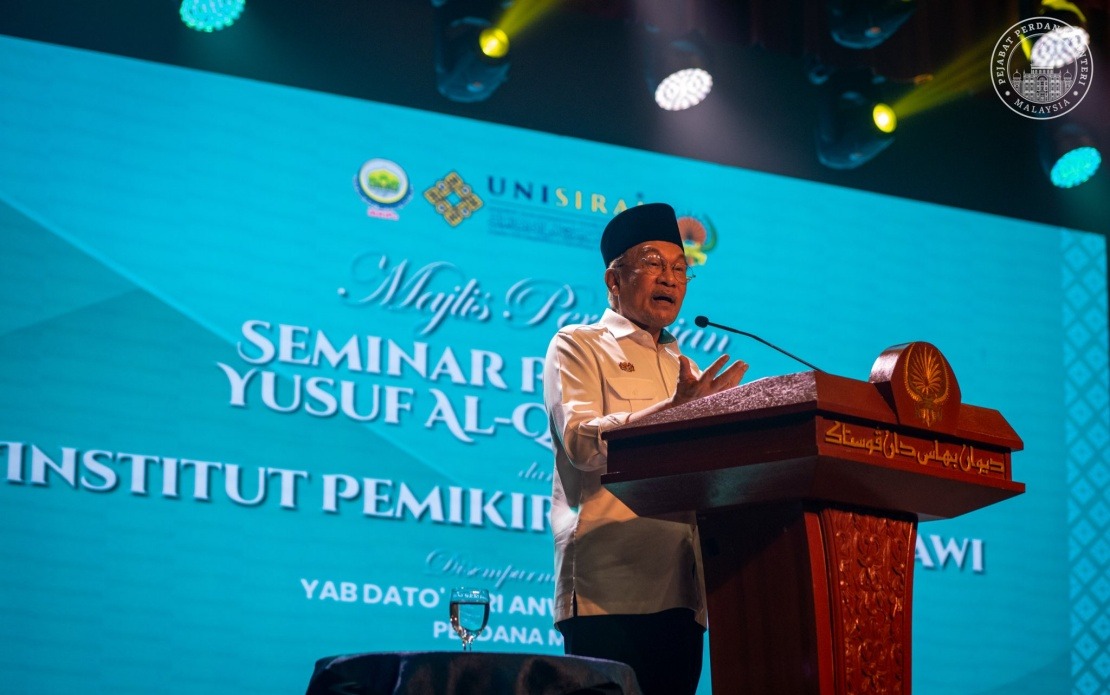
Prime Minister Datuk Seri Anwar Ibrahim has pledged RM2 million in MADANI Government support for the Al-Qaradawi Thought Institute, marking an official commitment to preserving and advancing the intellectual contributions of the late Sheikh Dr Yusuf Al-Qaradawi. The announcement came during the opening ceremony of the Yusuf Al-Qaradawi Thought Seminar and the establishment of the institute itself at Wisma Dewan Bahasa dan Pustaka in Kuala Lumpur on July 21, signalling the administration's emphasis on scholarly research into Islamic moderation and contemporary Islamic thought.
Through a post on the X platform, Anwar expressed his personal connection to Al-Qaradawi's work and philosophical influence. He acknowledged the intellectual and moral debt he carries toward the renowned Islamic scholar, framing the government's investment as part of a broader commitment to ensure that transformative ideas continue to benefit the Muslim community. The Prime Minister's framing reflected a recognition that sustained institutional support could allow Al-Qaradawi's legacy to extend beyond the scholar's lifetime into future generations of researchers and students across the Muslim world.
Anwar's relationship with Al-Qaradawi dates to his formative years leading the Malaysian Islamic Youth Movement, or ABIM, during the Islamic resurgence of the early 1980s. During that pivotal period, when Muslim societies were grappling with modernity and identity, Al-Qaradawi provided guidance to the young activist through written correspondence and intellectual direction. The Prime Minister specifically recalled how the scholar had counselled ABIM to avoid extremist positions and instead embrace wasatiyyah, a concept rooted in Islamic tradition that emphasises the middle path, balance, and moderation in religious interpretation and practice.
The timing of Al-Qaradawi's intervention proved historically significant. The early 1980s represented an era when Islamic movements worldwide were often polarised between secularist accommodation and doctrinaire resistance to contemporary change. Malaysian Islamic circles were equally susceptible to these tensions, with some voices advocating uncompromising stances against Western influence while others pushed for wholesale modernisation. Anwar characterised Al-Qaradawi's counsel as essential ballast during these turbulent ideological waters, offering intellectual permission to pursue Islamic revival without surrendering to insularity or hostility toward pluralistic thought.
In reflecting on Al-Qaradawi's broader intellectual legacy, Anwar positioned the scholar as a transformative figure whose primary contribution was demonstrating that Islam could engage constructively with contemporary challenges. Rather than treating modernity as an existential threat to Islamic identity, Al-Qaradawi modelled an approach that interrogated each modern development against Islamic principles, selectively adopting innovations while maintaining doctrinal integrity. This methodology proved influential not only in Malaysia but across the broader Muslim world, where his writings circulated widely and shaped generational cohorts of Islamic intellectuals.
The establishment of the Al-Qaradawi Thought Institute represents institutional recognition of this legacy at the national level. By creating a dedicated research entity, the Malaysian government signals that systematic study of moderate Islamic scholarship deserves the same resources and prestige afforded other domains of academic inquiry. The institute's mission extends beyond archival preservation to active scholarly engagement, potentially generating new research that explores how Al-Qaradawi's principles might apply to contemporary Malaysian challenges ranging from interfaith relations to economic justice within Islamic frameworks.
For Malaysian policy circles, the investment in the institute carries implicit messaging about the government's own ideological positioning. By elevating Al-Qaradawi's moderatism as worthy of state-sponsored research and funding, Anwar's administration reinforces its own public commitment to wasatiyyah principles and scholarly Islam over populist religious appeals. This positioning distinguishes the current government from competing visions of how Islamic identity should inform Malaysian governance, particularly relevant given ongoing domestic tensions over religious authority and the relationship between Islam and plural democracy.
The RM2 million allocation, while modest in budgetary terms, signals intent rather than furnishing a comprehensive research endowment. The funding likely covers institute establishment, initial staffing, library development, and seed research projects rather than sustained multiyear operations. Success will depend on whether the institute can attract additional funding from philanthropic sources, international Islamic academic networks, and perhaps modest parliamentary allocations in subsequent years. The Malaysian model of supporting Islamic scholarship through dedicated institutions remains comparatively underdeveloped relative to similar investments in other regions, presenting both opportunity and vulnerability for this nascent centre.
Regionally, the institute's establishment reflects broader Southeast Asian interest in Islamic thought institutions that can compete intellectually with Middle Eastern centres of learning. Malaysia, Indonesia, and other ASEAN nations have invested in creating indigenous Islamic scholarship hubs to avoid overdependence on external Islamic intellectual authority. The Al-Qaradawi Thought Institute slots into this strategic positioning, offering Malaysian researchers and students access to systematic study of a non-Arab Islamic intellectual who achieved pan-Muslim influence, potentially inspiring similar scholarly initiatives across the region.
For the institute's immediate operations, key questions include its governance structure, research priorities, and engagement with international Islamic academia. A well-functioning institution could attract visiting scholars, host international conferences, and publish research in languages beyond Malay and English, amplifying Malaysian contributions to global Islamic intellectual discourse. Conversely, if the institute becomes narrowly propagandistic or politicised, it may fail to achieve scholarly credibility essential for genuine intellectual influence.
Anwar's personal investment in honouring Al-Qaradawi also reflects the Prime Minister's own intellectual identity. Throughout his career, Anwar has positioned himself as an Islamic reformer committed to integrating Islamic principles with democratic governance, pluralistic coexistence, and economic modernisation. By publicly celebrating Al-Qaradawi's influence on his own thinking, Anwar authenticates his political philosophy through connection to a respected international Islamic scholar, enhancing his legitimacy among Muslim constituencies while signalling to secular and non-Muslim audiences that his Islamic vision remains compatible with democratic and inclusive governance frameworks.
The Al-Qaradawi Thought Institute thus emerges as more than a research centre—it functions as a statement about Malaysia's place in contemporary Islamic intellectual geography and the government's commitment to promoting scholarly Islam grounded in moderation, engagement with pluralism, and reform-minded interpretations of Islamic tradition. As the institute develops, its scholarly output and international reputation will significantly shape perceptions of Malaysian Islamic thought for years to come.

