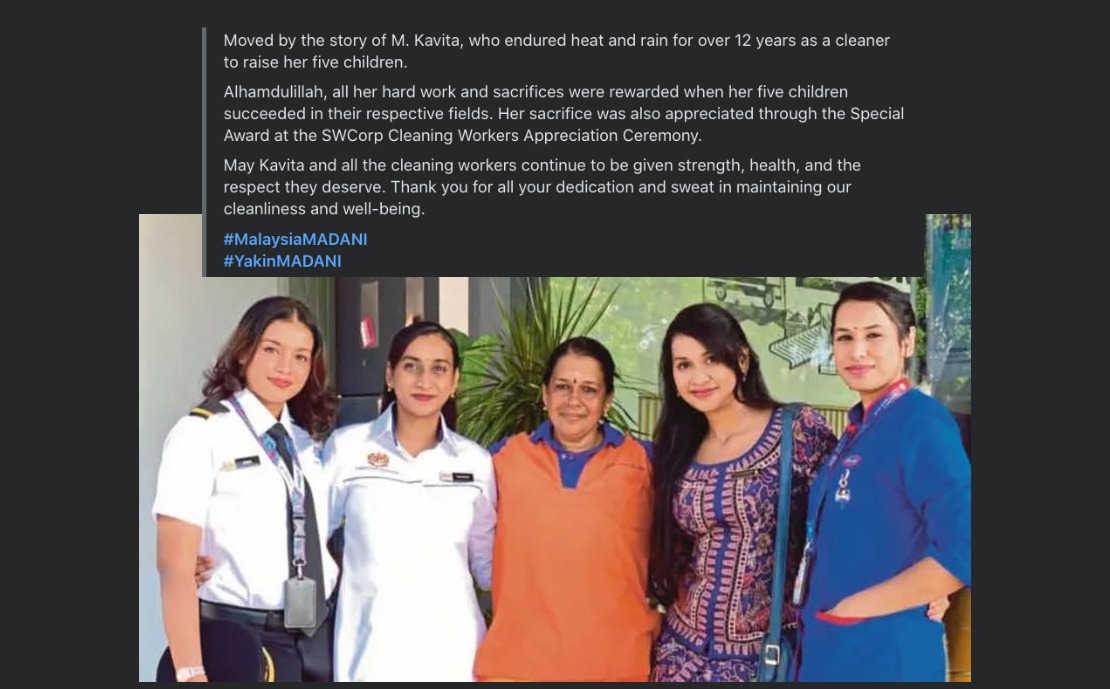
Prime Minister Datuk Seri Anwar Ibrahim has singled out for praise the contributions of M. Kavita, a street sweeper whose unwavering commitment to her family while performing essential municipal work has resonated deeply with the nation's leadership. Through a Facebook message shared today, Anwar acknowledged Kavita's extraordinary personal journey spanning more than a dozen years of labor in Malaysia's heat, rain, and challenging working conditions—all undertaken to secure a better future for her five children.
Kavita's story gained widespread traction across Malaysian social media platforms when her four daughters made an unexpected appearance at her workplace last month to celebrate her 50th birthday. The emotional moment captured public imagination precisely because the daughters arrived dressed in their professional uniforms, each representing a different field of achievement: one working as a commercial airline pilot, another as cabin crew, and a third employed as a qualified staff nurse. The spontaneous gathering moved Kavita to tears, crystallizing the payoff of years spent in one of Malaysia's most demanding frontline occupations.
The Prime Minister's intervention to publicly celebrate Kavita's accomplishments carries symbolic weight in Malaysia's ongoing national conversation about workers in essential services. Street sweepers and cleaning personnel form the invisible backbone of urban sanitation, yet their contributions often go unacknowledged in public discourse. By elevating Kavita's narrative, Anwar has directed attention toward the often-overlooked dignity embedded within manual labor and the resilience required to balance demanding work with responsible parenting. His recognition underscores an implicit government message that such workers merit respect as integral participants in Malaysian society.
Kavita's formal recognition extended beyond the Prime Minister's tribute when she received a Special Award at SWCorp's Cleaning Workers' Day Appreciation ceremony held the day before Anwar's statement. SWCorp Malaysia, the statutory body responsible for waste management in the country, designed this acknowledgment specifically to honor frontline sanitation employees whose contributions to public health infrastructure often receive minimal public appreciation. The timing of this award alongside the Prime Minister's comments suggests a coordinated institutional effort to elevate the profile of cleaning workers during a designated period of recognition.
The employee works for SWM Environment in Seremban, operating within Negeri Sembilan's municipal sanitation framework. Her case illustrates broader realities affecting cleaning workers across Malaysian cities, where single parents or families dependent on service-sector wages must navigate significant economic constraints while maintaining household responsibilities. Kavita's particular achievement—seeing all five children progress into stable, skilled employment—exceeds statistical expectations for families in comparable economic circumstances, making her trajectory genuinely noteworthy as both a personal and sociological phenomenon.
Anwar's tribute specifically acknowledged the sacrificial dimension of Kavita's labor, recognizing that year-round exposure to outdoor working conditions represents a significant physical and personal investment. Street sweepers encounter numerous occupational hazards including heat stress, traffic exposure, and physical strain while performing work that benefits entire communities. By framing Kavita's efforts as worthy of respect and blessing, the Prime Minister articulated a vision of Malaysian society in which such contributions receive appropriate social recognition rather than remaining invisible or stigmatized.
The message conveyed through Anwar's statement extends beyond individual commendation to encompass systemic acknowledgment. His call for continued strength, health, and respect for all street sweepers and cleaning workers signals governmental awareness that these professions demand structural support and societal appreciation. The phrasing suggests implicit recognition that workers in these roles deserve not merely employment but genuine dignity within Malaysia's social hierarchy—a perspective that challenges persistent stigmatization of manual service work.
Kavita's story arrives at a moment when Malaysian discourse increasingly engages questions about labor conditions, social mobility, and family resilience. Her ability to propel five children toward professional achievement while employed in one of Malaysia's most physically demanding occupations demonstrates possibilities for economic advancement and family stability even within constrained circumstances. For many Malaysians of modest means, her trajectory offers a narrative of hope and possibility, illustrating that parental dedication can transcend economic limitations.
The viral social media dimension of Kavita's birthday celebration highlights how modern technology enables personal stories to achieve national prominence and prompt official recognition. What began as a private family moment captured on video became a vehicle for broader conversation about work, sacrifice, and achievement in contemporary Malaysia. This democratization of narratives—where a street sweeper's story can reach the Prime Minister's attention through social platforms—represents a meaningful shift in how Malaysian society processes and values contributions from its working population.
Moving forward, Anwar's public acknowledgment may influence how Malaysian institutions and the general public regard cleaning workers and similar professions. By featuring Kavita prominently in official communications, the government signals that such workers merit inclusion in national narratives about progress and achievement. Whether this recognition translates into concrete policy improvements affecting wages, working conditions, or occupational safety for Malaysia's broader cleaning workforce remains to be seen, yet the symbolic validation itself represents a meaningful development in how the nation's highest leadership engages with its service-sector employees.

