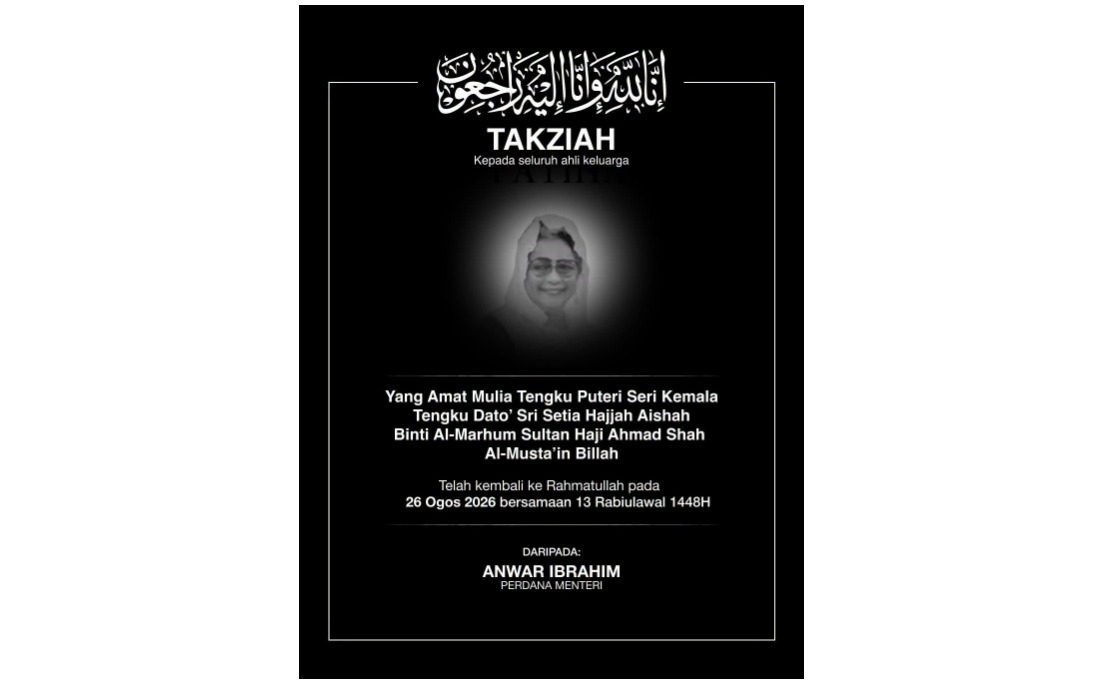
Prime Minister Datuk Seri Anwar Ibrahim has expressed his sympathies to the Pahang Royal Family following the passing of Tengku Puteri Seri Kemala Tengku Datuk Seri Aishah Almarhum Sultan Ahmad Shah, the elder sister of Pahang's reigning Sultan Al-Sultan Abdullah Ri'ayatuddin Al-Mustafa Billah Shah. The announcement came through a Facebook post issued on August 27, as the nation's leadership acknowledged the loss of a member of one of Malaysia's oldest and most prominent royal households.
Tengku Datuk Seri Aishah, who held the title Tengku Puteri Seri Kemala, passed away at a private hospital in Kuala Lumpur at 9:15 pm on August 26. Her death marks the passing of a generation within the Pahang royal lineage, as she was the sister of the current Sultan and the daughter of the late Sultan Ahmad Shah, who previously served as Yang di-Pertuan Agong. The timing of her death during the latter months of the year prompted swift official recognition from Malaysia's highest political office.
In his condolence message, the Prime Minister invoked Islamic traditions by praying that Allah would extend His mercy upon Tengku Datuk Seri Aishah's soul and forgive her transgressions. Such expressions form an important part of Malaysia's formal protocol when acknowledging the deaths of members of the royal families, reflecting both the constitutional status of the sultans and the predominantly Muslim character of the nation's leadership. Anwar's statement underscored the significance accorded to royalty in Malaysia's political and social hierarchy.
Beyond personal prayers for the deceased, Anwar also sought divine strength for the bereaved royal household, specifically naming Al-Sultan Abdullah, Tengku Ampuan of Pahang Tunku Azizah Aminah Maimunah Iskandariah, and the broader Pahang Royal Family. This multi-layered expression of sympathy demonstrated the customary acknowledgment of both the immediate family circle and the extended royal institution that required support during such moments of grief. The naming of specific family members reflected proper protocol in addressing royal loss.
The funeral arrangements proceeded according to royal tradition, with the remains scheduled to be interred at the Pahang Royal Mausoleum in Pekan, the state capital. This location holds particular significance within Pahang's royal heritage, serving as the final resting place for members of the sultanate across multiple generations. The choice of burial site reinforced the formal and ceremonial nature of the occasion, maintaining centuries-old practices governing royal funerals in the state.
The Pahang Royal Family occupies a distinctive position within Malaysia's constitutional monarchy system. As one of the nine state sultanates that collectively elect the Yang di-Pertuan Agong, Pahang's rulers maintain substantial ceremonial and constitutional importance. The current Sultan's lineage, particularly through his late father Sultan Ahmad Shah's tenure as the nation's head of state, has placed the Pahang royal household among the most prominent in the country. Deaths within this family therefore attract official recognition and public attention beyond typical circumstances.
Tengku Datuk Seri Aishah's passing represents another link to Malaysia's earlier post-independence era, as she came of age during the formative decades of the nation-state. Her generation witnessed the transformation of the Malaysian sultanates from colonial-era institutions into integral components of an independent federation. As the sister of a reigning Sultan, she would have participated in numerous state functions and served as a repository of royal memory and continuity.
The Prime Minister's decision to publicly express condolences through social media rather than through conventional state channels reflects modern practices in governmental communication, whilst maintaining the solemnity appropriate to the occasion. Such announcements carry weight beyond mere formality, signalling to the public and to the royal institution itself that the federal government acknowledges and respects the loss. This practice has become standard across Malaysia's senior political leadership when responding to significant deaths within the royal houses.
For Pahang state specifically, the passing of Tengku Datuk Seri Aishah occurs at a time when the state continues its role within Malaysia's broader political economy and the intricate federalism that characterises the country's constitutional arrangements. The Pahang sultanate, along with its counterparts in other states, maintains particular relevance in discussions concerning Malaysia's constitutional monarchy and the balance between federal and state-level authority. The death of a senior royal family member thus carries implications that extend beyond family mourning into the realm of institutional continuity.
The incident underscores the enduring visibility of Malaysia's royal institutions in national public discourse. Whilst the country has modernised substantially since independence, the sultanates retain considerable symbolic importance and constitutional function. The formal acknowledgment of deaths within these families through statements by the Prime Minister and other senior figures maintains the ceremonial framework that has characterised Malaysian governance throughout its independent history. Such rituals, though rooted in tradition, continue to shape how the nation's leaders and citizens respond to transitions within the royal establishments.

