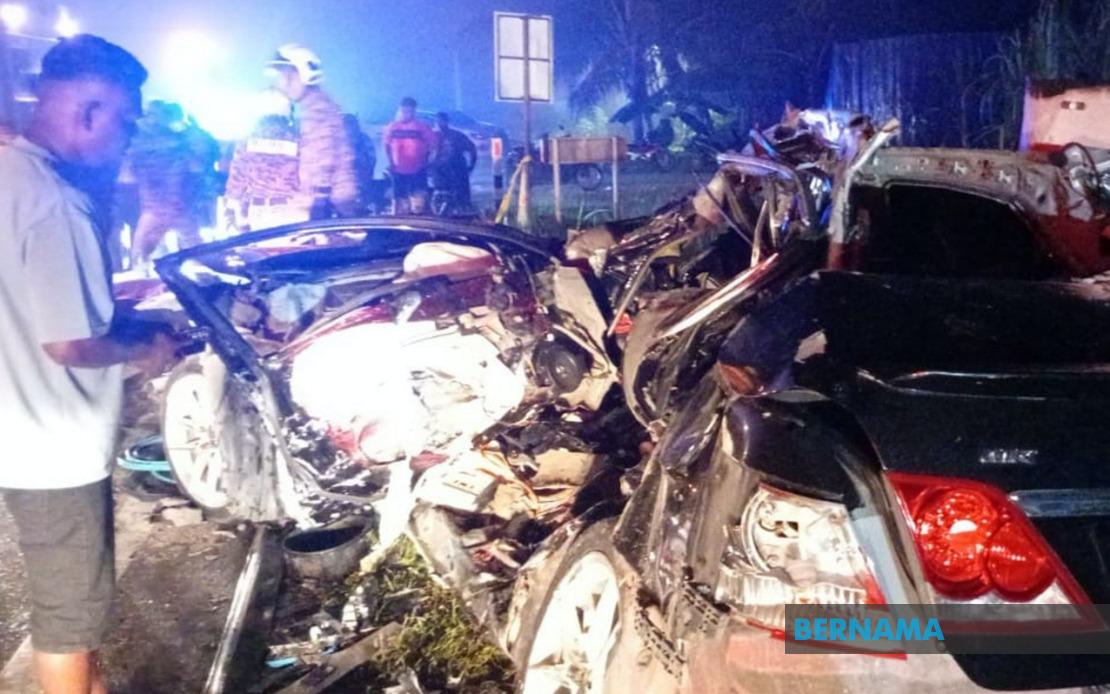
Prime Minister Datuk Seri Anwar Ibrahim has extended his condolences to the families of six men who lost their lives in a fatal road accident along Jalan Karak Lama in Bentong, Pahang, early yesterday morning. Through a statement posted on the social media platform X, the Prime Minister and his wife, Datuk Seri Dr Wan Azizah Wan Ismail, expressed their profound sadness at the tragedy and solidarity with those grieving the loss.
The collision occurred at approximately 4 am as a Toyota Vios carrying six occupants was descending a hill on the route towards Temerloh near Klink Desa Jambu Rias. The vehicle veered into the opposite lane during the descent before striking a one-tonne lorry head-on, a sequence of events that preliminary police investigations have determined led to the instantaneous deaths of all six car occupants at the scene. The lorry operator, aged 31, sustained severe injuries and received immediate medical attention.
The six victims who perished have been identified as the vehicle's driver V. Mugilan, 25, and five passengers: K. Dineshvaran, 22, K. Alaganathan, 21, A. Kanabati Raja, 19, S. Kiisven, 17, and M. Paranthaman, 16. The ages of the victims underscore the particular tragedy of this incident, with four of the six individuals under the age of 22, suggesting a group likely comprising friends or colleagues travelling together on a long-distance journey from Kuantan to Kuala Lumpur.
In his statement, Anwar conveyed wishes of strength and resilience for the grieving families while extending prayers for those injured to experience a swift and complete recovery. His words reflected the gravity with which the incident has been received at the highest levels of government, signalling an acknowledgment of the human cost of road accidents in Malaysia.
The Prime Minister utilised the occasion to highlight a broader concern that extends far beyond this single tragedy. By noting that the incident "serves as a reminder to all of us that road safety must never be taken lightly," Anwar pointedly addressed Malaysia's persistent road safety challenges. This message carries particular weight given Malaysia's longstanding struggle with fatal traffic accidents, especially along major highways where long-distance travel and fatigue-related incidents frequently contribute to collisions.
Jalan Karak Lama remains one of Malaysia's critical transport corridors, connecting the east coast with the capital and serving as a vital economic artery. The road's challenging terrain, including numerous descending hills and curves, combined with heavy traffic volumes particularly during early morning hours, creates conditions conducive to accidents when driver vigilance lapses or vehicles experience mechanical failures. The specific circumstances of this collision—the vehicle veering across lanes while descending—point to either loss of vehicle control, driver inattention, or possibly excessive speed unsuited to the road conditions.
The incident raises questions about enforcement of speed limits, the adequacy of road safety features such as barriers and warning signage on particularly hazardous sections, and broader driver education initiatives. Malaysia has implemented various road safety campaigns and enforcement measures, yet fatalities on major highways continue to occur with distressing regularity. The death toll of six individuals in a single incident represents a significant loss and highlights the potential consequences of momentary lapses in attention or judgment on high-speed corridors.
The involvement of younger victims may also prompt reflection on road safety practices among younger drivers and passengers. Whether the driver involved was fatigued after an extended journey, unfamiliar with the route, or simply encountered an unavoidable mechanical failure remains part of the ongoing investigation. However, the concentration of fatalities—all six car occupants perishing while the lorry driver survived despite impact injuries—suggests the Toyota Vios bore the brunt of collision force, with the vehicle's structural characteristics and impact dynamics contributing to the severity of injuries.
For families of those killed, the tragedy represents an irreversible loss and devastating personal circumstances. The incident occurred during early morning hours when traffic is typically lighter, suggesting these individuals may have been undertaking a journey that required early departure, possibly returning home or heading to work or appointments. The communal nature of their travel—evidenced by the vehicle capacity being fully occupied—indicates they were likely known to one another.
The Prime Minister's intervention, while largely ceremonial in nature, serves to underscore governmental awareness of road safety as a public health and safety issue requiring sustained attention. Effectiveness of such interventions ultimately depends on whether expressions of concern translate into concrete policy measures, enhanced enforcement capacity, infrastructure improvements, and public education campaigns that can reduce similar incidents in future.
This particular accident on Jalan Karak Lama stands as a sobering reminder of the fragility of life and the rapid manner in which ordinary journeys can transform into tragedies. As investigations continue into the precise causative factors, road users traversing Malaysian highways would be well-advised to exercise heightened caution, particularly on challenging terrain where descent and curves demand enhanced attention and reduced speed.

