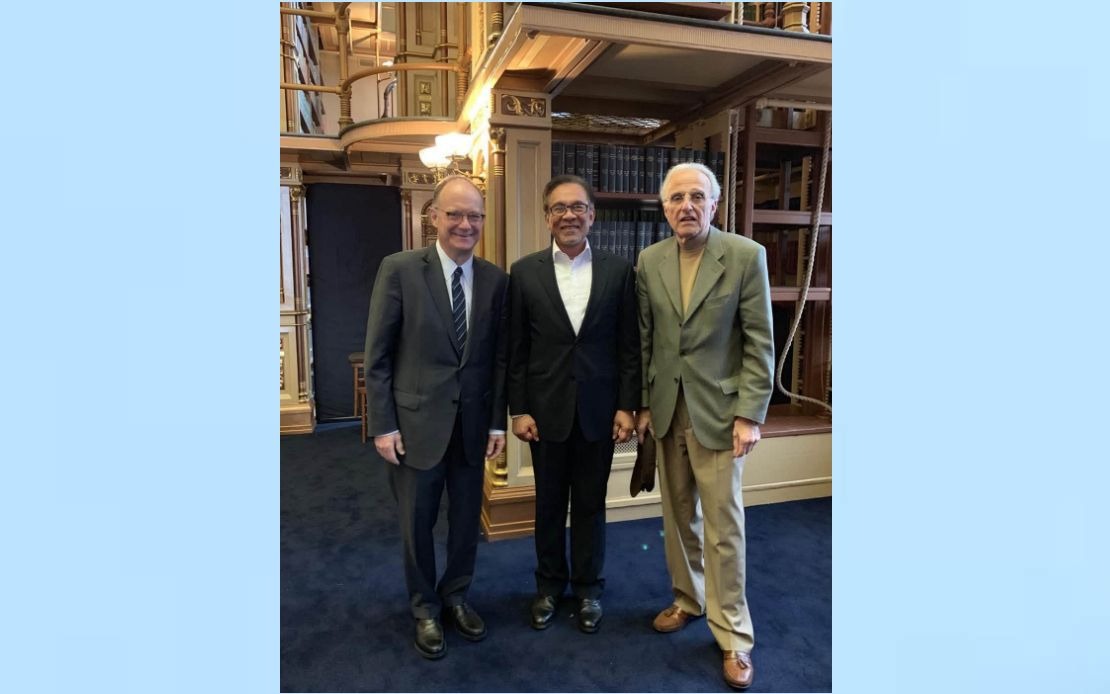
Prime Minister Datuk Seri Anwar Ibrahim has expressed profound grief at the passing of Professor John L. Esposito, one of the world's most respected voices in Islamic studies and interfaith relations. In a Facebook tribute released on July 16, Anwar characterised Esposito as a transformative intellectual figure whose scholarly work fundamentally reshaped how Western audiences comprehend Islam and Muslim societies.
The Malaysian Prime Minister's remarks underscore a personal relationship stretching across more than five decades, rooted in an initial encounter during the early 1970s. This long association reflects Anwar's deep respect for Esposito's intellectual contributions and suggests the American scholar's influence on Malaysian political and academic circles has been substantial. The tribute offers insight into how figures like Anwar, who have navigated complex religious and political landscapes themselves, valued Esposito's rigorous yet accessible approach to Islam scholarship.
Esposito's institutional legacy centres on his foundational work at Georgetown University, where he established the Centre for Muslim-Christian Understanding. This research hub became a beacon for scholars seeking to bridge historical divides between Islamic and Christian intellectual traditions during a period of heightened global tensions. His role as co-author of Makers of Contemporary Islam further cemented his position as an architect of modern Islamic discourse, offering readers frameworks for understanding contemporary Muslim movements and thinkers.
Anwar's characterisation of Esposito as someone who "built bridges where others were content to build civilisational barriers" carries particular weight in the current geopolitical moment. As religious polarisation has intensified globally, Esposito's lifetime commitment to fostering genuine dialogue between faith communities stands as a counter-narrative to narratives of inevitable clash. For Malaysia—a multi-religious society navigating its own communal tensions—this bridge-building approach holds distinct relevance, making Esposito's death a loss not just to Western academia but to global efforts toward religious understanding.
The Prime Minister specifically highlighted Esposito's popular academic works, particularly What Everyone Needs to Know About Islam and Who Speaks for Islam?, as exemplars of scholarship that refused to remain confined to university seminars. These publications gained particular prominence in the post-9/11 era, when Islamophobia surged and public discourse surrounding Islam became increasingly distorted. Esposito's willingness to translate complex theological and historical material into accessible prose served millions seeking factual understanding amid widespread misinformation. For Southeast Asian readers, these works represented authoritative counters to negative stereotyping perpetuated by international media.
Anwar's personal reflections reveal dimensions of Esposito's character that transcended his public intellectual stature. The Prime Minister recalled valuing Esposito's wisdom across decades of engagement, describing him as someone whose private generosity matched the rigour evident in his published scholarship. This observation suggests Esposito maintained genuine commitment to his principles rather than merely performing intellectual posturing—a distinction increasingly rare in contemporary academia and public life. The phrase "stood by him through thick and thin" suggests Esposito provided steadfast support during periods when Anwar faced significant political and personal challenges.
The timing of this tribute and Esposito's passing carries broader implications for dialogue initiatives across the Muslim world. As geopolitical tensions involving Islamic-majority nations intensify, the loss of scholars committed to nuanced, empathetic representation becomes more acute. Esposito's refusal to reduce Islam to monolithic identity or to characterise Muslim societies through the lens of terrorism or fundamentalism provided intellectual cover for more balanced policy discussions. His scholarly authority lent credence to arguments that religious faith and modernity were compatible, and that Muslims possessed diverse political and social philosophies.
For Malaysian policymakers and intellectuals, Esposito's career model offers instructive lessons about the power of accessible scholarship combined with institutional credibility. His Georgetown position provided academic legitimacy while his popular books ensured democratic reach. This dual approach—simultaneously advancing frontier scholarship while educating general audiences—represents an ideal few scholars achieve. As Malaysia positions itself as a regional hub for Islamic learning and interfaith understanding, Esposito's example demonstrates how serious intellectual work can also serve broader public education and cultural diplomacy.
Anwar's decision to issue a national tribute through official channels reflects the weight Esposito's contributions carried for Malaysian leadership. The Prime Minister's invocation of extended condolences to Esposito's wife Jean and broader academic and student communities demonstrates recognition of the ripple effects his work generated across generations of scholars. This acknowledgment suggests awareness that Esposito's influence extended far beyond North American academic circles, shaping intellectual currents throughout Southeast Asia and the broader Muslim world.
Looking forward, the scholarly and dialogical traditions Esposito pioneered require sustained commitment from new generations of researchers and public intellectuals. His passing marks the end of an era characterised by foundational work in establishing Islamic studies as a serious discipline in Western universities and by demonstrating that rigorous scholarship and public engagement need not conflict. For Malaysia and other Muslim-majority nations seeking to project sophisticated intellectual voices in international discourse, Esposito's legacy underscores the necessity of investing in scholars capable of articulating complex positions with both academic integrity and public accessibility. Anwar's tribute thus functions not merely as personal remembrance but as implicit call for continuing the bridge-building work to which Esposito dedicated his career.

