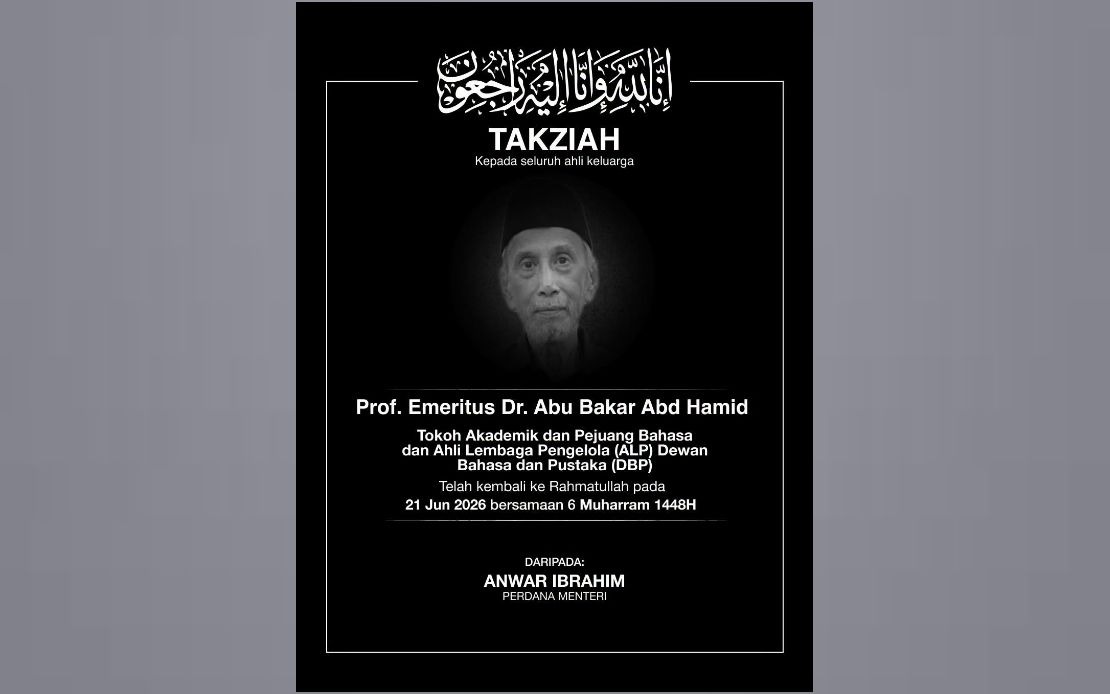
Prime Minister Datuk Seri Anwar Ibrahim has grieved the loss of one of Malaysia's most influential literary scholars, Professor Emeritus Datuk Abu Bakar Abd Hamid, who passed away on June 21 at his home in Petaling Jaya, Selangor. The academic luminary, a native of Johor, experienced a sudden respiratory crisis late Sunday evening and died around 10.30pm. His death marks the end of an era for Malaysian letters and higher education, removing from the cultural landscape a figure whose intellectual contributions shaped generations of students and scholars across the nation.
In a heartfelt social media tribute released on Monday, Anwar reflected on his personal connection to the deceased, drawing from his own experience as one of Abu Bakar's former pupils. The Prime Minister's statement transcended the typical condolence message, instead capturing the emotional resonance that Abu Bakar commanded among those fortunate enough to study under his tutelage. Anwar's decision to speak publicly underscored not merely the administrative importance of Abu Bakar's various roles, but rather the transformative impact the professor wielded within academic and intellectual circles throughout Malaysia.
Abū Bakar's contributions to Malay literature were substantial and multifaceted, positioning him as a central figure in the country's literary and scholarly tradition. His work helped elevate Malay letters to new heights of critical sophistication and cultural importance during a crucial period of nation-building. Beyond his role as a literary scholar, he represented a bridge between Malaysia's traditional intellectual heritage and its aspirations as a modern, knowledge-driven society. The loss of such a figure inevitably creates a void in the broader ecosystem of Malaysian cultural discourse and academic excellence.
The academic's institutional legacy remains particularly significant. Abu Bakar served as deputy vice-chancellor at Universiti Malaya during the 1987-1990 period, a tenure during which he helped shepherd the nation's oldest and most prestigious university through important transformative phases. More notably, he played a foundational role in establishing Universiti Kebangsaan Malaysia, serving as joint secretary of the committee tasked with creating the institution in 1968. This pioneering contribution meant that Abu Bakar was instrumental in building one of Southeast Asia's major centers of higher learning and research during the crucial early decades following Malaysian independence.
Beyond the campus, Abu Bakar's influence extended into the country's media landscape. Between 1996 and 2000, he chaired the Board of Governors of Bernama, the Malaysian National News Agency, a position that afforded him influence over the nation's primary news distribution mechanism. This appointment reflected the trust placed in him by successive governments and demonstrated that his standing extended well beyond academia into the broader arena of national institutions. His stewardship of Bernama during those formative years of the agency coincided with significant developments in Malaysian media and information dissemination.
Throughout his long career, Abu Bakar accumulated recognition from numerous quarters for his scholarly contributions and intellectual leadership. These accolades reflected not only the quality of his academic work but also the respect he commanded across diverse constituencies—from fellow academics to government officials to cultural organizations. Such recognition, spread across multiple decades, testifies to the consistent excellence and relevance of his endeavors. In Malaysia's context, where intellectual pursuits sometimes struggle for prominent cultural valuation, Abu Bakar's numerous honors represented a validation of scholarship and literary studies as worthy pursuits worthy of national recognition.
Anwar's personal testimony regarding his former mentor revealed the human dimension often absent from official tributes. The Prime Minister emphasized Abu Bakar's passion for knowledge and his capacity to inspire those around him, characteristics that distinguished him beyond mere academic credentials. This passion apparently animated every aspect of his professional life, whether he was teaching students, leading institutional committees, or engaging with broader questions of Malaysian culture and society. Such inspiration, when genuine and sustained over decades, leaves imprints on individuals and institutions that outlast formal career milestones.
The circumstances of Abu Bakar's death—sudden respiratory failure at his Petaling Jaya residence—marked a swift conclusion to a life of professional activity and engagement. There was no extended illness allowing for organized succession planning or ceremonial closure. Instead, the literary and academic community lost him abruptly, underscoring the fragility underlying even the most accomplished lives. His funeral took place the following day, with interment at the Bukit Kiara Muslim Cemetery, bringing to completion the earthly journey of a man whose intellectual output would continue resonating through academic circles and published works.
For Malaysia's literary and academic communities, Abu Bakar's departure represents more than the loss of an individual, however accomplished. It signals the passing of a generation of scholars who helped construct the intellectual foundations of the modern Malaysian nation-state. These pioneers, often trained in colonial-era institutions and influenced by diverse intellectual traditions, synthesized their learning into frameworks distinctly and authentically Malaysian. Abu Bakar exemplified this synthesizing capacity, maintaining deep roots in Malay literary traditions while engaging with international scholarly conversations. Fewer such bridging figures remain active in contemporary Malaysia.
The implications of Abu Bakar's death extend across Southeast Asia, where Malaysia's literary and educational institutions wield significant regional influence. Universities across the region have looked to Malaysian models of higher education and scholarship, and figures like Abu Bakar contributed substantially to defining what Malaysian intellectual excellence looked like. His mentoring of countless students meant that his influence radiated outward through their subsequent careers, potentially reaching colleagues and institutions across borders. The region loses not only a Malaysian asset but a figure whose reach transcended national boundaries.
Anwar's public mourning also reflected broader questions about how contemporary Malaysia values and honors its intellectual heritage. In societies where popular culture and entertainment often dominate public discourse, the death of a scholar—however eminent—sometimes passes with minimal public acknowledgment. The Prime Minister's decision to address the loss directly, through his own voice and platform, signaled that intellectual contributions merit national attention and respect. This gesture carries symbolic weight in affirming that literature, scholarship, and the cultivation of knowledge remain central to national self-understanding and aspirations.
Moving forward, Abu Bakar's legacy will be preserved through his published works, the institutional structures he helped establish, and the countless individuals he mentored throughout a career spanning multiple decades. Universities, particularly Universiti Malaya and Universiti Kebangsaan Malaysia, will likely reflect on his foundational contributions and the particular vision of Malaysian higher education he embodied. Literary scholars will continue engaging with his critical writings and ideas. For his former students, both those who achieved prominence and those who pursued quieter professional paths, Abu Bakar's example of intellectual integrity and passionate engagement with knowledge will endure as a formative influence on their own approaches to learning and teaching.