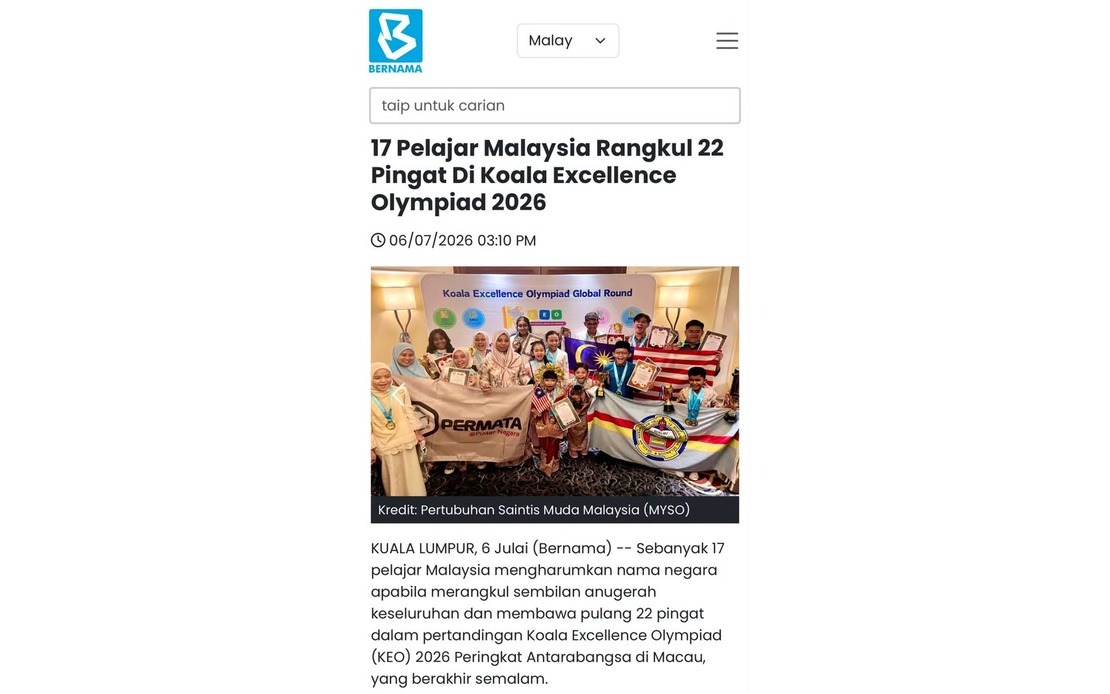
Prime Minister Datuk Seri Anwar Ibrahim has publicly acknowledged the remarkable international academic achievement of 17 Malaysian students who returned from Macau with an impressive medal haul at the 2026 Koala Excellence Olympiad (KEO) Global Finals. The competition, which concluded recently, saw the Malaysian contingent capture nine overall awards comprising five gold, six silver, and 11 bronze medals across multiple disciplines. Through a message posted on social media, Anwar extended his congratulations to the young scholars, encouraging them to maintain their dedication to excellence and pursue even greater accomplishments in their academic endeavours.
The KEO Global Finals represents a significant platform for young scholars from across the globe to demonstrate their intellectual capabilities in four core academic domains: English, Mathematics, Science, and Arts. The international competition was jointly organised by KEO and the Miss Man International Group, with coordination of Malaysia's participation managed by the Malaysia Young Scientists Organisation (MYSO). This structure allowed Malaysian students to compete alongside peers from various nations, providing exposure to international academic standards and fostering cross-cultural educational exchange among young minds.
MYSO coordinator and head of the Malaysian delegation to Macau, Aidah Misran, provided the detailed breakdown of the team's competitive performance at the finals. The distribution of medals—five gold, six silver, and 11 bronze—reflects a balanced strength across the participating students, suggesting that the selection and preparation process undertaken by MYSO had effectively identified and trained versatile young talent across multiple subject areas. This diversified medal distribution indicates that Malaysian excellence in the competition was not concentrated in a single discipline but rather demonstrated competence across the breadth of offered subjects.
The KEO itself has established itself as a credible international educational competition platform, developed by a team of Australian educational experts and graduates with substantial experience in academic assessment and curriculum development. By focusing on four fundamental academic pillars—English language proficiency, mathematical reasoning, scientific knowledge, and artistic expression—the competition seeks to cultivate well-rounded scholars who possess capabilities beyond narrow specialisation. This holistic approach to academic excellence aligns with contemporary educational philosophy that emphasises the importance of interdisciplinary skills and creative thinking alongside traditional technical knowledge.
For Malaysian students, participation in such international competitions carries particular significance within the regional context. Southeast Asia has increasingly emphasised the development of human capital and educational excellence as drivers of economic competitiveness and social progress. The success of Malaysian representatives in a prestigious global forum such as the KEO finals demonstrates the quality of instruction and preparation available within the Malaysian education system and the calibre of talented youth emerging from the nation's schools and institutions.
The Prime Minister's public acknowledgment of this achievement serves multiple purposes within Malaysia's broader policy framework. By highlighting student success on the international stage, the government reinforces the importance it places on educational development and meritocratic achievement. Such recognition also provides motivational impetus for other students to pursue academic excellence and participate in international competitions, potentially establishing a virtuous cycle of ambition and accomplishment within the Malaysian student population.
MYSO's role as the coordinating body for Malaysian participation reflects the importance of having dedicated organisations that can identify talented students, provide specialised preparation, and manage logistics for international academic competitions. The organisation functions as a bridge between individual schools and international platforms, enabling capable students to gain exposure and recognition that might otherwise remain constrained within national boundaries. The calibre of results achieved at KEO 2026 validates the effectiveness of MYSO's selection and training methodologies.
The concentration of medals won by Malaysian participants—with the plurality being bronze—suggests a broad base of capable competitors rather than a few exceptional standouts. This distribution pattern indicates that Malaysia is developing a pipeline of academically talented youth across multiple institutions and regions, rather than relying on elite centres of excellence. Such a pattern bodes well for the sustainability of Malaysia's academic competitiveness in regional and global forums over the medium to long term.
Within the broader Southeast Asian context, Malaysia's performance at international academic competitions contributes to the region's collective intellectual profile. As competition intensifies among Association of Southeast Asian Nations (ASEAN) member states for recognition as centres of educational excellence and innovation hubs, the success of national representatives in prestigious global competitions serves as a visible indicator of developmental progress and institutional quality. The KEO results provide tangible evidence of Malaysia's continued investment in nurturing young talent and maintaining academic standards.
Looking forward, the success of this cohort of students may inspire increased participation in future iterations of the KEO and similar international competitions. The visibility accorded by Prime Ministerial recognition creates positive associations between academic achievement and national pride, potentially encouraging other capable students to step forward and test their abilities in competitive international forums. This psychological and institutional support from the highest levels of government can be instrumental in cultivating a culture of academic aspiration among Malaysian youth.

