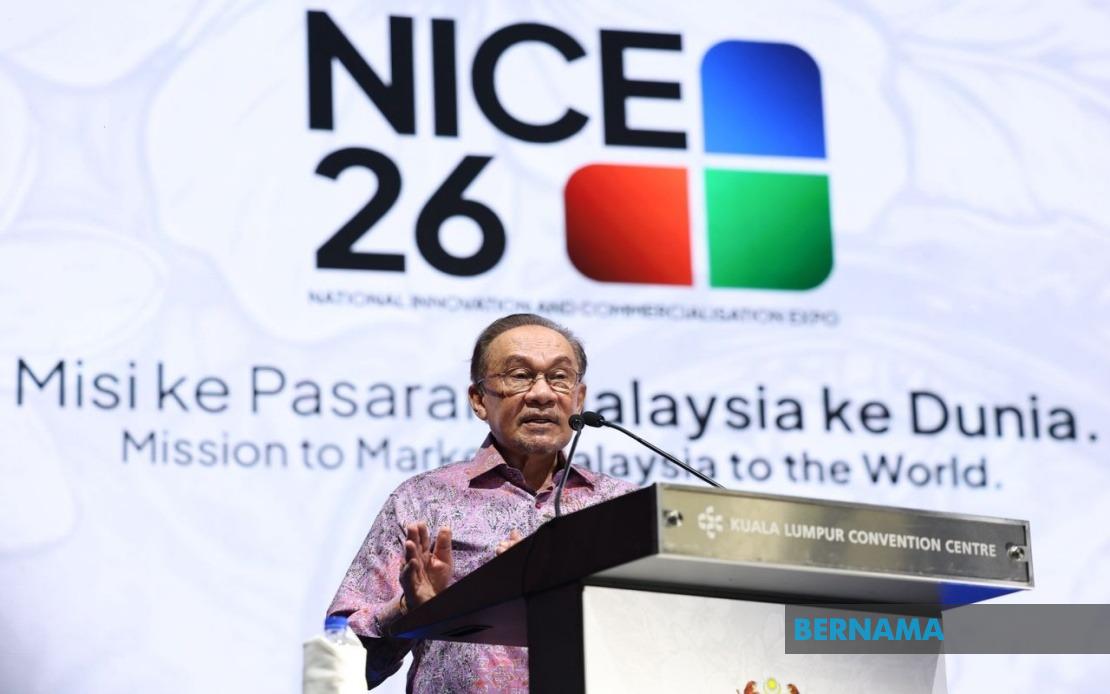
Prime Minister Datuk Seri Anwar Ibrahim has delivered a forceful call for Malaysian government agencies to abandon entrenched bureaucratic practices that are impeding the nation's ability to compete in the global innovation race. Speaking at the National Innovation and Commercialisation Expo (NICE) 2026 at the Kuala Lumpur Convention Centre, Anwar emphasised that outdated approval mechanisms and slow administrative procedures pose a genuine threat to Malaysia's technological advancement and economic competitiveness in an increasingly fast-paced global landscape.
The Prime Minister articulated a core tension facing developing economies attempting to leapfrog into high-technology sectors: traditional governance structures designed for stability and careful deliberation are fundamentally incompatible with the velocity demands of modern innovation ecosystems. Anwar stressed that the contemporary innovation environment and commercialisation landscape operate according to entirely different principles than those embedded in conventional government procedures, requiring institutions to embrace unprecedented levels of agility and responsiveness.
To illustrate the practical consequences of bureaucratic inertia, Anwar highlighted the recent establishment of Artificial Intelligence faculties across several Malaysian universities. These new academic programmes were successfully operationalised within a three-month timeframe—a remarkable achievement when measured against the standard institutional pathway, which typically consumes approximately twelve months and involves navigating multiple layers of university governance including senate deliberations and formal council endorsements. This dramatic acceleration demonstrates both the feasibility of rapid deployment and the substantial inefficiencies embedded in conventional approval frameworks.
The Prime Minister directly critiqued the feasibility of maintaining established administrative pathways in a transformed global context. He questioned how Malaysia could realistically compete internationally while remaining tethered to slow-moving approval methodologies that fragment decision-making authority across numerous committees and bureaucratic checkpoints. His rhetorical challenge—"How can we follow the old bureaucracy?"—reflects growing frustration within the highest levels of government regarding institutional resistance to modernisation and adaptive governance.
Anwar's remarks carry particular significance for the Ministry of Science, Technology and Innovation (MOSTI) and related government bodies responsible for nurturing technological sectors. His explicit exhortation that these agencies must "accept the fact" that speed and efficiency have become non-negotiable requirements signals that the Prime Minister is willing to apply substantial political pressure to force institutional transformation. This represents more than mere rhetorical flourish; it constitutes a direct directive to senior government officials to fundamentally reconceptualise how they approach their regulatory and facilitative functions.
The timing of these statements reflects Malaysia's intensifying awareness of competitive pressures from regional and global rivals. Singapore, South Korea, and increasingly Vietnam have demonstrated that streamlined government processes and rapid institutional adaptation are themselves competitive advantages in attracting technology investment and talent. Malaysia's success in rapidly establishing AI faculties suggests that focused political will can overcome systemic inertia, but Anwar's comments indicate that such exceptions remain precisely that—exceptions rather than the operating norm.
The concept of a "post-normal world" invoked by Anwar represents an implicit acknowledgment that Malaysia operates within a fundamentally transformed operating environment. This phrase suggests that linear, predictable, and methodical approaches to governance are increasingly anachronistic. Instead, institutions must adopt operating models characterised by flexibility, experimentation, and rapid iteration—frameworks more commonly associated with technology companies than government agencies. For Malaysian readers, this signals that government agencies responsible for technology, innovation, and education may undergo substantial restructuring in coming years.
The broader implications for Malaysia's developmental trajectory are substantial. The nation's capacity to cultivate indigenous technology sectors, attract multinational research and development operations, and retain talented scientists and entrepreneurs depends partly on institutional responsiveness. When government processes delay innovation initiatives by months or years, the cumulative opportunity cost—measured in forgone investment, brain drain, and competitive disadvantage—compounds rapidly. Anwar's emphasis on eliminating these friction points reflects economic logic rather than mere bureaucratic preference.
Implementing the Prime Minister's directives will require agencies to develop new decision-making frameworks that maintain appropriate oversight and accountability while dramatically compressing approval timelines. This represents a genuine institutional challenge, particularly for universities and research institutions accustomed to deliberative governance processes. The success of the AI faculty initiative suggests that dedicated teams and executive-level backing can achieve such transformations, but scaling such approaches across the innovation ecosystem remains uncertain.
For Malaysian enterprises, investors, and academic institutions, Anwar's statements provide both encouragement and a benchmark for accountability. Government agencies can no longer claim that lengthy approval processes reflect unavoidable institutional constraints; the Prime Minister has explicitly rejected such arguments. Stakeholders can increasingly leverage these pronouncements when challenging unjustified delays or demanding process improvements. This creates opportunities for those capable of navigating the emerging faster-paced administrative landscape.
The challenge ahead involves translating Anwar's vision into systematic, government-wide transformation. Individual success stories such as the rapid AI faculty establishment demonstrate possibility, but embedding speed and flexibility into institutional DNA requires sustained effort across multiple levels of government. Success will depend on whether senior officials throughout MOSTI and related agencies genuinely embrace the necessity of change or treat Anwar's directives as temporary political enthusiasm that will eventually subside.

