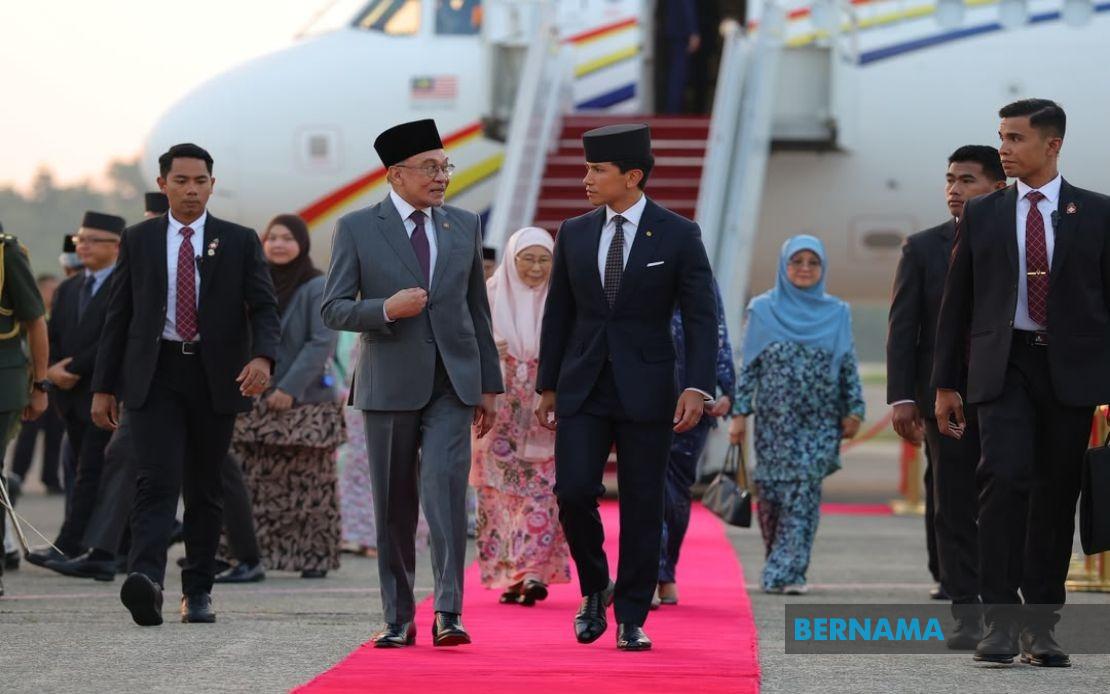
Prime Minister Datuk Seri Anwar Ibrahim touched down in Brunei on Wednesday evening to begin a two-day official working visit centred on the 27th Annual Leaders' Consultation, the pinnacle diplomatic forum between Malaysia and the sultanate. The arrival of Anwar and his wife, Datuk Seri Dr Wan Azizah Wan Ismail, at Brunei International Airport at 6.10 pm marked the resumption of high-level strategic dialogue between the neighbouring nations. The delegation was formally welcomed by Brunei's Minister of Foreign Affairs Prince Abdul Mateen Bolkiah, alongside Foreign Minister Datuk Seri Mohamad Hasan, Foreign Ministry secretary-general Tan Sri Amran Mohamed Zin, and Malaysian High Commissioner to Brunei Datuk Mohd Aini Atan.
The bilateral engagement represents far more than routine protocol. The Annual Leaders' Consultation functions as the primary mechanism through which Malaysia and Brunei address substantive matters of joint concern, ranging from trade and investment to security cooperation and regional diplomacy. For Malaysia, maintaining robust ties with Brunei remains strategically significant within the ASEAN framework, where the sultanate occupies an influential though smaller position. The consultation process allows both governments to align positions on regional challenges and ensure that cross-border issues are managed through high-level political channels rather than lower-tier bureaucratic routes.
During his visit, Anwar is scheduled to be received in audience by Sultan Hassanal Bolkiah at Nurul Iman Palace, where a formal bilateral meeting will take place. This face-to-face engagement between the two leaders provides an opportunity to discuss matters of national importance and chart the direction of bilateral relations. The personal dimension of such meetings cannot be overstated in Southeast Asian diplomacy, where relationship-building and trust between leaders directly influences the depth and scope of cooperation across all governmental sectors.
A significant milestone during the visit will be the joint witnessing by Sultan Hassanal Bolkiah and Anwar of the signing of a Memorandum of Understanding on disaster management cooperation. The new accord underscores both nations' shared vulnerability to natural disasters and climate-related challenges that do not respect borders. For Malaysia and Brunei, formalising disaster management protocols is particularly relevant given their geographical exposure to flooding, tropical storms, and other weather-related emergencies. The MoU will likely establish frameworks for information sharing, coordinated response mechanisms, and capacity-building initiatives that enhance the resilience of both societies.
The economic relationship between Malaysia and Brunei, though asymmetrical in scale, contributes meaningfully to both economies. In 2025, bilateral trade reached RM5.86 billion, with Malaysian exports dominating at RM4.20 billion against imports of RM1.66 billion. This trade surplus reflects Malaysia's role as a significant supplier of goods to Brunei, encompassing manufactured products, agricultural items, and services. The first half of 2026 has already recorded bilateral trade of RM2.38 billion, suggesting a sustained trajectory of commercial engagement despite global economic headwinds. For Malaysian businesses, Brunei represents a stable, well-regulated market with high purchasing power, whilst for Brunei, Malaysia serves as a crucial source of diverse commodities and services that support the sultanate's development agenda.
Beyond commerce, the consultation framework enables both nations to coordinate on regional and international issues affecting their mutual interests. ASEAN matters, maritime security concerns, and responses to geopolitical developments in the Indo-Pacific are typically subjects of discussion during such high-level engagements. Malaysia's larger population and economic heft sometimes positions it as a bridge nation within regional associations, and Anwar's diplomatic skills have been instrumental in maintaining consensus-building roles that benefit smaller neighbours like Brunei.
The timing of this visit also reflects the calendar of ASEAN diplomacy, with annual consultations forming part of the rhythm of regional engagement. Brunei, despite its modest size, maintains a disproportionate diplomatic influence through its ASEAN membership and its seat at regional forums. The bilateral consultation mechanism ensures that Malaysia does not overlook the sultanate's perspectives on critical issues and that governance cooperation remains grounded in personal relationships between leaders.
For Malaysian readers, the significance of this visit extends to how it signals Malaysia's commitment to maintaining strong neighbourhood relations. In an era of great power competition and shifting geopolitical alignments, bilateral solidarity within ASEAN demonstrates the region's capacity for internal cohesion. The disaster management agreement, in particular, carries implications for how Southeast Asia might collectively respond to climate emergencies that will almost certainly increase in frequency and severity.
Looking forward, the outcomes of the 27th Annual Leaders' Consultation will likely influence Malaysian-Brunei cooperation trajectories across multiple sectors including defence, education, tourism, and labour mobility. Both nations share historical ties and cultural affinities that provide a foundation for deepened engagement. The visit underscores that even as Malaysia charts its own development course and engages with major powers, the cultivation of stable, prosperous relationships with immediate neighbours remains a cornerstone of sound foreign policy.

