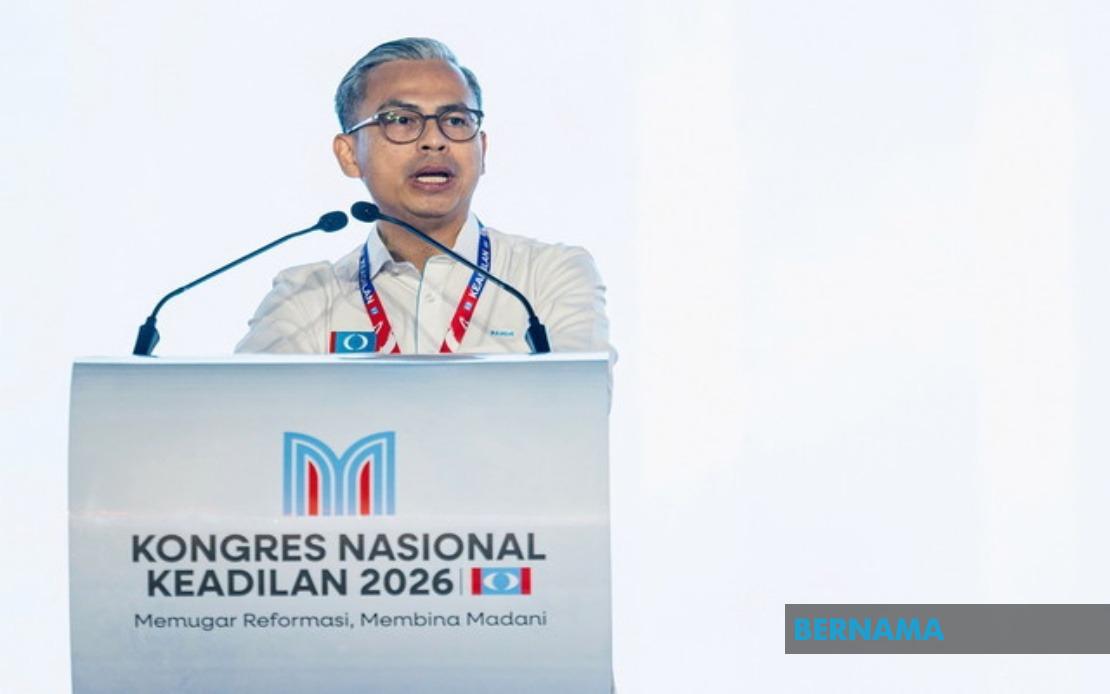
The ruling coalition faces a persistent challenge in translating headline-grabbing economic indicators into tangible support from voters, according to PKR's top communications strategist. Addressing delegates at the party's national congress in Melaka, Communications Minister Datuk Seri Fahmi Fadzil acknowledged that despite what he characterised as strong macroeconomic performance under Prime Minister Datuk Seri Anwar Ibrahim's administration, much of the Malaysian public remains unconvinced or unaware of these purported gains. This gap between statistical achievement and popular perception has emerged as a critical vulnerability for the coalition heading toward the 2026 general election.
Fahmi's remarks highlight a fundamental problem afflicting many governing parties across Southeast Asia: the difficulty in converting aggregate economic data into individually felt prosperity. He described the government's economic record as a "pot economy"—a metaphor suggesting that while the overall pot is growing, its contents are not being ladled out to ordinary households in ways they can recognise or appreciate. This semantic distinction matters considerably in Malaysian politics, where perceptions of equitable distribution and direct benefit often carry more electoral weight than abstract growth figures or inflation management statistics.
The PKR information chief signalled that communication approaches would undergo significant refinement to address what he identified as an emotional disconnect. Rather than continuing to broadcast achievements through traditional hierarchical channels, the party intends to prioritise smaller-scale public forums and community dialogue sessions. These settings, according to Fahmi, permit more nuanced explanations of complex policy terrain while enabling genuine two-way interaction rather than top-down messaging. For a government grappling with credibility challenges, such grassroots engagement represents an implicit acknowledgment that centralised communication strategies have achieved limited traction with sceptical constituencies.
Enhancing cooperation with division-level PKR leaders forms part of this recalibrated approach. These intermediate party structures, which maintain direct relationships with community organisations, grassroots activists, and neighbourhood influencers, possess inherent advantages for localised message dissemination that ministerial press conferences simply cannot match. By mobilising this distributed network, PKR aims to ensure that information about government initiatives percolates through social webs rather than arriving as official pronouncement. This represents a tacit recognition that trust flows more readily through peer networks and local opinion-formers than through government institutions themselves.
Parallel to improving positive messaging, Fahmi outlined the government's strategy for countering what it characterises as deliberate misinformation campaigns. The Malaysian Communications and Multimedia Commission, working with the government information apparatus, has identified over 8,410 fake social media accounts in recent months that exploit what Fahmi termed "3R issues"—religion, race, and the royal institution. These sensitive topics, historically volatile in Malaysian political discourse, have become prime vectors for coordinated disinformation designed to stoke emotional reactions that undermine rational public assessment of governance.
The prevalence of such accounts underscores a sophisticated understanding among opposition forces of Malaysian society's fault lines. By weaponising identity-based grievances, adversaries can deflect public attention from policy performance and economic management. Fahmi's acknowledgment of this challenge suggests the government recognises that controlling narrative requires not merely superior messaging but also active platform management and content moderation in partnership with digital gatekeepers. The scale of removals—over 8,400 accounts since the recent Johor state election—implies a campaign of substantial organised effort rather than incidental misinformation.
Fahmi also addressed media relations and the government's posture toward critical or inaccurate reporting. He explicitly disavowed any intention to control editorial content, framing the government's role as one of constructive correction delivered through "proper and respectful channels." This formulation attempts to distinguish between legitimate press freedom and tolerance of factual errors, positioning the government as a rational actor seeking accuracy rather than as a censor intimidating independent journalism. Such careful language matters in a regional context where press freedom remains contested and where government media relations can quickly escalate into broader accusations of authoritarianism.
The involvement of PKR's women's wing in this communication reorientation suggests deliberate targeting of female voters, who comprise roughly half the electorate and whose household-level perspectives on government performance often differ from abstract economic metrics. Women's grassroots networks, long recognised as effective mobilising mechanisms in Malaysian politics, can translate central government messaging into vernacular discussion appropriate to family and neighbourhood contexts. This gendered approach to communication acknowledges that effective political messaging requires understanding distinct constituencies' preoccupations and communication preferences.
Fahmi's statements during the congress reflect broader anxieties within Malaysia's ruling coalition about maintaining electoral competitiveness. The acknowledgment that successful policies lack sufficient public recognition implies previous communication failures—whether through inadequate explanation, poor timing, media capture by opposition narratives, or simple public scepticism toward government claims. For voters in Malaysia and comparable Southeast Asian democracies, economic achievement means little unless tangibly connected to household welfare. The PKR initiative represents an implicit admission that the gap between these realms requires deliberate bridging through sustained, locally-grounded communication effort rather than assumption that good governance will automatically generate political reward.

