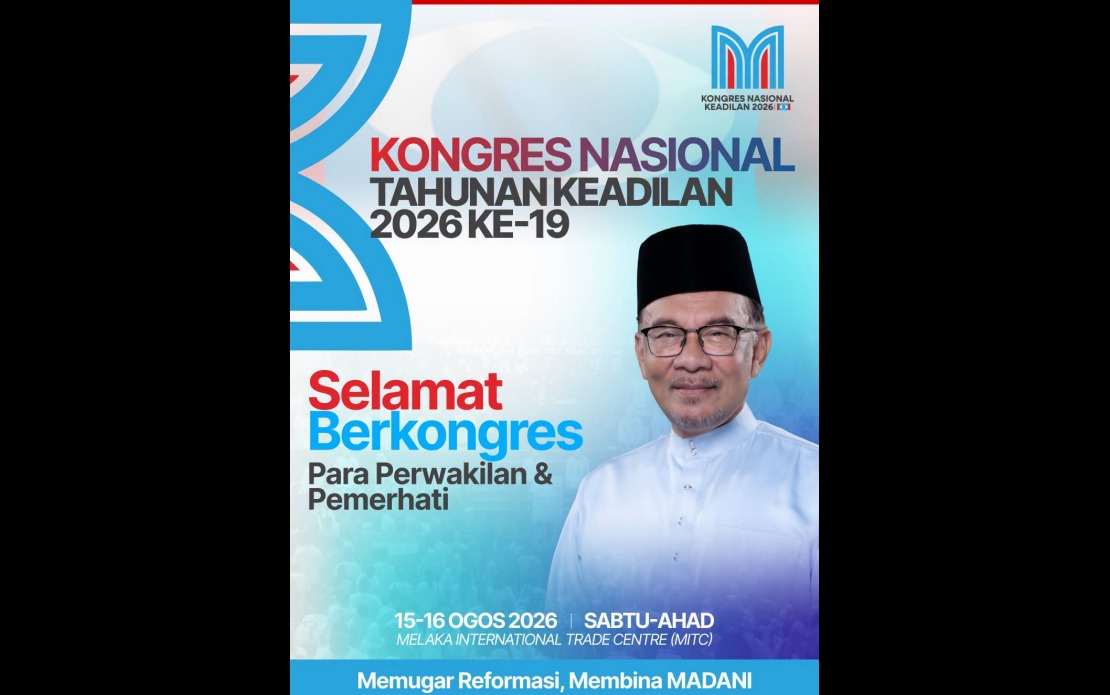
Prime Minister Datuk Seri Anwar Ibrahim has called on Parti Keadilan Rakyat to refocus its mission as a genuine mass movement rooted in principled governance, signalling his concern that the party risks losing its foundational identity in pursuit of electoral victories. In a statement ahead of PKR's National Congress 2026, Anwar emphasised that the party's strength lies not in its capacity to secure political power alone, but in its commitment to advancing integrity, social justice, unity and public confidence. This distinction matters significantly for Malaysia's political trajectory, as it reflects broader questions about whether opposition-turned-ruling parties can maintain their reformist credentials after assuming government.
The two-day congress, commencing in Melaka, represents a critical juncture for PKR as it grapples with the tensions inherent in governing while remaining true to its roots. Held at the Melaka International Trade Centre in Ayer Keroh under the banner "Memugar Reformasi, Membina MADANI" (Revitalising Reformasi, Building MADANI), the gathering convenes delegates to reassess the party's achievements and chart its course through Malaysia's evolving political landscape. The timing is significant, coming at a moment when PKR faces internal pressures and external scrutiny regarding its direction under Anwar's leadership. The congress framework explicitly invites introspection, suggesting party leadership recognises the need to reconnect with grassroots members and reaffirm shared values that have historically distinguished PKR from more establishment-oriented organisations.
Anwar's invocation of the Reformasi agenda signals a deliberate attempt to anchor PKR's contemporary identity to its historical mission. The Reformasi movement, which emerged during Malaysia's political upheaval in the late 1990s, represented a broader demand for democratic renewal, institutional reform and accountability. By explicitly linking the congress theme to this legacy, Anwar appears to be addressing concerns within the party that its transition into government has diluted its oppositional energy and moral clarity. This is not merely symbolic language; it reflects genuine tensions within coalitional politics in Malaysia, where parties must balance the compromises necessary for effective governance against the expectations of supporters who joined movements demanding systemic change.
The distinction Anwar draws between PKR as a "mass movement" and as merely "a vehicle for winning elections" carries particular weight in the Southeast Asian context. Political parties across the region frequently struggle with this transition, often becoming vehicles for factional interests once they enter government. Anwar's public emphasis on maintaining PKR's movement character suggests he recognises this risk and is attempting to inoculate the party against it. For Malaysian voters, this statement implicitly acknowledges that electoral success alone does not validate a political organisation; rather, the sustenance of founding principles and commitment to institutional reform remain the true measures of legitimacy.
The congress represents an opportunity for PKR to demonstrate how it translates its stated commitments into concrete party structures and policies. Social justice, integrity and unity are aspirational values, but their realisation depends on internal party discipline, transparent decision-making, and the prioritisation of public interest over factional advantage. Malaysian political observers will scrutinise how thoroughly the congress addresses governance mechanisms, disciplinary processes, and mechanisms for accountability within PKR itself. These internal practices are often more revealing than public statements about whether parties genuinely believe in the principles they advocate.
Anwar's scheduled policy speech during the congress will be closely watched for indications of PKR's strategic direction in the coming years. As Prime Minister, Anwar wields considerable influence over the party's institutional agenda, but his positioning of the congress as a platform for "introspection" and collective assessment suggests an intent to distribute decision-making beyond the party presidency. This approach, if genuine, could strengthen PKR's democratic credentials and internal legitimacy. Conversely, if the congress functions primarily as a venue for endorsing predetermined party leadership positions, it may reinforce perceptions that PKR has become increasingly hierarchical and centralised.
For Malaysia's broader political ecosystem, PKR's internal trajectory carries implications beyond the party itself. As a major component of the ruling coalition, PKR's character shapes how effectively the government can pursue reform agendas and maintain public confidence in institutions. If PKR successfully maintains its identity as a movement for systemic change while governing responsibly, it could model a path for other reformist parties navigating similar transitions. Conversely, if the party gradually becomes indistinguishable from more conventional political organisations, it risks disappointing supporters and validating cynicism about the prospects for meaningful institutional reform in Malaysia.
The congress also occurs within a context of Malaysian politics where questions of generational transition loom large. Anwar, now in his late sixties, has not explicitly outlined succession planning for PKR's leadership. The congress provides an opportunity to develop younger leaders and broaden the party's institutional base beyond reliance on individual personalities. This succession planning is crucial for ensuring that the values and mission Anwar articulates can be sustained regardless of specific leadership figures.
Anwar's invocation of religious language—"May Allah SWT bless all our efforts for our beloved homeland, Insya-Allah"—serves multiple rhetorical functions. It connects PKR's political mission to spiritual and moral dimensions, framing governance reform as an ethical undertaking rather than merely technical or pragmatic exercise. For a multi-religious, multi-ethnic nation like Malaysia, this language simultaneously acknowledges the Islamic identity of the Muslim-majority population while the broader message about justice and integrity operates on universal principles accessible to citizens of all faiths.
Looking ahead, the National Congress 2026 will likely set the tone for PKR's engagement with Malaysian voters in the lead-up to the next general election. If the congress succeeds in revitalising the party's reformist mission and demonstrating genuine commitment to democratic principles, it could enhance PKR's electoral appeal among voters seeking alternatives to politics-as-usual. If it devolves into factional maneuvering or confirms perceptions of centralised control, it may undermine the party's broader political positioning. For observers across Southeast Asia watching how Malaysia's political landscape develops, this congress represents a meaningful test of whether ruling parties in developing democracies can sustain their foundational commitments while exercising state power.

